 Back
BackComprehensive Study Notes on Chemical Kinetics
Study Guide - Smart Notes
 Tailored notes based on your materials, expanded with key definitions, examples, and context.
Chemical Kinetics
Introduction to Chemical Kinetics
Chemical kinetics is the branch of chemistry that deals with the study of the rate at which chemical reactions occur and the factors affecting these rates. It helps us understand how fast or slow a reaction proceeds and the mechanisms by which reactions take place.
Definition: Chemical kinetics is the study of reaction rates and the factors influencing them, such as temperature, pressure, catalysts, and radiation.
Types of Reactions by Rate:
Very fast reactions (e.g., ionic reactions) occur in 10–14 to 10–16 seconds and are typically studied by flash-photolysis and spectrographic methods.
Moderate speed reactions (e.g., hydrolysis of esters) are commonly studied in kinetics.
Very slow reactions (e.g., rusting of iron) are not usually studied under kinetics.
Rate of Reaction
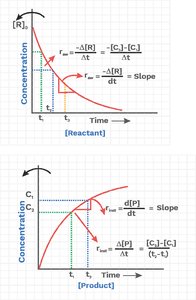
The rate of a reaction is defined as the change in concentration of a reactant or product per unit time.
Mathematical Expression:
Units: mol L–1 s–1 or atm s–1 (for gases).
Observation: The rate of reaction generally decreases with time as the concentration of reactants decreases.
Average and Instantaneous Rate of Reaction
The rate of reaction can be measured as an average over a time interval or as an instantaneous value at a specific moment.
Average Rate: The total change in concentration divided by the time interval.
Instantaneous Rate: The rate at a particular instant, given by the derivative:
Stoichiometry and Rate Expressions
Rates can be expressed in terms of the stoichiometric coefficients of reactants and products.
For a general reaction:
Features of Rate of Reaction
Always a positive quantity.
Proportional to the active masses (concentrations) of reactants.
Measured by monitoring concentration changes over time.
Varies with time; average rate is often used for practical purposes.
Specific Reaction Rate or Rate Constant (k)
The rate constant is a proportionality constant in the rate law equation, characteristic of a particular reaction at a given temperature.
For a reaction:
At unit concentration, the rate equals the rate constant.
Units: (where n = order of reaction).
Factors Affecting Rate of Reaction
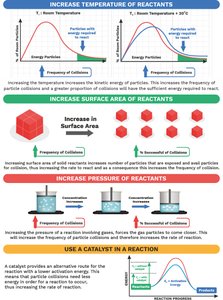
Several factors influence the rate of a chemical reaction:
Physical State: Gaseous > Liquid > Solid (in terms of rate).
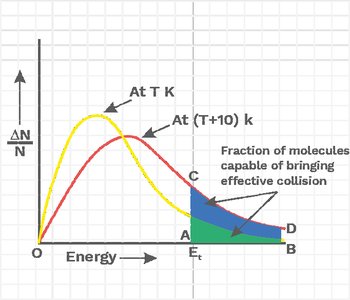
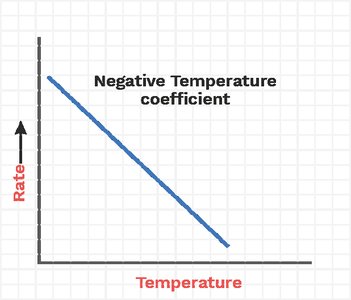
Temperature: For every 10°C rise, the rate typically doubles or triples. Temperature coefficient: (usually 2–3).
Concentration: Rate increases with concentration.
Pressure: For gases, rate increases with pressure.
Surface Area: Greater surface area increases rate (e.g., powdered solids react faster).
Nature of Reactants: Ionic reactions are faster than molecular reactions.
Radiation: For photochemical reactions, rate depends on light intensity.
Catalysts: Positive catalysts increase rate by lowering activation energy; negative catalysts decrease rate.
Collision Theory
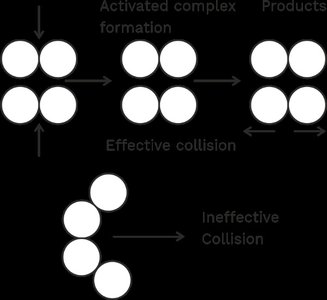
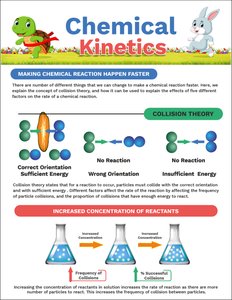
Collision theory explains that reactions occur when reactant molecules collide with sufficient energy and proper orientation.
Effective Collisions: Only collisions with energy greater than or equal to the threshold energy and correct orientation lead to product formation.
Threshold Energy: The minimum energy required for a reaction to occur.
Activation Energy and Transition State Theory
Activation energy (Ea) is the minimum extra energy required for reactants to form products. The transition state theory describes the formation of an activated complex at the peak of the energy barrier.
Activation Energy:
Effect on Rate: Lower activation energy leads to a faster reaction.


Arrhenius Equation
The Arrhenius equation relates the rate constant (k) to temperature and activation energy:
Logarithmic form:
At two temperatures:

Elementary and Complex Reactions
Elementary Reaction: Occurs in a single step.
Complex Reaction: Occurs in multiple steps (mechanism); the slowest step is the rate-determining step.
Molecularity
Number of particles (atoms, ions, or molecules) colliding simultaneously in an elementary reaction.
Always a whole number (never zero or fractional).
Does not determine the rate of complex reactions.
Order of Reaction
The order of a reaction is the sum of the powers to which the concentration terms are raised in the rate law equation.
For , order = m + n.
Order can be zero, fractional, or negative (determined experimentally).
Order is not necessarily equal to the stoichiometric coefficients.
![Graph for first order reaction: log[A] vs time](https://static.studychannel.pearsonprd.tech/study_guide_files/general-chemistry/sub_images/3948b9f6_image_33.png)
Zero, First, Second, and Third Order Reactions
Zero-Order Reaction
Rate is independent of reactant concentration:
Integrated form:
Examples: Photochemical reactions, enzyme-catalyzed reactions.
First-Order Reaction
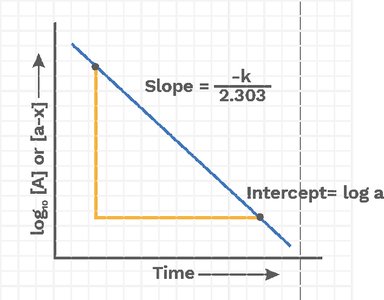
Rate depends on one concentration term:
Integrated form: or
Half-life: (independent of initial concentration).
Examples: Radioactive decay, hydrolysis of esters.
Second-Order Reaction
Rate depends on two concentration terms: or
Integrated form (for equal concentrations):
Half-life:
Third-Order Reaction
Rate depends on three concentration terms: or
Integrated form is more complex; units of k: L2 mol–2 s–1.

Pseudo First-Order Reactions
Reactions that are higher order but behave as first order due to one reactant being in large excess.
Example: Hydrolysis of ethyl acetate in excess water.
Methods for Determining Order of Reaction
Initial concentration method
Integration method
Graphical method
Half-life method
Van’t Hoff differential method
Photochemical Reactions
Reactions that occur only in the presence of light (e.g., photosynthesis, formation of HCl).
Proceed via chain reaction mechanisms involving free radicals.
Not affected by temperature but by light intensity.
Photosensitizers and Luminescence
Photosensitizer: Substance that initiates a photochemical reaction without being consumed (e.g., chlorophyll, Hg vapor).
Luminescence: Emission of light without heat.
Chemiluminescence: Light emission due to a chemical reaction (e.g., fireflies).
Fluorescence: Light emission stops immediately when excitation ceases.
Phosphorescence: Light emission continues after excitation stops.
Quantum Efficiency (φ)
Defined as:
Parallel and Successive Reactions
Parallel (Side) Reactions: Reactant decomposes via multiple pathways.
Successive Reactions: Product of one step becomes reactant for the next.
Summary Table: Key Equations and Concepts
Concept | Equation/Definition |
|---|---|
Rate of Reaction | |
Instantaneous Rate | |
Activation Energy | |
Arrhenius Equation | |
Order of Reaction | (from ) |
First Order Half-life | |
Second Order Half-life | |
Quantum Efficiency |
