 Back
BackConcentration of Solutions: Molarity vs. Normality
Study Guide - Smart Notes
 Tailored notes based on your materials, expanded with key definitions, examples, and context.
Concentration of Solutions
Definition and Types of Solution Concentration
The concentration of a solution is a quantitative measure of the amount of solute dissolved in a given amount of solvent. Understanding concentration is fundamental in general chemistry, as it determines the properties and behavior of solutions in chemical reactions.
Concentrated solution: Contains a relatively large amount of dissolved solute.
Dilute solution: Contains a relatively small amount of dissolved solute.
Solute: The substance dissolved in the solvent.
Solvent: The substance in which the solute is dissolved, typically the component present in greater quantity.
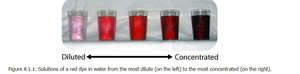
Example: A red dye dissolved in water can form solutions of varying concentration, from very dilute (light color) to very concentrated (dark color).
Normality
Definition of Normality
Normality (N) is a concentration unit that expresses the number of equivalents of solute per liter of solution. It is commonly used in acid-base chemistry and redox reactions.
Equivalent: The amount of substance that reacts with or supplies one mole of hydrogen ions (H+) or electrons in a reaction.
Formula:
Application: Used in titration calculations and reactions where the concept of equivalents is important.
Difference Between Normality and Molarity
Comparison of Normality and Molarity
Molarity (M) and Normality (N) are both units of concentration, but they differ in what they measure and how they are used.
Molarity (M): Measures the number of moles of solute per liter of solution. Formula:
Normality (N): Measures the number of equivalents per liter of solution. Formula:
Key Difference: Normality depends on the type of reaction (acid-base, redox, etc.), while molarity is a general measure of solute amount.
Property | Molarity (M) | Normality (N) |
|---|---|---|
Definition | Moles of solute per liter | Equivalents of solute per liter |
Formula | ||
Usage | General chemistry | Acid-base, redox reactions |
Depends on reaction type? | No | Yes |
Example: In a sulfuric acid (H2SO4) solution, molarity counts the total moles of H2SO4, while normality counts the number of equivalents based on how many H+ ions each molecule can donate.
