 Back
Covalent Bonding: Structure and Formation
Study Guide - Smart Notes
 Tailored notes based on your materials, expanded with key definitions, examples, and context.
Covalent Bonding
Definition and Basic Principles
A covalent bond is a type of chemical bond that involves the sharing of electron pairs between atoms. These shared electrons allow each atom to achieve a stable electron configuration, often resembling that of noble gases.
Key Point 1: Covalent bonds form when two atoms share one or more pairs of electrons.
Key Point 2: Most covalent bonds occur between nonmetal atoms, which have similar tendencies to attract electrons.
Key Point 3: The shared electron pairs are called bonding pairs, while unshared pairs are called lone pairs.
Example: The formation of a water molecule (H2O) involves covalent bonding between one oxygen atom and two hydrogen atoms. Each hydrogen atom shares its single electron with the oxygen atom, resulting in two covalent bonds.
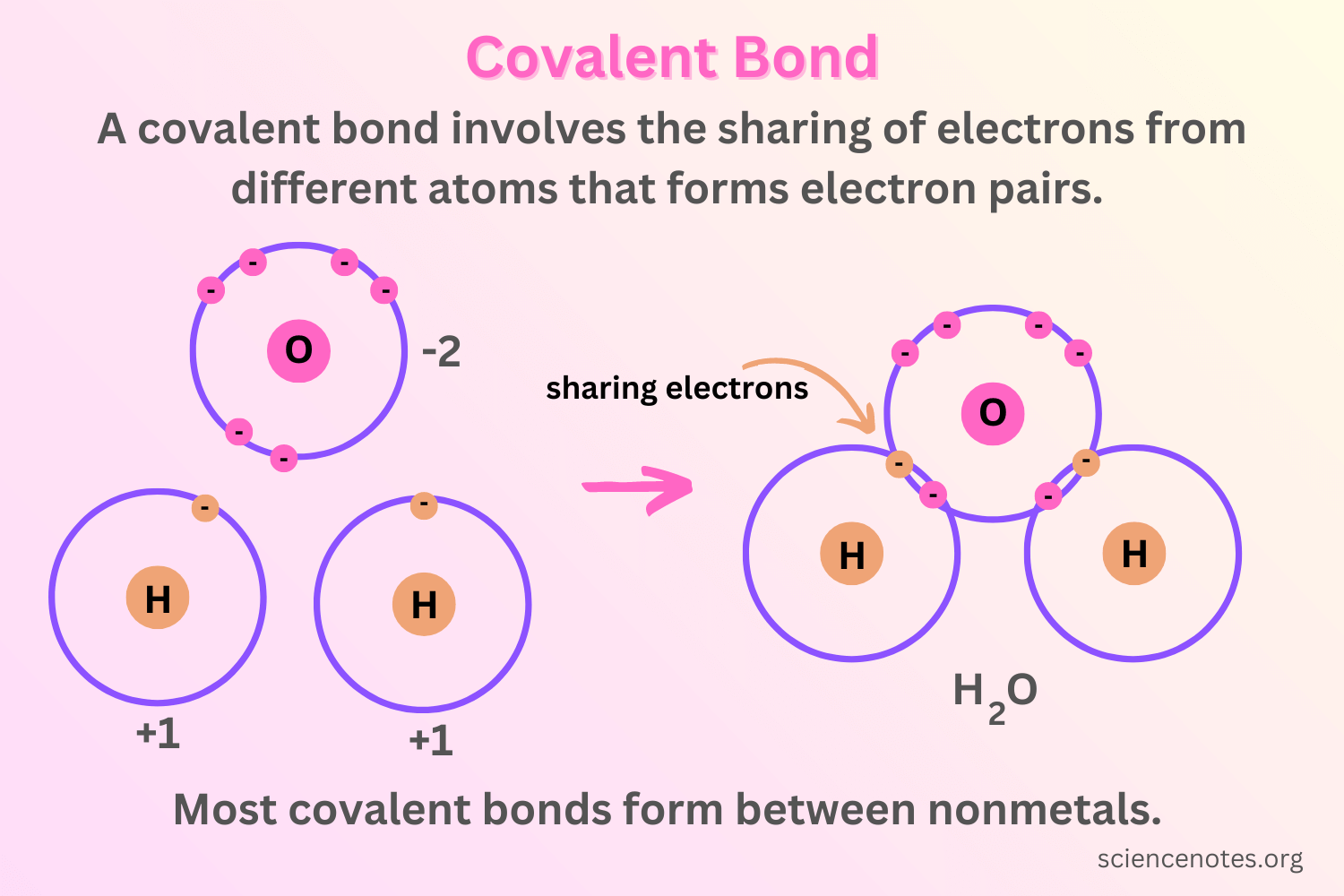
Electron Sharing and Bond Formation
Atoms form covalent bonds to achieve a stable electron configuration. The number of covalent bonds an atom can form depends on its number of valence electrons and the need to complete its outer shell.
Key Point 1: Oxygen has six valence electrons and needs two more to complete its octet, so it forms two covalent bonds.
Key Point 2: Hydrogen has one valence electron and needs one more to achieve the stable configuration of helium, so it forms one covalent bond.
Equation: The formation of water can be represented as:
Properties of Covalent Bonds
Covalent bonds have distinct properties compared to other types of chemical bonds, such as ionic bonds.
Bond Strength: Covalent bonds are generally strong due to the shared electron pairs.
Bond Length: The distance between the nuclei of the bonded atoms is called the bond length, which is characteristic for each bond type.
Polarity: If the atoms involved have different electronegativities, the bond may be polar, resulting in partial charges.
Example: In water, the oxygen atom is more electronegative than hydrogen, making the O-H bonds polar covalent.
Comparison: Covalent vs. Ionic Bonds
Covalent bonds differ from ionic bonds, which involve the transfer of electrons from one atom to another, resulting in charged ions.
Bond Type | Electron Movement | Typical Elements |
|---|---|---|
Covalent | Sharing | Nonmetals |
Ionic | Transfer | Metals & Nonmetals |
Additional info: Covalent bonding is fundamental to molecular chemistry and is covered in detail in Chapter 8: Basic Concepts of Chemical Bonding.
Key Takeaways:
Definition: A covalent bond forms when atoms share electron pairs to reach a more stable electron configuration (often like noble gases).
Where it happens: Most covalent bonds form between nonmetal atoms because they have similar tendencies to attract electrons.
Bonding vs. lone pairs:
Bonding pairs = shared electron pairs that make the bond.
Lone pairs = unshared electron pairs on an atom.
Why bonds form: Atoms form covalent bonds to complete their valence shell (often an octet).
Valence electrons predict bonding:
Oxygen has 6 valence electrons and needs 2 more → typically forms two covalent bonds.
Hydrogen has 1 valence electron and needs 1 more (helium-like stability) → forms one covalent bond.
Example (water): In H2O, one oxygen forms two covalent bonds with two hydrogens by sharing electrons.
Formation equation (as given):
Bond strength: Covalent bonds are generally strong because of shared electron pairs.
Bond length: The bond length is the distance between the nuclei of bonded atoms and is characteristic for each bond type.
Bond polarity: If atoms have different electronegativities, the covalent bond can be polar, producing partial charges.
Water polarity example: Oxygen is more electronegative than hydrogen, so the O–H bonds are polar covalent.
Covalent vs. ionic (core difference):
Covalent: electrons are shared (typical: nonmetals).
Ionic: electrons are transferred, producing ions (typical: metals + nonmetals).
Course context: Covalent bonding is emphasized as fundamental to molecular chemistry and is covered in Chapter 8: Basic Concepts of Chemical Bonding.
Questions related to this on the exam prep:
Practice Questions in “Exam Prep” Related to “Covalent Bonding: Structure and Formation” 🧠based on the study notes, the exam-prep questions that would match this document are the ones focused on these skills/topics:
Identifying covalent bonding: questions asking whether a bond is covalent vs. ionic (sharing vs. transfer; nonmetals vs. metals + nonmetals).
Bonding pairs vs. lone pairs: questions that ask you to label or count bonding pairs and lone pairs in a molecule.
Valence electrons → number of bonds: questions using valence electron counts to predict typical bonding (e.g., O forms 2 bonds; H forms 1 bond).
Polarity of covalent bonds: questions asking whether a bond is polar covalent based on electronegativity differences and identifying partial charges.
Bond properties: questions about bond strength (generally strong) and bond length (distance between nuclei; characteristic of bond type).
Water as a covalent-bond example: questions that use H2O to test understanding of covalent bonding and polar covalent O–H bonds.
Quick check (so I point you to the right set) ✅ from the study notes, this content is tied to Chapter 8: Basic Concepts of Chemical Bonding. If your Exam Prep is organized by chapter, look under Ch. 8 for items matching the bullets above.
