 Back
Distribution of Molecular Speeds in Ideal Gases: Maxwell-Boltzmann Distribution
Study Guide - Smart Notes
 Tailored notes based on your materials, expanded with key definitions, examples, and context.
Distribution of Molecular Speeds
Maxwell-Boltzmann Distribution in Ideal Gases
The Maxwell-Boltzmann distribution describes the statistical distribution of speeds among molecules in an ideal gas. Although all gas particles move rapidly, their speeds vary, resulting in a characteristic distribution that is fundamental to understanding gas behavior and kinetic theory.
Random Motion: Individual molecules move randomly in both magnitude and direction, but the overall speed distribution is predictable for a large collection of molecules.
Distribution Function: The probability that a molecule has a speed between v and v + dv is given by the distribution function f(v).
Normalization: The distribution is normalized so that the total probability over all possible speeds equals 1.
Maxwell-Boltzmann Distribution Function:
The mathematical form of the distribution function for speeds in an ideal gas at temperature T is:
m: Mass of a single molecule
kB: Boltzmann constant
T: Absolute temperature
v: Speed of the molecule
The function is zero at v = 0, rises to a peak (most probable speed), and then falls off exponentially for higher speeds.
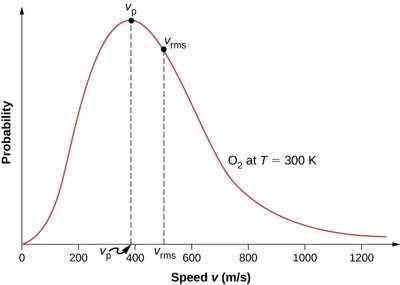
Characteristic Speeds in the Distribution
Three important speeds characterize the Maxwell-Boltzmann distribution:
Most Probable Speed (vp): The speed at which the distribution peaks; most molecules move at this speed.
Average Speed (\bar{v}): The mean speed of all molecules, calculated by integrating the product of speed and the distribution function.
Root-Mean-Square (RMS) Speed (vrms): The square root of the average of the squares of the speeds; related to kinetic energy.
The formulas for these speeds are:
Most Probable Speed:
Average Speed:
RMS Speed:
Where R is the gas constant and M is the molar mass.
Comparison:
Temperature Dependence of the Distribution
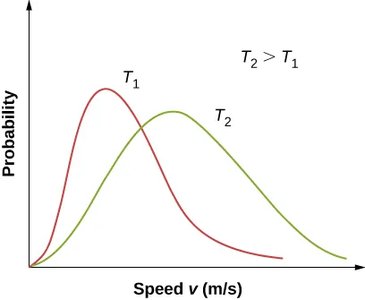
The shape and position of the Maxwell-Boltzmann distribution depend on temperature:
At higher temperatures, the distribution shifts to higher speeds and becomes broader.
At lower temperatures, the distribution is narrower and peaks at lower speeds.
Applications and Implications
The Maxwell-Boltzmann distribution has several important implications:
Atmospheric Composition: Lighter gases (e.g., hydrogen, helium) have higher speeds and are more likely to escape Earth's atmosphere, explaining their scarcity.
Evaporative Cooling: In liquids, molecules with higher energies escape, lowering the average energy and temperature of the remaining liquid.
Ratio of Molecules at Different Speeds: The ratio of molecules with speeds near v1 and v2 can be calculated using the distribution function:
Example: For nitrogen at 27°C, the ratio of molecules with speeds near 300 m/s to those near 100 m/s is approximately 5.74.
Problem-Solving Strategy: Speed Distribution
To solve problems involving molecular speed distributions:
Confirm the problem relates to molecular speed distribution.
List known and unknown quantities.
Convert values to SI units.
Choose the appropriate distribution function or characteristic speed formula.
Solve for the desired quantity, substituting known values.
Energy Distribution
The Maxwell-Boltzmann distribution can also be expressed in terms of kinetic energy:
This form is widely used in both classical and quantum statistical mechanics.
Summary Table: Characteristic Speeds
Speed Type | Formula | Physical Meaning |
|---|---|---|
Most Probable Speed (vp) | Speed at the peak of the distribution | |
Average Speed (\bar{v}) | Mean speed of all molecules | |
RMS Speed (vrms) | Related to average kinetic energy |
