 Back
BackLesson 3.1: Early Atomic Theories and the Origins of Quantum Theory
Study Guide - Smart Notes
 Tailored notes based on your materials, expanded with key definitions, examples, and context.
Early Atomic Theories and the Origins of Quantum Theory
Introduction to Atomic Theory
The nature of matter and the structure of atoms have been central questions in chemistry for centuries. Early philosophers speculated about the existence of indivisible particles called atoms, but only through experimentation and technological advances did the atomic theory become scientifically established.
Development of Atomic Structure
Democritus (c. 460 BCE): Proposed that matter is composed of tiny, indivisible particles called atoms. His ideas were based on reasoning, not experimentation.
John Dalton (1766–1844): Formulated the first modern atomic theory, stating that elements consist of identical atoms, which cannot be created, destroyed, or divided. Dalton's theory was supported by experimental evidence and precise measurements of chemical reactions.
Experimental Evidence for Atoms
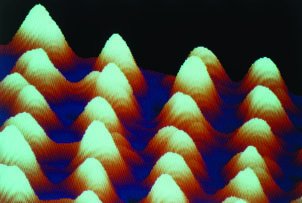
With the invention of advanced instruments, scientists could finally observe and measure atomic phenomena. The scanning tunnelling microscope (STM) allowed for the visualization of individual atoms on surfaces, confirming their existence.
Discovering Subatomic Particles
The Electron and Cathode Ray Experiments
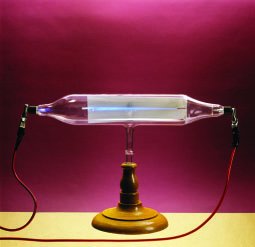
J.J. Thomson's experiments with cathode ray tubes provided the first evidence for the existence of electrons, negatively charged subatomic particles. He observed that cathode rays were deflected by electric and magnetic fields, indicating they were streams of negatively charged particles.
Charge-to-Mass Ratio: Thomson measured the charge-to-mass ratio of the electron using the formula:
Where e is the charge (in coulombs) and m is the mass (in grams).
Thomson's model of the atom, known as the "blueberry muffin model," proposed that electrons were embedded in a diffuse cloud of positive charge.

Millikan's Oil Drop Experiment
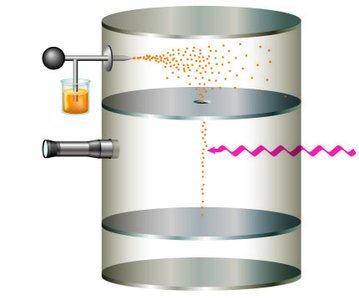
Robert Millikan determined the charge of the electron by observing the behavior of charged oil droplets in an electric field. By balancing gravitational and electrical forces, he calculated the fundamental charge and, using Thomson's ratio, the mass of the electron:
Electron mass:
Radioactivity and the Nucleus
Discovery of Radioactivity
Henri Becquerel discovered that uranium emits spontaneous radiation, leading to the concept of radioactivity—the spontaneous decay of atomic nuclei. Ernest Rutherford further characterized radioactive emissions, identifying alpha, beta, and gamma radiation.
Type | Symbol | Mass (u) | Charge | Speed | Ionizing Ability | Penetrating Power | Stopped by |
|---|---|---|---|---|---|---|---|
Alpha particle | or | 4 | +2 | Slow | High | Low | Paper |
Beta particle | or or | 1/2000 | -1 | Fast | Medium | Medium | Aluminum |
Gamma ray | 0 | 0 | Very fast (speed of light) | None | High | Lead |
Rutherford's Gold Foil Experiment and Nuclear Model
Rutherford's experiments with alpha particles and gold foil demonstrated that atoms have a small, dense, positively charged nucleus. Most alpha particles passed through the foil, but some were deflected, indicating a concentrated center of mass and charge.
Nucleus: Contains protons (positive charge) and neutrons (neutral), with electrons moving around the nucleus.
Proton mass:
Neutron mass:
Electron mass:
Atomic Number, Mass Number, and Isotopes
The atomic number (Z) is the number of protons in the nucleus, while the mass number (A) is the total number of protons and neutrons. Atoms of the same element with different numbers of neutrons are called isotopes. Some isotopes are unstable and radioactive (radioisotopes).
Example: Carbon-12 () and Carbon-14 () are isotopes of carbon.
The Nature of Matter and Energy: Quantum Theory
Classical Theories of Light
Light was historically debated as either a stream of particles or a wave. James Clerk Maxwell's electromagnetic wave theory described light as a continuous spectrum of electromagnetic radiation, with visible light being a small portion of the spectrum.
The Photoelectric Effect
Heinrich Hertz discovered that light shining on a metal surface can cause the emission of electrons, a phenomenon called the photoelectric effect. Classical theory could not explain why the frequency, not the intensity, of light determined electron emission.
Key Point: Only light above a certain threshold frequency can eject electrons from a metal surface, regardless of intensity.
Planck's Quantum Hypothesis
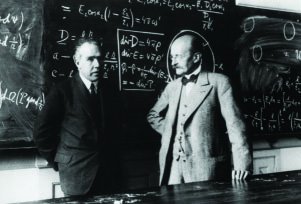
Max Planck proposed that energy is quantized and can only be absorbed or emitted in discrete packets called quanta. The energy of each quantum is given by:
Where n is an integer, h is Planck's constant (), and f is the frequency.
Photons and Einstein's Explanation
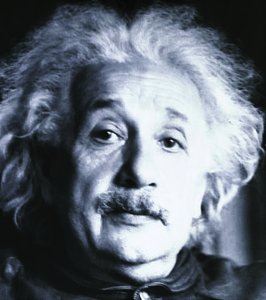
Albert Einstein extended Planck's ideas, proposing that light consists of particles called photons, each carrying a quantum of energy. The photoelectric effect occurs when a photon with sufficient energy collides with an electron, freeing it from the metal.
Photon energy:
If the photon's energy is below the threshold, no electrons are emitted, regardless of the number of photons.
Summary Table: Mass and Charge of Subatomic Particles
Particle | Mass (kg) | Charge |
|---|---|---|
Electron () | -1 | |
Proton () | +1 | |
Neutron () | 0 |
Key Terms and Concepts
Atom: Smallest unit of an element, consisting of a nucleus and electrons.
Electron: Negatively charged subatomic particle.
Proton: Positively charged subatomic particle in the nucleus.
Neutron: Neutral subatomic particle in the nucleus.
Isotope: Atoms of the same element with different numbers of neutrons.
Radioisotope: An unstable isotope that emits radiation.
Quantum: Discrete packet of energy.
Photon: Quantum of light energy.
Photoelectric Effect: Emission of electrons from a material when exposed to light of sufficient frequency.
Applications and Importance
Radioisotopes are used in medicine (e.g., cancer treatment), archaeology (carbon dating), and energy production (nuclear reactors).
Quantum theory is foundational for understanding atomic structure, chemical bonding, and modern technologies such as lasers and semiconductors.
