 Back
Electrochemical Cells and Standard Electrode Potentials
Study Guide - Smart Notes
 Tailored notes based on your materials, expanded with key definitions, examples, and context.
Electrochemical Processes and Reactions
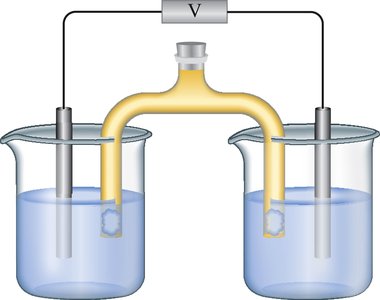
Electrochemical Cells
Electrochemical cells are devices that convert chemical energy into electrical energy, or vice versa, through redox reactions. These cells are fundamental in understanding electrochemistry and are widely used in batteries and industrial processes.
Galvanic (Voltaic) Cell: A type of electrochemical cell where spontaneous redox reactions generate electrical energy.
Components: Each cell consists of two half-cells, each containing an electrode and an electrolyte. The electrodes are connected by a wire, and the electrolytes are connected by a salt bridge.
Salt Bridge: Maintains electrical neutrality by allowing ions to flow between the half-cells.
Electrodes: The anode is where oxidation occurs, and the cathode is where reduction occurs.
Example: The classic Daniell cell uses zinc and copper electrodes in their respective sulfate solutions.
Standard Electrode Potentials
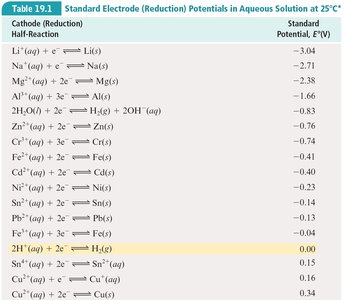
Standard electrode potentials (E0) are measured under standard conditions (25°C, 1 M concentration, 1 atm pressure) and indicate the tendency of a species to be reduced. These values are essential for predicting the direction of redox reactions and calculating cell potentials.
Reduction Potential: The potential associated with a reduction half-reaction at an electrode.
Reference Electrode: The standard hydrogen electrode (SHE) is assigned a potential of 0.00 V.
Cell Potential Calculation: The overall cell potential is calculated as:
Positive Cell Potential: Indicates a spontaneous reaction.
Negative Cell Potential: Indicates a non-spontaneous reaction.
Example: Comparing the reduction potentials of Cu2+/Cu and Zn2+/Zn allows prediction of electron flow in a galvanic cell.
Applications and Importance
Electrochemical cells are used in batteries, electrolysis, corrosion prevention, and metal plating. Understanding electrode potentials is crucial for designing efficient cells and predicting reaction feasibility.
Batteries: Portable energy sources based on electrochemical principles.
Electrolysis: Non-spontaneous reactions driven by external voltage.
Corrosion: Electrochemical process leading to metal degradation.
Additional info: The table of standard electrode potentials is used to determine which species will act as the oxidizing or reducing agent in a cell.
