 Back
Electrochemical Processes and Reactions: Electrolysis and Cell Components
Study Guide - Smart Notes
 Tailored notes based on your materials, expanded with key definitions, examples, and context.
Electrochemical Processes and Reactions
Electrolysis: Principles and Cell Structure
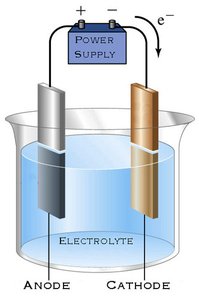
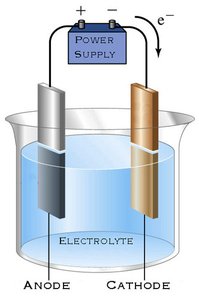
Electrolysis is a fundamental process in electrochemistry where electrical energy is used to drive a non-spontaneous chemical reaction. This process is widely used for the extraction and purification of metals, as well as for the decomposition of compounds.
Electrolyte: A substance containing free ions that conducts electricity. Common electrolytes include molten salts or aqueous solutions.
Anode: The electrode where oxidation occurs (loss of electrons).
Cathode: The electrode where reduction occurs (gain of electrons).
Power Supply: Provides the external voltage necessary to drive the reaction.
Electron Flow: Electrons flow from the anode to the cathode through the external circuit.
Example: Electrolysis of water produces hydrogen at the cathode and oxygen at the anode.
Industrial Electrolysis: Extraction of Magnesium
Industrial electrolysis is used to extract metals such as magnesium from their molten salts. The process involves passing an electric current through molten magnesium chloride, resulting in the deposition of magnesium metal and the release of chlorine gas.
Graphite Anode: Site of chlorine gas evolution (oxidation).
Iron Cathode: Site of magnesium metal deposition (reduction).
Molten Magnesium Chloride: Acts as the electrolyte, often mixed with NaCl and CaCl2 to lower melting point.
Inert Gas: Used to prevent unwanted reactions and maintain purity.
Key Reactions:
At the anode:
At the cathode:
Example: The Dow process for magnesium extraction uses this setup to produce magnesium metal and chlorine gas.
Comparison: Electrolysis vs. Galvanic Cells
Electrolysis cells and galvanic cells are both types of electrochemical cells, but they operate in opposite ways.
Electrolysis Cell: Requires external electrical energy to drive a non-spontaneous reaction.
Galvanic Cell: Generates electrical energy from a spontaneous chemical reaction.
Electron Flow: In both, electrons flow from anode to cathode, but the direction of chemical change differs.
Cell Type | Energy Source | Reaction Type | Anode Process | Cathode Process |
|---|---|---|---|---|
Electrolysis Cell | External Power Supply | Non-spontaneous | Oxidation | Reduction |
Galvanic Cell | Chemical Reaction | Spontaneous | Oxidation | Reduction |
Example: Electrolysis of molten NaCl produces Na and Cl2, while a galvanic cell like the Daniell cell produces electrical energy from Zn and Cu reactions.
Key Equations in Electrolysis
Electrolysis involves the transfer of electrons and can be described by half-reactions at each electrode.
Oxidation (Anode):
Reduction (Cathode):
Faraday's Law: The amount of substance produced is proportional to the charge passed.
Where: = mass of substance produced = total charge (Coulombs) = molar mass = number of electrons = Faraday constant ($96485$ C/mol)
Applications of Electrolysis
Electrolysis is used in various industrial and laboratory processes:
Metal extraction (e.g., magnesium, aluminum)
Electroplating
Purification of metals
Production of gases (e.g., hydrogen, chlorine)
Example: Electroplating involves depositing a thin layer of metal onto a surface using electrolysis.
