 Back
BackElectrochemistry: Galvanic Cells, Electrolysis, and Cell Potentials
Study Guide - Smart Notes
 Tailored notes based on your materials, expanded with key definitions, examples, and context.
Electrochemistry
Redox Reactions
Electrochemistry is the study of chemical processes that cause electrons to move, resulting in electricity. Redox (reduction-oxidation) reactions are central to this field, involving the transfer of electrons between substances.
Oxidation: Loss of electrons by a substance.
Reduction: Gain of electrons by a substance.
Example: Placing copper (Cu) in silver nitrate (AgNO3) solution results in silver metal forming and the solution turning blue, indicating a redox reaction.
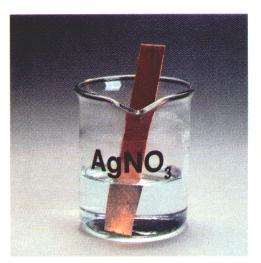
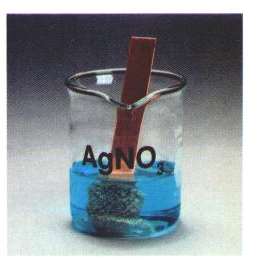
Key Points:
Cu is oxidized (loses electrons).
Ag+ is reduced (gains electrons).
The blue color is due to Cu2+ ions formed in solution.
Electrochemical Cells
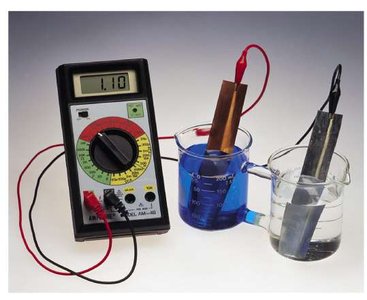
Electrochemical cells separate redox reactions into two half-cells, allowing electrons to flow through a wire, generating an electric current. This current can be used to power devices.
Galvanic (Voltaic) Cell: Spontaneous redox reaction produces electricity.
Electrolytic Cell: Electricity is used to drive a nonspontaneous reaction.
Components of an Electrochemical Cell
Each cell consists of two electrodes, a wire, and a salt bridge:
Anode: Site of oxidation (electrons are lost).
Cathode: Site of reduction (electrons are gained).
Wire: Pathway for electron flow.
Salt Bridge: Maintains charge balance by allowing ion flow.
Electromotive Force (emf) and Cell Potential
The cell potential (Ecell) is the driving force for electron flow from anode to cathode, measured in volts (V). In a galvanic cell, Ecell must be positive for the reaction to be spontaneous.
Formula:
Standard Cell Potential: Eocell is calculated under standard conditions (1 M, 1 atm, 25°C).
Writing Reactions for Galvanic Cells
To construct a galvanic cell, select two half-reactions from a table of standard reduction potentials. The half-reaction with the higher Eo remains as reduction; the other is reversed for oxidation.
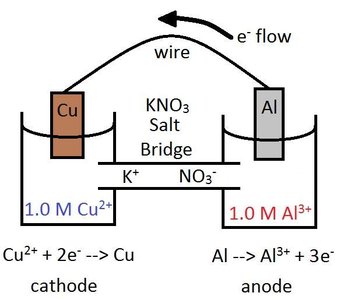
Example: Cu2+ + 2e- → Cu (Eo = 0.34 V), Al3+ + 3e- → Al (Eo = -1.66 V)
Cu2+ is reduced at the cathode; Al is oxidized at the anode.
Identifying Anode and Cathode
Anode: Al (s) → Al3+ (aq) + 3e-
Cathode: Cu2+ (aq) + 2e- → Cu (s)
Electrons flow from anode to cathode.
Calculating Eocell and ΔGo
Balance electrons in the half-reactions, add Eo values, and relate to Gibbs Free Energy:
Formula:
n = moles of electrons transferred
F = Faraday's constant (96,485 C/mol e-)
Example: For 2 Al (s) + 3 Cu2+ (aq) → 3 Cu (s) + 2 Al3+ (aq), Eocell = 2.00 V, ΔGo = -1158 kJ (spontaneous).
Galvanic Cell Summary: Salt Bridge Ion Flow
Cations flow to the cathode.
Anions flow to the anode.
Why Eocell Values Do Not Depend on Number of Moles
Multiplying the reaction by a factor changes ΔGo proportionally, but Eocell remains constant because it is an intensive property.
Electrolysis
Electrolytic cells use external voltage to drive nonspontaneous reactions. Applications include electroplating, water splitting, and battery recharging.
Electroplating: Depositing metals like Au onto surfaces.
Water Splitting: Producing H2 and O2 gases.
Battery Charging: Reversing cell reactions to store energy.
Units and Electrolysis Calculations
Current (I): Measured in amperes (A), charge/time.
Charge (q): nF, where n = moles of electrons.
Time (t): Measured in seconds (s).
Formula:
Example: To plate 10.0 g Ni from Ni2+ solution with 100 A current, use stoichiometry to find n and solve for t.
Predicting Spontaneity of Redox Reactions
To determine if a reaction is spontaneous, calculate Eocell and ΔGo:
If Eocell > 0, ΔGo < 0: spontaneous.
If Eocell < 0, ΔGo > 0: nonspontaneous (requires external voltage).
Example: Cu (s) + 2 H+ → Cu2+ + H2 (g), Eocell = -0.34 V, ΔGo = +65.6 kJ (not spontaneous).
Interpreting Standard Reduction Potentials
Standard reduction potentials (Eo) are tabulated for various half-reactions. The higher the Eo, the stronger the oxidizing agent.
Half Reaction | Eo (V) |
|---|---|
F2 + 2e- → 2F- | 2.87 |
Cu2+ + 2e- → Cu (s) | 0.34 |
2H+ + 2e- → H2 | 0.00 |
Zn2+ + 2e- → Zn (s) | -0.76 |
Al3+ + 3e- → Al (s) | -1.66 |
Li+ + e- → Li (s) | -3.05 |
Oxidizing agents: Left side of the table; Reducing agents: Right side.
Effect of Concentration on Cell Potential: The Nernst Equation
Cell potential changes under nonstandard conditions. The Nernst equation relates Ecell to concentrations:
Formula:
Q = reaction quotient
R = gas constant (8.314 J/mol·K)
T = temperature (K)
Example: Increasing [Zn2+] in a Zn/Ag cell decreases Ecell.
Concentration Cells
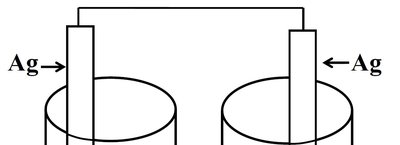
Concentration cells generate voltage from differences in ion concentration between two compartments. The cell potential is calculated using the Nernst equation.
Example: Ag electrodes in 0.1 M and 1.0 M Ag+ solutions.
Eocell = 0 V; Ecell = 0.059 V at 298 K.

Line Notation for Electrochemical Cells
Line notation succinctly describes the setup of an electrochemical cell:
Format: Anode | Anode ion || Cathode ion | Cathode
Example: Zn | Zn2+ || Ag+ | Ag
Review: Oxidizing and Reducing Agents
Oxidizing agent: Causes oxidation, is itself reduced.
Reducing agent: Causes reduction, is itself oxidized.
Example: In Zn + Cu2+ → Zn2+ + Cu, Cu2+ is the oxidizing agent.
Summary of Chapter 20 Topics
Galvanic cells and their construction
Writing and balancing redox reactions
Direction of electron flow
Anode || Cathode line notation
Calculating Eocell and ΔGo
Predicting spontaneity
Interpreting reduction potential tables
Stoichiometry in electrolysis
Calculating Ecell and ΔG under nonstandard conditions
Concentration cells
