 Back
BackElectrochemistry: Principles, Applications, and Calculations
Study Guide - Smart Notes
 Tailored notes based on your materials, expanded with key definitions, examples, and context.
Chapter 20: Electrochemistry
Oxidation and Reduction: Fundamental Concepts
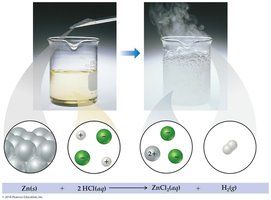
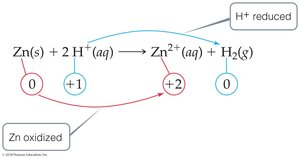
Electrochemistry is the study of chemical processes that involve the transfer of electrons, known as redox (reduction-oxidation) reactions. Understanding oxidation numbers is essential for tracking electron movement in these reactions.
Oxidation: Loss of electrons by a species; oxidation number increases.
Reduction: Gain of electrons by a species; oxidation number decreases.
Oxidizing agent: Causes another species to be oxidized (itself is reduced).
Reducing agent: Causes another species to be reduced (itself is oxidized).
Assigning Oxidation Numbers
Oxidation numbers help identify which atoms are oxidized or reduced in a reaction. The following rules are used:
Elements: oxidation number = 0
Monatomic ions: oxidation number = ion charge
Halogens: usually −1
Oxygen: usually −2 (except in peroxides, where it is −1)
Hydrogen: +1 (except in metal hydrides, where it is −1)
The sum of oxidation numbers in a neutral compound is 0; in a polyatomic ion, it equals the ion's charge.
Half-Reactions and Balancing Redox Reactions
Redox reactions can be separated into two half-reactions: one for oxidation and one for reduction. This method is useful for balancing complex redox equations, especially in aqueous solutions.
Oxidation half-reaction: shows loss of electrons.
Reduction half-reaction: shows gain of electrons.
Balance atoms and charges by adding H+, H2O, and electrons as needed.
Example: The reaction between permanganate ion (MnO4−) and oxalate ion (C2O42−) is balanced by splitting into half-reactions and ensuring both mass and charge are conserved.
Voltaic (Galvanic) Cells
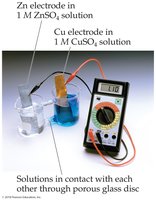
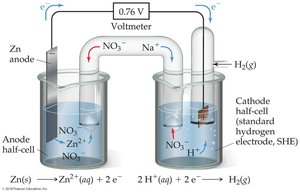
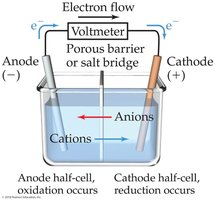
Voltaic cells use spontaneous redox reactions to generate electrical energy. They consist of two half-cells connected by a wire and a salt bridge.
Anode: Site of oxidation (electrons are produced; negative terminal).
Cathode: Site of reduction (electrons are consumed; positive terminal).
Electrons flow from anode to cathode through the external circuit.
The salt bridge maintains electrical neutrality by allowing ion flow.
Electromotive Force (emf) and Cell Potential
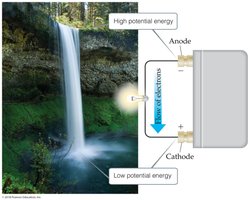
The electromotive force (emf) or cell potential (Ecell) is the voltage generated by a voltaic cell. It is measured in volts (V), where 1 V = 1 J/C (joule per coulomb).
Electrons flow spontaneously from higher to lower potential energy, analogous to water flowing downhill.
Standard Reduction Potentials
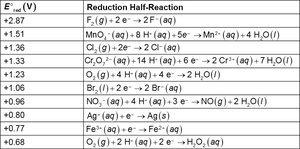
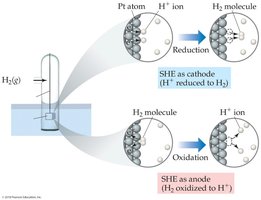
Each half-cell has a standard reduction potential (E°), measured relative to the standard hydrogen electrode (SHE), which is defined as 0 V under standard conditions (1 M, 1 atm, 25°C).
Reduction potentials are tabulated for many electrodes.
Oxidation potential = −(reduction potential).
Calculating Standard Cell Potentials
The standard cell potential is calculated using the standard reduction potentials of the cathode and anode:
Only reduction potentials are used; the anode value is subtracted because oxidation is the reverse of reduction.
Oxidizing and Reducing Agents
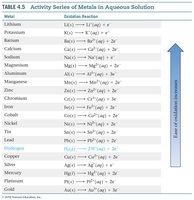
The strength of oxidizing and reducing agents can be compared using standard reduction potentials or the activity series of metals. A higher (more positive) reduction potential means a stronger oxidizing agent.
Free Energy and Redox Reactions
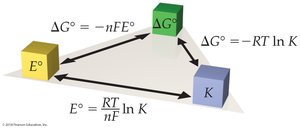
Spontaneous redox reactions have a positive cell potential and a negative Gibbs free energy change (ΔG). The relationship is given by:
n = number of moles of electrons transferred
F = Faraday constant (96,485 C/mol)
The Nernst Equation
The Nernst equation relates cell potential to concentrations of reactants and products (reaction quotient Q):
This equation allows calculation of cell potential under non-standard conditions.
Applications of Electrochemistry
Electrochemistry has many practical applications, including:
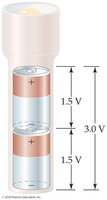
Batteries: Portable power sources made of one or more voltaic cells. Primary cells are non-rechargeable; secondary cells are rechargeable.
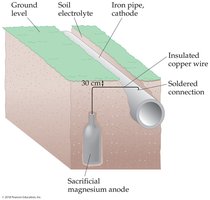
Corrosion prevention: Methods such as cathodic protection and sacrificial anodes are used to prevent rusting of metals.
Electrolysis: Nonspontaneous reactions are driven by electrical energy, used in electroplating and industrial processes.
Corrosion and Its Prevention
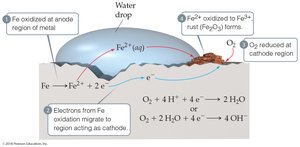
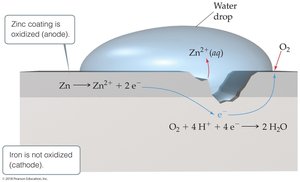
Corrosion is the oxidation of metals, commonly known as rusting in iron. It involves the formation of Fe2+ and Fe3+ ions and the reduction of oxygen.
Corrosion can be prevented by:
Cathodic protection: Using a more easily oxidized metal (e.g., zinc) as a sacrificial anode.
Sacrificial anodes: Attaching metals like magnesium to underground pipes to protect them from oxidation.
Electrolysis and Electroplating
Electrolysis uses electrical energy to drive nonspontaneous chemical reactions. This process is essential for electroplating, metal extraction, and other industrial applications.
Electroplating: Depositing a thin layer of metal onto another material using an electric current.
Electrolysis: Splitting compounds (e.g., water into H2 and O2) using electricity.
Additional info: Mastery of electrochemistry is essential for understanding batteries, corrosion, and many industrial processes. Practice balancing redox reactions and calculating cell potentials for exam success.
