 Back
BackElectrochemistry: Principles, Calculations, and Applications
Study Guide - Smart Notes
 Tailored notes based on your materials, expanded with key definitions, examples, and context.
Ch. 19 – Electrochemistry
Introduction to Electrochemistry
Electrochemistry studies the relationship between chemical reactions and electrical energy. This field is essential for understanding batteries, corrosion, and electrolysis, as it connects chemical changes to the flow of electrons.
Oxidation: The loss of electrons by a substance. Example:
Reduction: The gain of electrons by a substance. Example:
Oxidizing agent: Causes oxidation by being reduced.
Reducing agent: Causes reduction by being oxidized.
Example: - is the oxidizing agent - is the reducing agent
Oxidation Numbers
Oxidation numbers help track electron transfer in redox reactions. They are assigned based on a set of rules:
An atom in its elemental state: Oxidation number = 0
An atom in a monatomic ion: Oxidation number = ion charge
In compounds and polyatomic ions, typical values are: - Hydrogen: +1 (with nonmetals), –1 (with metals) - Oxygen: –2 (except in peroxides, e.g., H2O2) - Halogens: –1 (unless central atom)
The sum of oxidation numbers is 0 for neutral compounds and equals the net charge for polyatomic ions.
Identifying and Balancing Redox Reactions (Half-Reaction Method)
Redox reactions are balanced using the half-reaction method:
Identify atoms oxidized and reduced.
Write unbalanced half-reactions for oxidation and reduction.
Balance all atoms except O and H.
Balance O by adding H2O; balance H by adding H+.
Balance charge by adding electrons ().
Multiply half-reactions to equalize electron transfer.
Add half-reactions and cancel electrons and common species.
Electrochemical Cells: Galvanic vs. Electrolytic
Electrochemical cells convert chemical energy to electrical energy or vice versa. There are two main types:
Galvanic (Voltaic) Cell: Uses a spontaneous reaction to generate electricity.
Electrolytic Cell: Uses an external power source to drive a nonspontaneous reaction.
Anode: Site of oxidation (loses electrons); negative in galvanic cells.
Cathode: Site of reduction (gains electrons); positive in galvanic cells.
Salt Bridge: Maintains ion balance by allowing ion flow between half-cells.
Direction of electron flow: From anode to cathode.
Cell Notation: Shorthand for representing electrochemical cells. Example: Zn(s) | Zn2+(aq, 1 M) || Cu2+(aq, 1 M) | Cu(s)
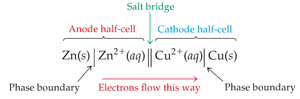
This diagram shows the structure of a galvanic cell, the direction of electron flow, and the role of the salt bridge.
Inert Electrodes: Use Pt as an inert electrode when no solid metal is present in the half-cell.
Standard Reduction Potentials and Cell Potential (E°)
Standard reduction potentials () measure the tendency of a species to be reduced. The cell potential is calculated as:
Use standard reduction potential tables (all half-reactions written as reductions).
Half-reactions are listed in order of decreasing .
If , the reaction is spontaneous (product-favored).
If , the reaction is nonspontaneous (reactant-favored).
Example calculation:
Thermodynamics and Electrochemistry
Electrochemical cell potential is related to thermodynamic quantities:
Gibbs Free Energy: - : Number of electrons transferred - : Faraday’s constant ()
Equilibrium Constant (K): - : Gas constant () - : Temperature in Kelvin
Spontaneity: - , : Spontaneous - , : Non-spontaneous
Concentration Effects and the Nernst Equation
The Nernst equation allows calculation of cell potential under non-standard conditions:
: Reaction quotient = [products]/[reactants]
Increasing reactant concentration increases
Increasing product concentration decreases
Summary and Practice
Balance redox reactions and identify oxidizing/reducing agents.
Analyze and interpret galvanic cells and their shorthand notations.
Calculate , , and use the Nernst equation for non-standard conditions.
Predict how concentration changes affect cell voltage.
