 Back
BackElectrochemistry: Principles, Cells, and Applications
Study Guide - Smart Notes
 Tailored notes based on your materials, expanded with key definitions, examples, and context.
Electrochemistry
Introduction to Electrochemistry
Electrochemistry is the branch of chemistry that studies the transformation between chemical and electrical energy. This field is foundational for understanding batteries, fuel cells, and many industrial processes. The core of electrochemistry is the redox (reduction-oxidation) reaction, where electrons are transferred between species.
Redox Reactions: Involve the transfer of electrons from one substance to another.
OIL RIG: "Oxidation Is Loss (of electrons); Reduction Is Gain (of electrons)" is a helpful mnemonic.
Applications: Batteries, fuel cells, corrosion, and electroplating.

Oxidation and Reduction
Definitions and Agents
Oxidation and reduction always occur together in a redox reaction. The substance that loses electrons is oxidized, while the substance that gains electrons is reduced.
Oxidation: Loss of electrons, increase in oxidation number, gain of oxygen, or loss of hydrogen. Occurs at the anode in an electrochemical cell.
Reduction: Gain of electrons, decrease in oxidation number, loss of oxygen, or gain of hydrogen. Occurs at the cathode in an electrochemical cell.
Oxidizing Agent: Electron acceptor; causes another species to be oxidized and is itself reduced.
Reducing Agent: Electron donor; causes another species to be reduced and is itself oxidized.
Oxidation States
Rules for Assigning Oxidation Numbers
Oxidation states (or numbers) are used to keep track of electron transfer in redox reactions. They are assigned based on a set of rules:
Free elements: Oxidation number is 0 (e.g., Na(s), Cl2(g)).
Alkali metals: Always +1; alkaline earth metals: Always +2.
Fluorine: Always –1; other halogens usually –1 but can vary.
Hydrogen: +1 (with nonmetals), –1 (with metals).
Oxygen: Usually –2 (oxide), –1 (peroxide), –½ (superoxide).
The sum of oxidation states in a compound is 0; in a polyatomic ion, it equals the ion's charge.
Example Assignments:
Br2: 0 (elemental state)
K+: +1 (alkali metal)
SO42–: S = +6, O = –2
Na2O2: Na = +1, O = –1 (peroxide)
Redox Reactions and Electron Flow
Simultaneity and Electron Transfer
Oxidation and reduction must occur simultaneously. The atom whose oxidation state increases is oxidized, while the atom whose oxidation state decreases is reduced. The flow of electrons from the anode to the cathode generates an electric current.
Electric Current: The amount of electric charge passing a point per unit time, measured in amperes (A).
Voltage (Potential Difference): The energy difference per unit charge between two points, measured in volts (V).
Electromotive Force (emf): The force that drives electrons through a circuit.
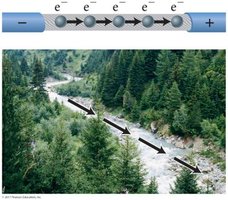
Electrochemical Cells
Voltaic (Galvanic) Cells
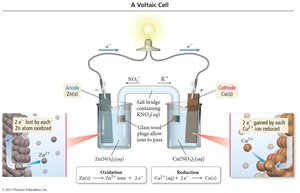
Voltaic cells are devices that use spontaneous redox reactions to generate electrical energy. They consist of two half-cells connected by a salt bridge and an external circuit.
Anode: Site of oxidation (negative terminal).
Cathode: Site of reduction (positive terminal).
Salt Bridge: Maintains electrical neutrality by allowing ion flow between half-cells.
Cell Potential (Eocell): The voltage difference between the two electrodes under standard conditions.
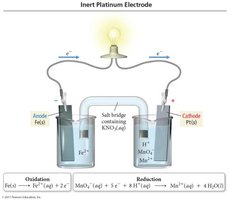
Inert Electrodes
When a half-cell contains only ions or non-conductive materials, an inert electrode (such as platinum) is used to transfer electrons without participating in the reaction.
Cell Notation
Voltaic cells are described using a shorthand notation:
Format: anode | anode solution || cathode solution | cathode
Single vertical line (|): Phase boundary
Double vertical line (||): Salt bridge
Example: Zn(s) | Zn2+(aq) || Cu2+(aq) | Cu(s)
Standard Reduction Potentials
Definition and Measurement
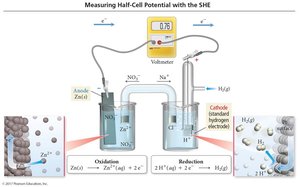
The standard reduction potential (Eo) measures the tendency of a species to gain electrons (be reduced) relative to the standard hydrogen electrode (SHE), which is assigned a value of 0.00 V.
More Positive Eo: Greater tendency to be reduced.
More Negative Eo: Greater tendency to be oxidized.
Calculation:
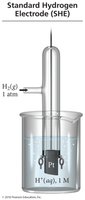
Spontaneity of Redox Reactions
Predicting Reaction Direction
When two half-cells are connected, electrons flow from the half-cell with lower reduction potential to the one with higher reduction potential. A positive Eocell indicates a spontaneous reaction.
Spontaneous Reaction: Eocell > 0
Non-spontaneous Reaction: Eocell < 0
Any substance on the right of the table will reduce any substance higher than it on the left.
Relationship Between Eocell, ΔG°, and K
Thermodynamics of Electrochemical Cells
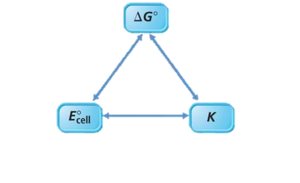
The spontaneity of a redox reaction is related to the cell potential, the standard free energy change (ΔG°), and the equilibrium constant (K).
ΔG° = –nFEocell
ΔG° = –RT ln K
Eocell = (RT / nF) ln K
Where n = number of moles of electrons, F = Faraday's constant (96,485 C/mol e–), R = gas constant, T = temperature in Kelvin.
The Nernst Equation
Non-Standard Conditions
The Nernst equation allows calculation of cell potential under non-standard conditions (when concentrations are not 1 M, pressure is not 1 atm, or temperature is not 25°C):
Q = reaction quotient (ratio of product and reactant concentrations)
Concentration Cells
Cells with Identical Electrodes but Different Concentrations
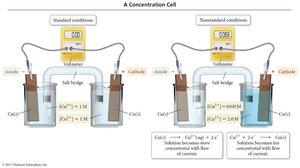
Concentration cells generate a potential from the difference in ion concentration between two half-cells. Electrons flow from the less concentrated solution (anode) to the more concentrated solution (cathode) until equilibrium is reached.
When concentrations are equal, Ecell = 0 (no net reaction).
When concentrations differ, a spontaneous reaction occurs to equalize concentrations.
Summary Table: Key Equations in Electrochemistry
Equation | Description |
|---|---|
Standard cell potential | |
Standard free energy change | |
Relationship to equilibrium constant | |
Nernst equation (25°C) |
