 Back
BackElectrochemistry: Redox Reactions and Balancing Equations
Study Guide - Smart Notes
 Tailored notes based on your materials, expanded with key definitions, examples, and context.
Chapter 18: Electrochemistry
Introduction to Electrochemistry
Electrochemistry is the study of chemical processes that involve the transfer of electrons, known as redox (reduction-oxidation) reactions. These reactions are fundamental to understanding batteries, corrosion, and many biological processes.
Oxidation and Reduction
Oxidation States and Their Importance
Atoms and molecules can possess various degrees of charge, known as oxidation states or oxidation numbers. These values help track electron movement in redox reactions. For example, iron can exist as Fe, Fe2+, or Fe3+. The oxidation state is a formalism that assumes the more electronegative atom in a covalent bond 'takes' all the electrons.
Rules for Assigning Oxidation Numbers
The oxidation state of each atom in an element is 0.
The oxidation state of the atom in a monatomic ion equals the ion's charge.
The sum of oxidation states in a neutral molecule is zero; in a polyatomic ion, it equals the ion's charge.
In compounds:
Group 1 metals: +1
Group 2 metals: +2
Hydrogen: +1 (except in metal hydrides, where it is -1)
Fluorine: -1
Other group 17 elements: usually -1
Oxygen: usually -2
Other group 16 elements: usually -2
Group 15 elements: usually -3
Redox Reactions
Definition and Half-Reactions
A redox reaction involves both the gain and loss of electrons. It is convenient to split the overall reaction into two half-reactions: one for oxidation (loss of electrons) and one for reduction (gain of electrons).
Oxidation half-reaction:
Reduction half-reaction:
Overall reaction:
Oxidizing and Reducing Agents
Oxidizing Agent: Causes another species to be oxidized by accepting electrons.
Reducing Agent: Causes another species to be reduced by donating electrons.
The oxidizing agent is reduced, and the reducing agent is oxidized.
Oxidation: Increase in oxidation state (loss of electrons).
Reduction: Decrease in oxidation state (gain of electrons).
Balancing Redox Equations
General Requirements
A balanced redox equation must have the same number of each atom and the same total charge on both sides. Additionally, the gain and loss of electrons must be balanced.
Balancing Redox Reactions in Acidic Solution
Identify the redox pairs and split the equation into two half-reactions (oxidation and reduction).
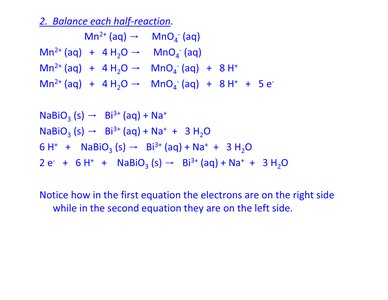
Balance each half-reaction:
Balance all elements except H and O.
Balance O by adding H2O.
Balance H by adding H+.
Balance charge by adding electrons to the more positive side.
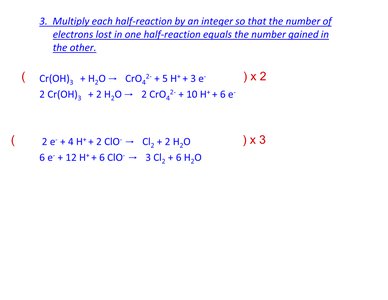
Multiply each half-reaction by an integer so the number of electrons lost equals the number gained.
Add the half-reactions and cancel identical species on both sides.
Check that atoms and charges are balanced.
Example: Balancing in Acidic Solution
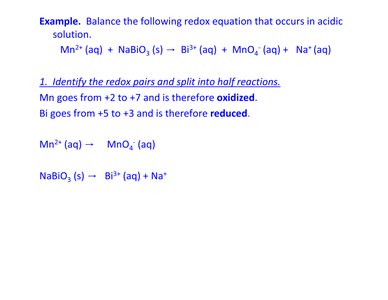
Balance:
Identify redox pairs: Mn is oxidized, Bi is reduced.
Balance each half-reaction (see images for stepwise balancing).
Multiply and add half-reactions, then check for balance.
Balancing Redox Reactions in Basic Solution
Balance the equation as if in acidic solution.
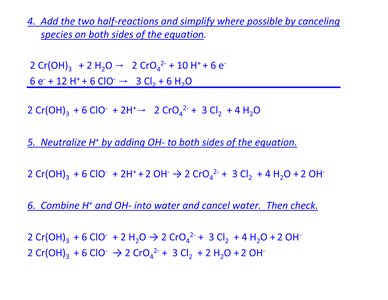
Neutralize H+ by adding OH- to both sides. Where H+ and OH- are on the same side, combine to form H2O and cancel as much water as possible.
Verify that the reaction is balanced.
Example: Balancing in Basic Solution
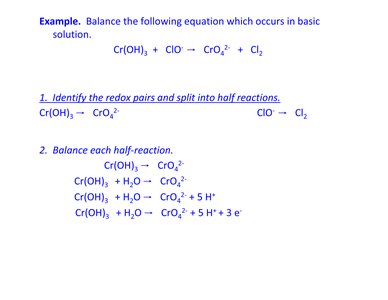
Balance:
Identify redox pairs and split into half-reactions.
Balance each half-reaction, multiply as needed, add, and neutralize H+ with OH-.
Combine H+ and OH- into water and simplify.
Practice Problem
Balance: (basic solution)
Follow the steps for basic solution: balance, add OH-, combine with H+ to form water, and simplify.
Summary Table: Key Steps for Balancing Redox Equations
Step | Acidic Solution | Basic Solution |
|---|---|---|
1 | Split into half-reactions | Split into half-reactions |
2 | Balance all elements except H, O | Balance all elements except H, O |
3 | Balance O with H2O | Balance O with H2O |
4 | Balance H with H+ | Balance H with H+ |
5 | Balance charge with e- | Balance charge with e- |
6 | Multiply to equalize electrons | Multiply to equalize electrons |
7 | Add and simplify | Add and simplify |
8 | Check atoms and charge | Add OH- to neutralize H+, combine to form H2O, then check |
Additional info: These notes cover the foundational aspects of redox reactions and balancing equations in both acidic and basic solutions, which are essential for understanding electrochemistry in general chemistry courses.
