 Back
BackElectrochemistry: Redox Reactions and Voltaic Cells (General Chemistry II, Chapter 18)
Study Guide - Smart Notes
 Tailored notes based on your materials, expanded with key definitions, examples, and context.
Electrochemistry: Redox Reactions and Voltaic Cells
Introduction to Electrochemistry
Electrochemistry is the study of chemical processes that involve the transfer of electrons, known as redox (reduction-oxidation) reactions. These reactions are fundamental to understanding how chemical energy is converted into electrical energy and vice versa.
Oxidation and Reduction
Oxidation States and Their Assignment
Oxidation states (or oxidation numbers) are used to keep track of electron transfer in redox reactions. The oxidation state of an atom in a molecule or ion is a formalism that assumes the more electronegative atom in a bond 'takes' all the electrons.
Oxidation: Loss of electrons (increase in oxidation state).
Reduction: Gain of electrons (decrease in oxidation state).
Rules for assigning oxidation numbers:
The oxidation state of an element in its standard state is 0.
For a monatomic ion, the oxidation state equals the ion's charge.
The sum of oxidation states in a neutral molecule is 0; in a polyatomic ion, it equals the ion's charge.
Group 1 metals: +1; Group 2 metals: +2.
Hydrogen: +1 (except in metal hydrides, where it is -1).
Fluorine: always -1; Oxygen: usually -2; Group 17 elements: usually -1; Group 16: usually -2; Group 15: usually -3.
Redox Reactions and Half-Reactions
A redox reaction involves both oxidation and reduction. It is often helpful to split the overall reaction into two half-reactions: one for oxidation and one for reduction.
Oxidation half-reaction: Shows the species losing electrons.
Reduction half-reaction: Shows the species gaining electrons.
Example:
Oxidation:
Reduction:
Overall:
Oxidizing and Reducing Agents
Oxidizing Agent: Causes another species to be oxidized by accepting electrons (itself is reduced).
Reducing Agent: Causes another species to be reduced by donating electrons (itself is oxidized).
"The oxidizing agent is reduced and the reducing agent is oxidized."
Balancing Redox Equations
General Requirements
Balanced redox equations must have the same number of atoms of each element and the same total charge on both sides. The gain and loss of electrons must also be balanced.
Balancing in Acidic Solution
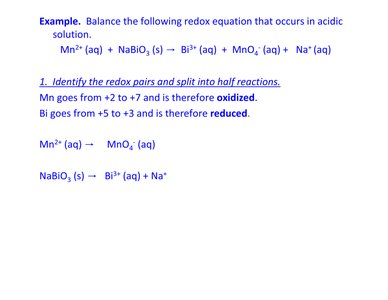
Identify the redox pairs and split the equation into oxidation and reduction half-reactions.
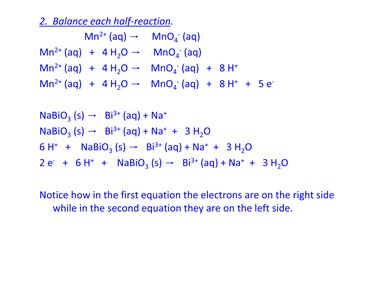
Balance all elements except H and O.
Balance O by adding .
Balance H by adding .
Balance charge by adding electrons () to the more positive side.
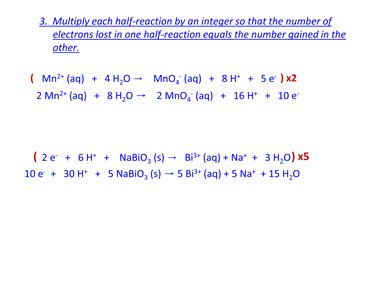
Multiply half-reactions by integers if necessary to equalize electrons transferred.
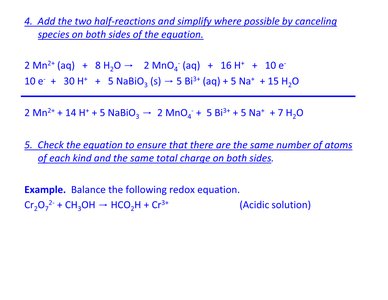
Add the half-reactions and cancel identical species.
Check that atoms and charges are balanced.
Example: Balancing in Acidic Solution
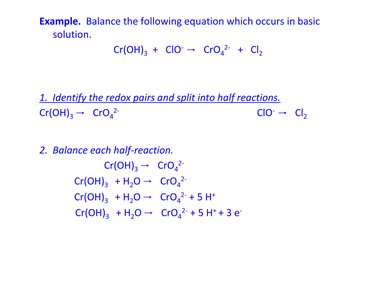
Balance:
Identify half-reactions and balance each for atoms, H, O, and charge as described above.
Balancing in Basic Solution
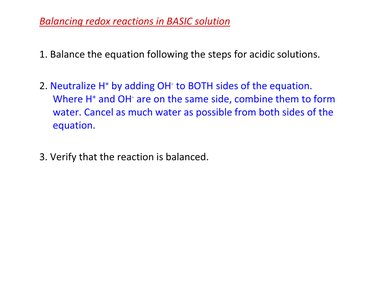
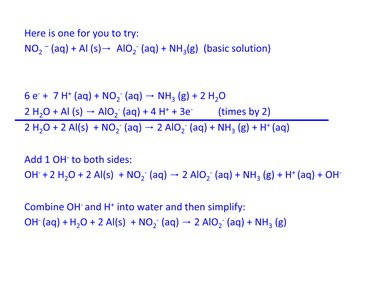
Balance as if in acidic solution.
Neutralize by adding to both sides (combine and to form ).
Cancel water molecules as needed and verify the equation is balanced.
Voltaic (Galvanic) Cells
Introduction to Voltaic Cells
A voltaic cell (or galvanic cell) is an electrochemical cell that produces electric current from a spontaneous chemical reaction. It consists of two half-cells connected by a salt bridge or porous disk, allowing ions to flow and maintain electrical neutrality.
Features of Voltaic Cells
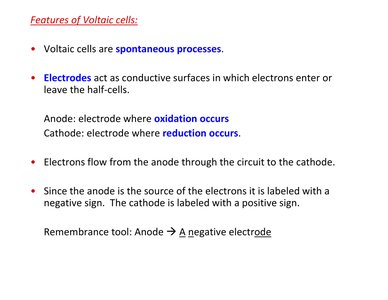
Spontaneous processes generate electrical energy.
Electrodes are conductive surfaces where oxidation (anode) and reduction (cathode) occur.
Electrons flow from anode (negative) to cathode (positive) through the external circuit.
Mnemonic: Anode is the A negative electrode.
Maintaining Neutrality
As the reaction proceeds, cations accumulate in the anode compartment and anions in the cathode compartment. To maintain neutrality, a salt bridge or porous glass disc allows the flow of ions between compartments:
Cations flow into the cathode compartment.
Anions flow into the anode compartment.
Cell Notation
Cell notation summarizes the components of a voltaic cell.
Reactants and products in the same phase are separated by a comma; different phases by a vertical line.
Coefficients are omitted; inert electrodes (e.g., Pt) are used if no solid is present.
Cell Electromotive Force (EMF)
Definition and Origin
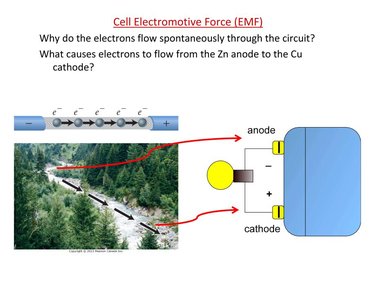
The cell electromotive force (EMF) is the potential difference between the two electrodes of a voltaic cell. It acts as the driving force for electron flow from the anode to the cathode.
Electrons flow from high to low electrical potential energy.
The anode has higher potential energy than the cathode.
Electromotive Force (EMF): The potential difference (in volts) that drives electrons through the circuit.
Summary Table: Key Terms in Electrochemistry
Term | Definition |
|---|---|
Oxidation | Loss of electrons; increase in oxidation state |
Reduction | Gain of electrons; decrease in oxidation state |
Anode | Electrode where oxidation occurs (negative in voltaic cell) |
Cathode | Electrode where reduction occurs (positive in voltaic cell) |
Oxidizing Agent | Species that is reduced (accepts electrons) |
Reducing Agent | Species that is oxidized (donates electrons) |
EMF | Potential difference driving electron flow |
Additional info: These notes cover the foundational aspects of electrochemistry, including redox reactions, balancing equations in acidic and basic solutions, and the operation of voltaic cells. For further study, students should explore standard electrode potentials and applications of electrochemical cells in batteries and corrosion.
