 Back
BackElectrochemistry: Redox Reactions, Electrochemical Cells, and Applications
Study Guide - Smart Notes
 Tailored notes based on your materials, expanded with key definitions, examples, and context.
Electrochemistry
Introduction to Electrochemistry
Electrochemistry is the branch of chemistry that studies oxidation-reduction (redox) reactions in which electrons are transferred between species, resulting in the production or consumption of electrical current. These processes are fundamental to batteries, corrosion, electrolysis, and biological energy conversion.
Oxidation-Reduction (Redox) Reactions
Definitions and Key Concepts
Oxidation: The loss of electrons by a substance. The species that loses electrons is said to be oxidized.
Reduction: The gain of electrons by a substance. The species that gains electrons is said to be reduced.
Oxidizing Agent: The substance that causes oxidation by accepting electrons (itself is reduced).
Reducing Agent: The substance that causes reduction by donating electrons (itself is oxidized).
Redox reactions are essential in many chemical and biological processes, including combustion, metabolism, and corrosion.
Assigning Oxidation Numbers
Oxidation numbers (O.N.) are used to keep track of electron transfer in redox reactions. The rules for assigning oxidation numbers are:
Elements in their elemental form have O.N. = 0.
Monatomic ions have O.N. equal to their charge.
Group 1A metals: O.N. = +1; Group 2A metals: O.N. = +2.
Fluorine: O.N. = -1; Oxygen: O.N. = -2 (except in peroxides, where O.N. = -1); Hydrogen: O.N. = +1 (except in metal hydrides, where O.N. = -1).
The sum of oxidation numbers in a neutral compound is 0; in a polyatomic ion, it equals the ion's charge.
Balancing Redox Reactions
Redox reactions must be balanced for both mass and charge. The half-reaction method is commonly used:
Assign oxidation states to all elements.
Write separate half-reactions for oxidation and reduction.
Balance all elements except H and O.
Balance O by adding H2O; balance H by adding H+ (or OH- in basic solution).
Balance charge by adding electrons.
Multiply half-reactions to equalize electron transfer, then add together.
Check that atoms and charges are balanced.
Electrochemical Cells
Voltaic (Galvanic) Cells
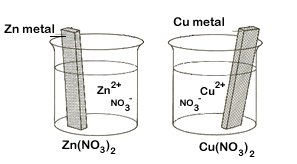
Voltaic cells use spontaneous redox reactions to generate electrical energy. Each half-reaction occurs in a separate half-cell, connected by a salt bridge that allows ion flow to maintain charge balance.
Anode: Electrode where oxidation occurs; electrons are released here.
Cathode: Electrode where reduction occurs; electrons are accepted here.
Electrons flow from anode to cathode through an external circuit.
Cell Notation
Cell notation is a shorthand for representing electrochemical cells:
Format: Anode | Anode solution || Cathode solution | Cathode
Single vertical line (|) indicates a phase boundary; double vertical line (||) indicates a salt bridge.
Example: Zn(s) | Zn2+(aq) || Cu2+(aq) | Cu(s)
Standard Electrode Potentials
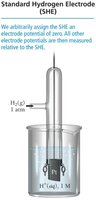
The standard hydrogen electrode (SHE) is assigned a potential of 0 V and is used as a reference for measuring other electrode potentials. Standard reduction potentials (E°) are measured under standard conditions (1 M, 1 atm, 25°C).
Calculating Cell Potential
The standard cell potential (E°cell) is calculated as:
If E°cell is positive, the reaction is spontaneous; if negative, it is nonspontaneous.
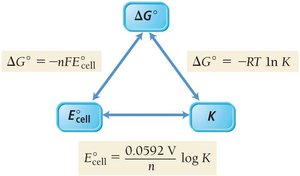
Relationship Between Cell Potential, Free Energy, and Equilibrium
The Nernst Equation
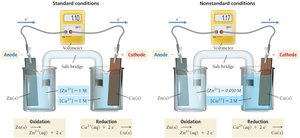
The Nernst equation allows calculation of cell potential under nonstandard conditions:
Where Q is the reaction quotient, n is the number of electrons transferred.
Types of Electrochemical Cells
Voltaic vs. Electrolytic Cells
Voltaic (Galvanic) Cell: Spontaneous redox reaction produces electricity. Anode is negative, cathode is positive.
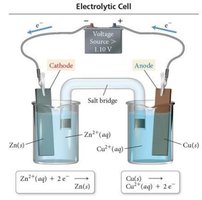
Electrolytic Cell: Nonspontaneous reaction is driven by external electrical energy. Anode is positive, cathode is negative.
Applications of Electrochemistry
Batteries
Batteries are practical applications of voltaic cells. Common types include:
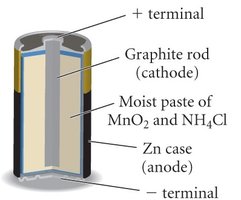
Dry Cell (Leclanché Cell): Uses a Zn anode and MnO2 cathode in a paste electrolyte.
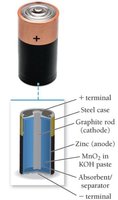
Alkaline Cell: Similar to dry cell but uses KOH as electrolyte for longer shelf life.
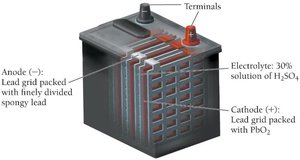
Lead Storage Battery: Rechargeable, used in vehicles; consists of Pb and PbO2 electrodes in H2SO4.
Nickel-Cadmium (NiCad) and Nickel-Metal Hydride (NiMH) Batteries: Rechargeable, used in portable electronics.
Lithium-Ion Battery: High energy density, used in modern electronics.
Electrolysis
Electrolysis is the process of using electrical energy to drive a nonspontaneous chemical reaction. It is used for electroplating, metal extraction, and decomposition of compounds.
Oxidation occurs at the anode; reduction at the cathode.
Common examples: Electrolysis of water, molten salts, and aqueous solutions.
Corrosion and Its Prevention
Corrosion is the deterioration of metals due to redox reactions with environmental agents, such as oxygen and water. Iron rusting is a common example, where iron is oxidized to Fe2+ and then to Fe3+, forming rust (Fe2O3·xH2O).

Prevention methods include painting, coating with less active metals, or using sacrificial anodes (cathodic protection).
Quantitative Electrochemistry
Faraday’s Laws of Electrolysis
The amount of substance produced at each electrode is proportional to the amount of electric charge passed through the cell.
1 Faraday (F) = 96,485 C = charge for 1 mole of electrons.
Current (A) × time (s) = charge (C).
Example: To deposit 1 mole of Ag from Ag+, 1 mole of electrons (1 F) is required.
Summary Table: Key Electrochemical Terms
Term | Definition |
|---|---|
Anode | Electrode where oxidation occurs |
Cathode | Electrode where reduction occurs |
Cell Potential (Ecell) | Electrical potential difference between two electrodes |
Standard Electrode Potential (E°) | Potential of a half-cell under standard conditions |
Faraday (F) | Charge of 1 mole of electrons (96,485 C) |
Nernst Equation | Relates Ecell to concentrations: |
