 Back
BackElectrochemistry: Redox Reactions, Electrochemical Cells, and Applications
Study Guide - Smart Notes
 Tailored notes based on your materials, expanded with key definitions, examples, and context.
Electrochemistry
Redox Reactions
Electrochemistry is the study of chemical processes that involve the transfer of electrons, known as oxidation-reduction (redox) reactions. These reactions are fundamental to the conversion of chemical energy into electrical energy and vice versa.
Oxidation: Loss of electrons by a substance; increase in oxidation state.
Reduction: Gain of electrons by a substance; decrease in oxidation state.
Reducing agent: The reactant that donates electrons and is oxidized.
Oxidizing agent: The reactant that accepts electrons and is reduced.
Example: Assigning oxidation states and identifying agents in a redox reaction:
Oxidation:
Reduction:
Redox reactions can be separated into two half-reactions: one for oxidation and one for reduction.

Balancing Redox Reactions
Balancing redox reactions, especially in aqueous solutions, requires a systematic approach:
Assign oxidation numbers to all atoms.
Separate the overall reaction into oxidation and reduction half-reactions.
Balance each half-reaction for mass (other elements, then O by adding , then H by adding ).
Balance each half-reaction for charge (add electrons).
Equalize the number of electrons in both half-reactions by multiplying as needed.
Add the half-reactions and cancel like terms.
Check by counting atoms and total charge.
Example: Balancing in acidic solution:
Oxidation:
Reduction:
Electrochemical Cells
Voltaic (Galvanic) Cells
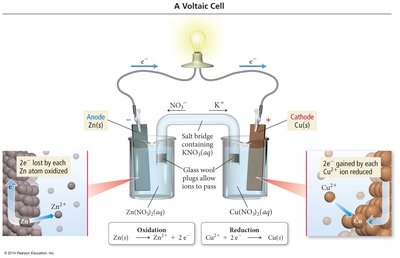
Voltaic cells generate electricity from spontaneous redox reactions. They consist of two half-cells connected by a salt bridge and conductive electrodes.
Anode: Site of oxidation; negative electrode.
Cathode: Site of reduction; positive electrode.
Salt bridge: Maintains charge balance by allowing ion migration.
Electrochemical Cell Notation
Cell notation represents the components and reactions in an electrochemical cell:
Anode (oxidation half-cell) is on the left; cathode (reduction half-cell) is on the right.
"|" denotes a phase boundary; "||" denotes a salt bridge.
Example:
Standard Electrode Potentials
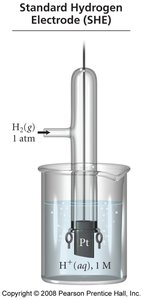
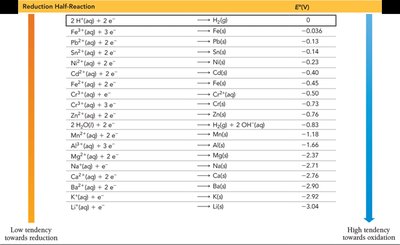
Each half-cell has a standard reduction potential (), measured relative to the Standard Hydrogen Electrode (SHE), which is defined as V.
Cell potential is calculated as:
indicates a spontaneous reaction.
Cell Potential, Free Energy, and Equilibrium
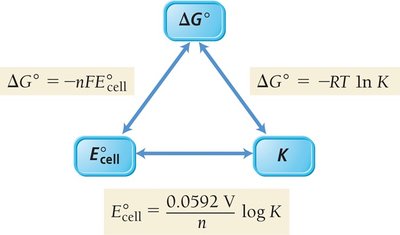
Relationship Between , , and
The cell potential, Gibbs free energy, and equilibrium constant are interrelated:
Nernst Equation: Cell Potential and Concentration
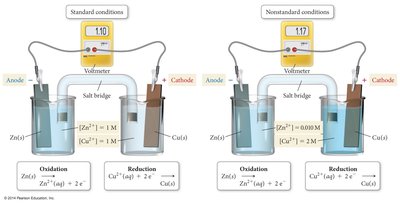
The Nernst equation allows calculation of cell potential under non-standard conditions:
is the reaction quotient, reflecting ion concentrations.
Batteries and Fuel Cells
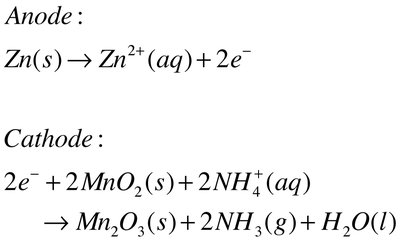
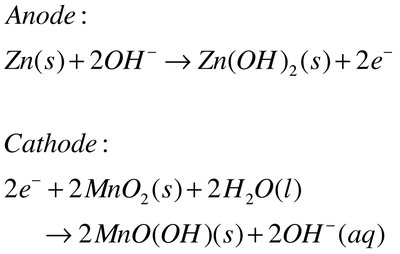
Dry-Cell Batteries
Dry-cell batteries use chemical reactions to generate electricity without large amounts of liquid water. The traditional dry cell and alkaline battery both produce about 1.5 V.
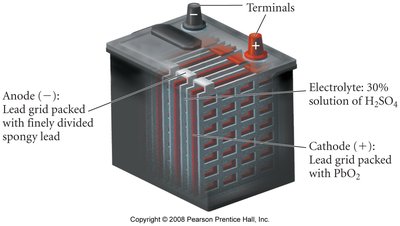
Lead-Acid Storage Battery
Lead-acid batteries are rechargeable and used in automobiles. They consist of lead and lead dioxide electrodes in sulfuric acid.
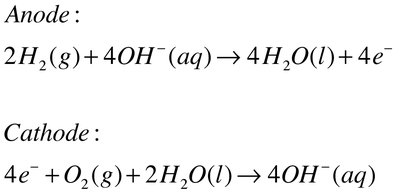
Hydrogen-Oxygen Fuel Cell
Fuel cells generate electricity by combining hydrogen and oxygen, producing water as the only byproduct.
Electrolysis and Electrolytic Cells
Electrolysis
Electrolysis uses electrical energy to drive nonspontaneous chemical reactions. It is performed in electrolytic cells, which are used for metal extraction, purification, and plating.
Anode: Site of oxidation; positive electrode in electrolytic cell.
Cathode: Site of reduction; negative electrode in electrolytic cell.
Stoichiometry of Electrolysis
Electrolysis calculations involve converting current and time to moles of electrons, then to moles and mass/volume of product.
Faraday's constant:
Example:
Corrosion and Prevention
Corrosion
Corrosion is an undesirable redox reaction, such as the rusting of iron. Prevention methods include painting and using sacrificial electrodes (e.g., Mg or Al attached to iron).
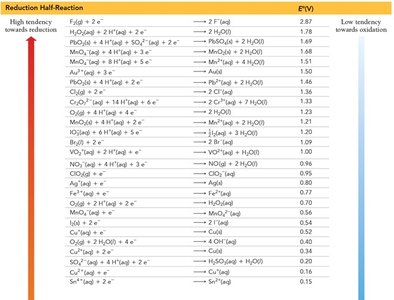
Summary Table: Standard Reduction Potentials
Reduction Half-Reaction | E0 (V) |
|---|---|
F2(g) + 2e- → 2F-(aq) | 2.87 |
Li+(aq) + e- → Li(s) | -3.04 |
2H+(aq) + 2e- → H2(g) | 0.00 |
Cu2+(aq) + 2e- → Cu(s) | 0.34 |
Zn2+(aq) + 2e- → Zn(s) | -0.76 |
Fe2+(aq) + 2e- → Fe(s) | -0.44 |
Ag+(aq) + e- → Ag(s) | 0.80 |
Sn2+(aq) + 2e- → Sn(s) | -0.14 |
Pb2+(aq) + 2e- → Pb(s) | -0.13 |
Mn2+(aq) + 2e- → Mn(s) | -1.18 |
Mg2+(aq) + 2e- → Mg(s) | -2.37 |
K+(aq) + e- → K(s) | -2.93 |
Additional info: Table entries are a selection from the full standard reduction potential table, which is used to predict cell voltages and spontaneity.
