 Back
BackElectrochemistry: Voltaic Cells, Cell Potentials, and Standard Electrode Potentials
Study Guide - Smart Notes
 Tailored notes based on your materials, expanded with key definitions, examples, and context.
Electrochemistry
Introduction to Electrochemical Cells
Electrochemistry studies the relationship between chemical reactions and electrical energy. An electrochemical cell is a device that can generate electrical energy from chemical reactions or use electrical energy to drive chemical reactions. The two main types are voltaic (galvanic) cells and electrolytic cells. Voltaic cells generate electricity from spontaneous redox reactions, while electrolytic cells use electricity to drive nonspontaneous reactions.
Voltaic (Galvanic) Cells
A voltaic cell consists of two half-cells, each containing an electrode and an electrolyte. The half-cells are connected by a salt bridge that allows ion flow to maintain electrical neutrality. The anode is where oxidation occurs (loss of electrons), and the cathode is where reduction occurs (gain of electrons). Electrons flow from the anode to the cathode through an external circuit, generating an electric current.
Anode: Site of oxidation; connected to the negative terminal of the voltmeter.
Cathode: Site of reduction; connected to the positive terminal of the voltmeter.
Salt Bridge: Contains ions (e.g., K+, Cl−) that migrate to balance charge as the reaction proceeds.
Cell Reaction: The sum of the two half-reactions occurring in the cell.
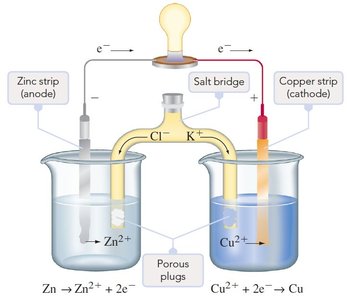
Constructing Voltaic Cells
To construct a voltaic cell, you need:
Two half-cells (e.g., Zn/Zn2+ and Cu/Cu2+).
Metal electrodes connected by a wire and a voltmeter.
A salt bridge linking the solutions.
Oxidation at the anode and reduction at the cathode.
The voltage measured depends on the nature of the electrodes and the concentrations of the ions in solution. For standard conditions (1.0 M solutions, 1 atm gases), the cell voltage is characteristic for each cell.
Special Cases: Inert Electrodes and Gas Electrodes
When a half-cell involves a gas or ions that cannot serve as electrodes, an inert electrode (such as platinum or graphite) is used to transfer electrons without participating in the reaction. For example, the standard hydrogen electrode (SHE) uses a platinum electrode with H2 gas bubbling over it in an acidic solution.
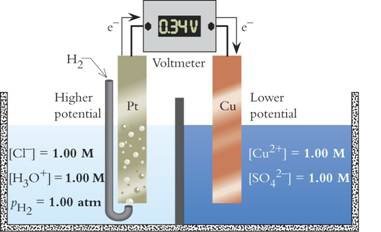
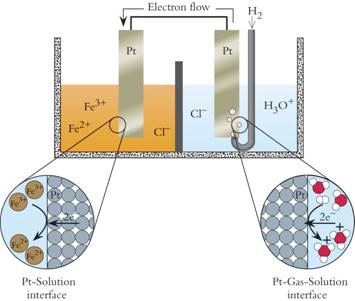
Cell Notation
Shorthand Representation of Voltaic Cells
Cell notation is a shorthand method for describing voltaic cells. The anode (oxidation half-cell) is written on the left, and the cathode (reduction half-cell) on the right. Phase boundaries are indicated by a single vertical bar (|), and the salt bridge by a double vertical bar (||).
Example: Zn(s) | Zn2+(aq) || Cu2+(aq) | Cu(s)
For gas electrodes: Pt | H2(g) | H+(aq) || ...
Concentrations and pressures are specified in parentheses if not standard.
When multiple ions are present in the same phase, they are separated by commas.
Cell Potential and Electromotive Force (emf)
Definition and Calculation
The cell potential (Ecell) or electromotive force (emf) is the maximum potential difference between the electrodes of a voltaic cell. It is measured in volts (V) and can be determined using a voltmeter. The cell potential is related to the ability of the cell to do electrical work:
Electrical work:
n: Number of moles of electrons transferred
F: Faraday constant ( C/mol e−)
The cell potential is an intensive property, meaning it does not depend on the amount of material present.
Standard Cell Potentials (E°cell)
The standard cell potential is the emf of a cell operating under standard-state conditions (1 M concentrations, 1 atm pressure, 25°C). It is calculated using standard reduction potentials (E°) for the half-reactions:
Standard reduction potentials are measured relative to the standard hydrogen electrode (SHE), which is assigned a potential of 0.00 V.
Using Standard Reduction Potentials
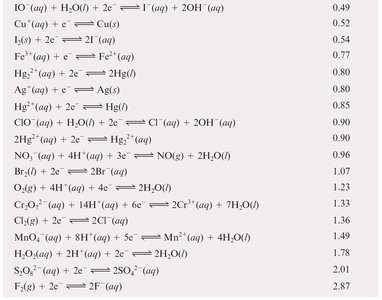
Standard reduction potentials (SRPs) are tabulated values that indicate the tendency of a species to be reduced. A more positive E° means a greater tendency to be reduced (stronger oxidizing agent). A more negative E° means a greater tendency to be oxidized (stronger reducing agent).
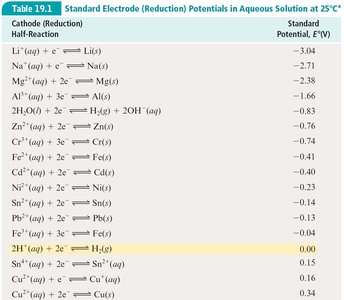
Comparing Oxidizing and Reducing Agents
The strongest oxidizing agents are found at the top left of the SRP table (most positive E° values).
The strongest reducing agents are found at the bottom right of the SRP table (most negative E° values).
Spontaneous redox reactions occur when the oxidizing agent has a higher (more positive) E° than the reducing agent.
Predicting Spontaneity and Calculating Cell Potentials
Determining Spontaneity
To predict if a reaction is spontaneous under standard conditions:
Identify the oxidizing and reducing agents in the reaction.
Find their standard reduction potentials in the table.
If the oxidizing agent (being reduced) has a more positive E°, the reaction is spontaneous as written.
For a spontaneous voltaic cell, is positive.
Calculating Standard Cell Potentials
To calculate the standard cell potential for a cell:
Write the two half-reactions and their standard reduction potentials.
Assign the more positive E° as the cathode (reduction), the less positive as the anode (oxidation).
Use .
Example: For a Cu2+/Cu and Zn2+/Zn cell:
Cu2+(aq) + 2e− → Cu(s) E° = +0.34 V
Zn2+(aq) + 2e− → Zn(s) E° = −0.76 V
V
Summary Table: Standard Reduction Potentials (Selected)
Cathode (Reduction) | Standard Potential, E° (V) |
|---|---|
F2(g) + 2e− → 2F−(aq) | 2.87 |
Cl2(g) + 2e− → 2Cl−(aq) | 1.36 |
Ag+(aq) + e− → Ag(s) | 0.80 |
Cu2+(aq) + 2e− → Cu(s) | 0.34 |
2H+(aq) + 2e− → H2(g) | 0.00 |
Zn2+(aq) + 2e− → Zn(s) | −0.76 |
Na+(aq) + e− → Na(s) | −2.71 |
Li+(aq) + e− → Li(s) | −3.04 |
Key Equations
Electrical work:
Cell potential:
Standard cell potential:
Summary
Electrochemical cells convert chemical energy to electrical energy (or vice versa).
Voltaic cells use spontaneous redox reactions to generate electricity.
Cell notation provides a shorthand for describing cell components and reactions.
Standard reduction potentials allow prediction of cell voltages and reaction spontaneity.
Spontaneous voltaic cells have positive cell potentials under standard conditions.
