 Back
Electron Configuration and Chemical Periodicity: Study Notes
Study Guide - Smart Notes
 Tailored notes based on your materials, expanded with key definitions, examples, and context.
Electron Configuration and Chemical Periodicity
Characteristics of Many-Electron Atoms
Understanding the behavior of electrons in atoms is fundamental to predicting chemical reactivity. The outermost electrons, known as valence electrons, are responsible for chemical interactions, while the nucleus remains shielded by inner electrons.
Valence electrons are loosely held and participate in bonding.
Core electrons are tightly held and do not participate in chemical reactions.
Electron configuration reveals the distribution of electrons and predicts chemical behavior.
Quantum Numbers and the Pauli Exclusion Principle
Each electron in an atom is described by four quantum numbers, which define its energy, position, and spin. The Pauli exclusion principle states that no two electrons in the same atom can have identical sets of quantum numbers.
Quantum numbers: n (principal), l (angular momentum), ml (magnetic), ms (spin).
Pauli exclusion principle: Maximum of two electrons per orbital, with opposite spins.
Factors Affecting Atomic Orbital Energies
Nuclear Charge and Shielding
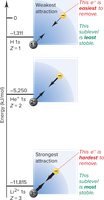
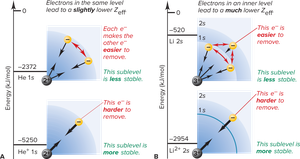
The energy of atomic orbitals is influenced by the nuclear charge (Z) and the shielding effect of other electrons. Higher nuclear charge increases attraction and lowers orbital energy, while shielding reduces the effective nuclear charge experienced by outer electrons.
Nuclear charge (Z): More protons increase attraction, lowering energy.
Shielding: Inner electrons block nuclear charge, raising energy for outer electrons.
Effective nuclear charge (Zeff): The net positive charge felt by an electron.
Penetration and Sublevel Energy
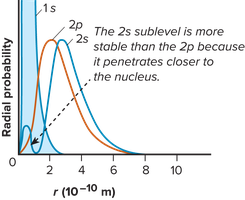
Orbital shape affects how close electrons can get to the nucleus. Greater penetration increases nuclear attraction and decreases shielding, making the sublevel more stable.
Penetration: s orbitals penetrate closer to the nucleus than p, d, or f orbitals.
Order of sublevel energies: s < p < d < f
Splitting of Levels into Sublevels
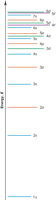
Each principal energy level (n) is split into sublevels (s, p, d, f) of differing energy due to penetration and shielding effects. Lower l values correspond to lower energy sublevels.
For a given n, s is lower in energy than p, which is lower than d, and so on.
Sublevel energies increase as n and l increase.
Electron Configurations and Orbital Diagrams
Notation and Diagrams
Electron configuration notation shows the distribution of electrons among energy levels and sublevels. Orbital diagrams visually represent electron occupancy and spin.
Notation: n (energy level), l (sublevel), superscript (number of electrons).
Orbital diagram: Boxes or lines for orbitals, arrows for electrons and their spins.
Aufbau Principle, Pauli Exclusion Principle, and Hund’s Rule
These rules govern the arrangement of electrons in orbitals:
Aufbau principle: Electrons fill the lowest energy sublevel available.
Pauli exclusion principle: Maximum two electrons per orbital, opposite spins.
Hund’s rule: Orbitals of equal energy are filled to maximize unpaired electrons with parallel spins.
Building up Periods 1 and 2
Orbital diagrams for the first ten elements illustrate how electrons fill the 1s, 2s, and 2p sublevels according to the rules above.
Hydrogen: 1s1
Helium: 1s2
Carbon: 1s2 2s2 2p2
Neon: 1s2 2s2 2p6
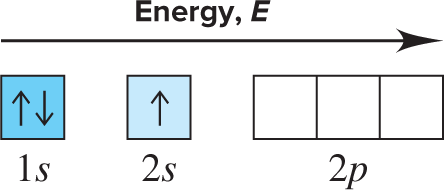
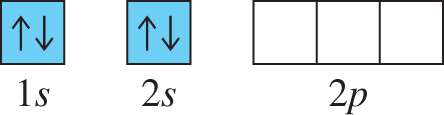
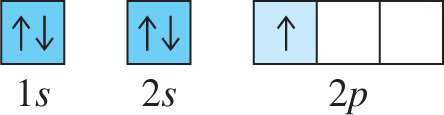
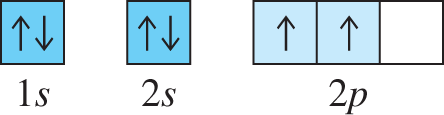
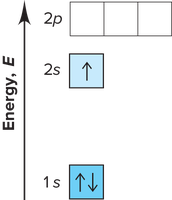
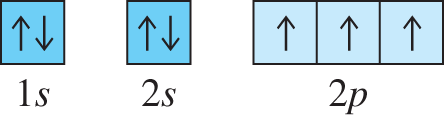
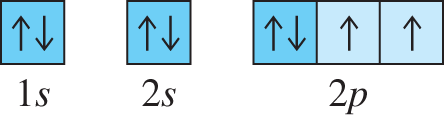
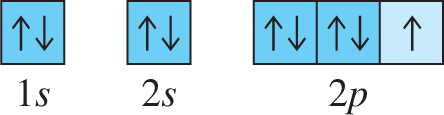
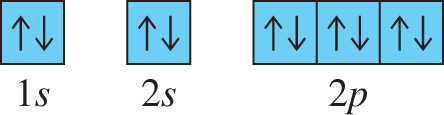
Depicting Orbital Occupancy for the First 10 Elements
Visual representations of electron configurations for the first ten elements show the filling of orbitals and the resulting atomic structure.
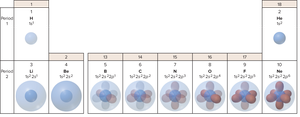
Partial Orbital Diagrams and Condensed Configurations
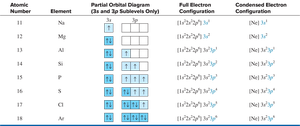
Partial diagrams focus on the highest energy sublevels being filled. Condensed configurations use the previous noble gas in brackets to simplify notation.
Example: Al: [Ne] 3s2 3p1
Electron Configuration and Group
Elements in the same group have similar outer electron configurations, leading to similar chemical properties and reactivity patterns.
Partial Orbital Diagrams and Electron Configurations for Period 3 Elements
Table of electron configurations and partial orbital diagrams for Period 3 elements illustrates the filling of 3s and 3p sublevels.
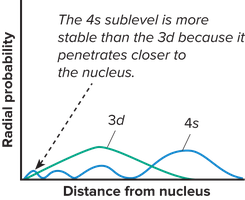
Building Up Period 4: The First Transition Series
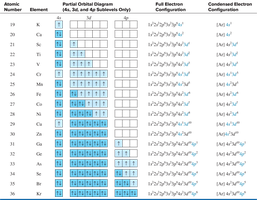
In Period 4, the 4s sublevel is filled before the 3d sublevel due to its greater penetration and lower energy.
Partial Orbital Diagrams and Electron Configurations for Period 4 Elements
Table of electron configurations and partial orbital diagrams for Period 4 elements shows the filling of 4s, 3d, and 4p sublevels.
Stability of Half-filled and Filled Sublevels
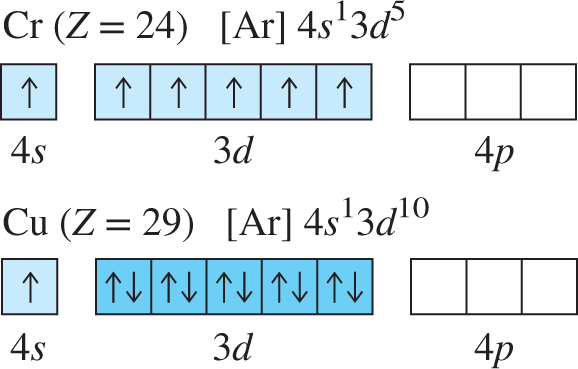
Some elements, such as chromium and copper, exhibit exceptions to expected electron configurations due to the stability of half-filled and fully filled sublevels.
Cr: [Ar] 4s1 3d5
Cu: [Ar] 4s1 3d10
Trends in Atomic Properties
Defining Atomic Size
Atomic size is measured by metallic and covalent radii. Metallic radius is half the distance between nuclei in a metal crystal, while covalent radius is half the distance between nuclei of identical, covalently bonded atoms.
Trends in Atomic Size
Atomic size increases down a group and decreases across a period due to changes in principal quantum number and effective nuclear charge.
Size increases as n increases (down a group).
Size decreases as Zeff increases (across a period).
Trends in Ionization Energy
Ionization energy is the energy required to remove an electron from an atom. It decreases down a group and increases across a period.
Atoms with low ionization energy form cations.
Atoms with high ionization energy form anions.
Successive ionization energies increase as more electrons are removed.
Trends in Electron Affinity
Electron affinity is the energy change when an atom gains an electron. Most elements release energy (negative EA) when gaining electrons, but trends are less regular than for atomic size or ionization energy.
High EA: tendency to form anions.
Low EA: tendency to form cations.
Metallic Behavior
Metals are shiny, conductive, and lose electrons easily. Nonmetals are dull, poor conductors, and gain electrons. Metalloids have intermediate properties.
Metallic behavior increases down a group and decreases across a period.
Acid-Base Behavior of Oxides
Main-group metals form basic oxides, while main-group nonmetals form acidic oxides. Amphoteric oxides can act as acids or bases.
Oxides become more basic down a group.
Oxides become more acidic across a period.
Electron Configurations of Ions
Main-Group Ions
Elements at the ends of periods gain or lose electrons to achieve a noble gas configuration, becoming isoelectronic with that noble gas.
Group 1 and 2 metals lose electrons to form cations.
Group 16 and 17 nonmetals gain electrons to form anions.
Transition Metal Ions
Transition metals lose ns electrons before (n−1)d electrons when forming cations. They often exhibit multiple oxidation states.
Paramagnetism: ions with unpaired electrons are attracted to magnetic fields.
Diamagnetism: ions with all electrons paired are slightly repelled by magnetic fields.
Ionic Size vs. Atomic Size
Cations are smaller than their parent atoms, while anions are larger. Ionic radius increases down a group and varies across a period depending on charge.
Isoelectronic series: ions with the same electron configuration but different nuclear charges.
Element | Partial Orbital Diagram | Full Electron Configuration | Condensed Electron Configuration |
|---|---|---|---|
Na | 1s2 2s2 2p6 3s1 | [Ne] 3s1 | [Ne] 3s1 |
Mg | 1s2 2s2 2p6 3s2 | [Ne] 3s2 | [Ne] 3s2 |
Al | 1s2 2s2 2p6 3s2 3p1 | [Ne] 3s2 3p1 | [Ne] 3s2 3p1 |
P | 1s2 2s2 2p6 3s2 3p3 | [Ne] 3s2 3p3 | [Ne] 3s2 3p3 |
Additional info: Table entries inferred for clarity and completeness.
