 Back
BackLesson 9.1: Electron Transfer Reactions and Oxidation–Reduction (Redox) Chemistry
Study Guide - Smart Notes
 Tailored notes based on your materials, expanded with key definitions, examples, and context.
Electron Transfer Reactions
Introduction to Redox Reactions
Many chemical reactions involve the transfer of electrons between substances. These reactions are known as oxidation–reduction reactions, or redox reactions. In a redox reaction, one substance loses electrons (is oxidized) while another gains electrons (is reduced). The process is fundamental to many chemical and biological systems, including corrosion, metabolism, and industrial processes.
Oxidation: The loss of one or more electrons by a chemical entity.
Reduction: The gain of one or more electrons by a chemical entity.
Redox Reaction: A reaction in which electrons are transferred from one entity to another.
Example: The reaction between copper metal and silver nitrate solution:
In this reaction, copper metal is oxidized to copper(II) ions, and silver ions are reduced to silver metal.
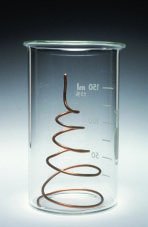

Images: (a) Copper wire before reaction; (b) After reaction, silver metal forms on the wire and the solution turns blue due to copper(II) ions.
Ionic and Net Ionic Equations
Redox reactions in aqueous solution can be represented in different ways:
Molecular Equation: Shows all reactants and products as compounds.
Total Ionic Equation: Shows all strong electrolytes as ions.
Net Ionic Equation: Shows only the species that actually change during the reaction (spectator ions are omitted).
Example:
Total ionic equation:
Net ionic equation (removing spectator ions):
Half-Reaction Equations
Redox reactions can be split into two half-reactions to show the oxidation and reduction processes separately. Each half-reaction shows either the loss or gain of electrons.
Oxidation half-reaction (copper):
Reduction half-reaction (silver):
To balance the electrons, multiply the reduction half-reaction by 2:
Combining the half-reactions gives the overall balanced redox equation.
Mnemonic: "LEO says GER" — Losing Electrons is Oxidation, Gaining Electrons is Reduction.
Practice: Writing Half-Reactions
Given a redox reaction, you can write the oxidation and reduction half-reactions by:
Separating the equation into two parts, one for each element changing oxidation state.
Balancing atoms and charges by adding electrons as needed.
Identifying which is oxidation (loss of electrons) and which is reduction (gain of electrons).
Example:
Oxidation:
Reduction:
Oxidation Numbers
Definition and Assignment
Oxidation number (or oxidation state) is a bookkeeping tool used to keep track of electron transfer in redox reactions. It is the hypothetical charge an atom would have if all bonds to atoms of different elements were 100% ionic.
In elements: Oxidation number is 0 (e.g., , ).
In monatomic ions: Oxidation number equals the ion charge (e.g., is +1).
Fluorine: Always –1 in compounds.
Oxygen: Usually –2 (except in peroxides, where it is –1).
Hydrogen: +1 in covalent compounds (–1 in metal hydrides).
The sum of oxidation numbers in a neutral compound is 0; in a polyatomic ion, it equals the ion charge.
Assigning Oxidation Numbers: Examples
Water (): H = +1, O = –2
Carbon dioxide (): O = –2, C = +4 (since )
Nitrate ion (): O = –2, N = +5 (since )
Rule | Summary | Examples |
|---|---|---|
Element | 0 | Na(s), O2(g), Hg(l) |
Monatomic ion | Charge of ion | Na+, Cl– |
Fluorine | –1 | HF, PF3 |
Oxygen | –2 (except peroxides: –1) | H2O, CO2 (except H2O2) |
Hydrogen | +1 (except metal hydrides: –1) | H2O, NH3 (except CaH2) |
Oxidation Numbers in Redox Reactions
By assigning oxidation numbers to each atom in a reaction, you can identify which atoms are oxidized and which are reduced. The atom whose oxidation number increases is oxidized (loses electrons), and the atom whose oxidation number decreases is reduced (gains electrons).
Example: Reaction of nickel(II) oxide with carbon:
Ni: +2 (in NiO) to 0 (in Ni) — reduced
C: 0 (in C) to +2 (in CO) — oxidized
Oxidizing and Reducing Agents
Definitions
Oxidizing agent: The substance that gains electrons (is reduced) and causes oxidation of another substance.
Reducing agent: The substance that loses electrons (is oxidized) and causes reduction of another substance.
In the synthesis of water:
H2 is the reducing agent (oxidized from 0 to +1).
O2 is the oxidizing agent (reduced from 0 to –2).
Oxidizing Agent | Reducing Agent |
|---|---|
Causes oxidation | Causes reduction |
Gains electrons | Loses electrons |
Is reduced | Is oxidized |
Summary of Key Concepts
Redox reactions involve the transfer of electrons between substances.
Oxidation is the loss of electrons; reduction is the gain of electrons.
Oxidation numbers help track electron transfer in reactions.
Oxidizing agents are reduced; reducing agents are oxidized.
Half-reactions clarify the electron transfer process in redox reactions.
