 Back
Electronegativity and Bond Polarity
Study Guide - Smart Notes
 Tailored notes based on your materials, expanded with key definitions, examples, and context.
Electronegativity and Bond Polarity
Introduction to Electronegativity
Electronegativity is a fundamental concept in chemistry that describes the ability of an atom to attract shared electrons in a covalent bond. Understanding electronegativity helps predict bond types and molecular polarity, which are crucial for explaining chemical behavior and reactivity.
Electronegativity (EN): The tendency of an atom in a molecule to attract the shared pair of electrons towards itself.
Trend: Electronegativity generally increases across a period (left to right) and decreases down a group (top to bottom) in the periodic table.
Most Electronegative Element: Fluorine (F) is the most electronegative element.
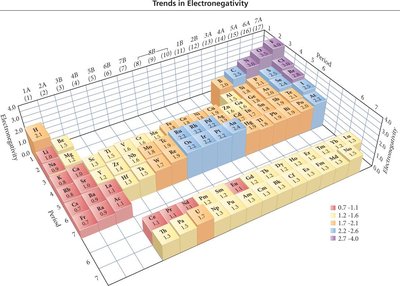
Bond Polarity and Types of Bonds
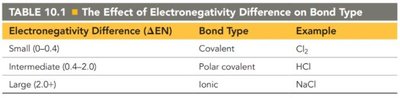
The difference in electronegativity between two bonded atoms determines the type of bond formed. Bonds can be classified as pure covalent, polar covalent, or ionic based on the magnitude of the electronegativity difference (ΔEN).
Pure Covalent Bond: Equal sharing of electrons between atoms with identical or very similar electronegativities (ΔEN ≈ 0).
Polar Covalent Bond: Unequal sharing of electrons between atoms with moderate differences in electronegativity (0.4 < ΔEN < 2.0).
Ionic Bond: Complete transfer of electrons from one atom to another, typically between atoms with large differences in electronegativity (ΔEN > 2.0).
Electronegativity Difference (ΔEN) | Bond Type | Example |
|---|---|---|
Small (0–0.4) | Covalent | Cl2 |
Intermediate (0.4–2.0) | Polar covalent | HCl |
Large (2.0+) | Ionic | NaCl |
Arranging Elements by Electronegativity
To arrange elements in order of decreasing electronegativity, compare their positions in the periodic table and their respective electronegativity values.
Example: Arrange P, Na, N, and Al in order of decreasing EN.
Order: N > P > Al > Na
Reasoning: Nitrogen (N) is further right and higher up in the periodic table, making it the most electronegative among the four. Sodium (Na), being an alkali metal, is the least electronegative.
Determining Bond Type from Electronegativity Difference
Calculate the difference in electronegativity (ΔEN) between two atoms to predict the bond type:
Sr and F: ΔEN = 4.0 – 1.0 = 3.0 (Ionic)
N and Cl: ΔEN = 3.0 – 3.0 = 0 (Pure covalent)
N and O: ΔEN = 3.5 – 3.0 = 0.5 (Polar covalent)
I and I: ΔEN = 0 (Pure covalent)
Cs and Br: ΔEN = 2.8 – 0.7 = 2.1 (Ionic)
P and O: ΔEN = 3.5 – 2.1 = 1.4 (Polar covalent)
General Formula:
Summary Table: Electronegativity Difference and Bond Type
ΔEN | Bond Type | Example |
|---|---|---|
0 | Pure Covalent | I2, N2 |
0.4–2.0 | Polar Covalent | HCl, P–O |
>2.0 | Ionic | NaCl, SrF2 |
Key Takeaways
Electronegativity is a periodic property that influences bond polarity and type.
The greater the difference in electronegativity, the more polar (or ionic) the bond.
Understanding these trends is essential for predicting molecular properties and reactivity.
