 Back
Electronic Structure and Periodic Properties of Elements: Study Notes
Study Guide - Smart Notes
 Tailored notes based on your materials, expanded with key definitions, examples, and context.
Electronic Structure and Periodic Properties of Elements
Nature of Light
Light is a fundamental concept in chemistry, crucial for understanding atomic structure and behavior. Historically, scientists debated whether light was a particle or a wave, leading to the modern concept of wave-particle duality.
Isaac Newton (1660): Proposed light as streams of tiny particles.
Thomas Young (1801): Demonstrated interference patterns, supporting the wave theory.
James Clerk Maxwell (1865): Described light as electromagnetic waves.
Albert Einstein (1905): Introduced wave-particle duality, connecting particles and waves.
Properties of Waves
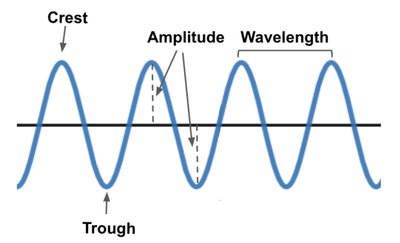
Waves are oscillations that transport energy without transporting matter. Key properties include wavelength, frequency, and amplitude.
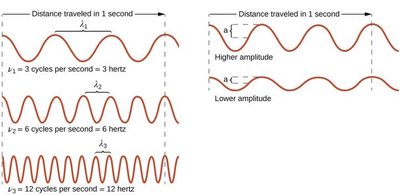
Wavelength (\(\lambda\)): The distance between two consecutive peaks or troughs.
Frequency (\(\nu\)): The number of wavelengths passing a point per unit time (measured in Hertz, Hz).
Amplitude: One-half the distance between the peak and trough, indicating the wave's energy.
Electromagnetic Radiation
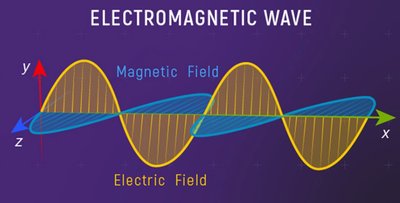
Electromagnetic waves consist of oscillating electric and magnetic fields perpendicular to each other and to the direction of travel. All electromagnetic radiation travels at the speed of light in a vacuum:
Speed of light: \(c = 3.00 \times 10^8\) m/s
Relationship: \(c = \lambda \nu\)
Wavelength and Frequency Units
Wavelength is measured in meters (m), while frequency is measured in Hertz (Hz), or cycles per second (s-1).
Equation:
The Photoelectric Effect
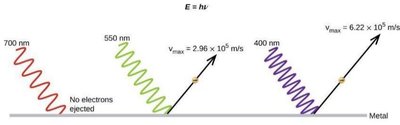
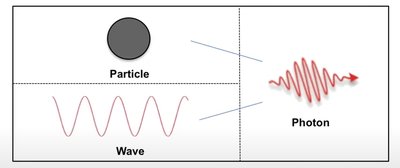
The photoelectric effect is the emission of electrons from a metal surface when exposed to light of sufficient frequency. The kinetic energy of ejected electrons depends on the light's frequency, not its brightness.
Einstein's explanation: Light consists of particles called photons.
Energy of a photon:
Planck's constant: J·s
Electromagnetic Spectrum
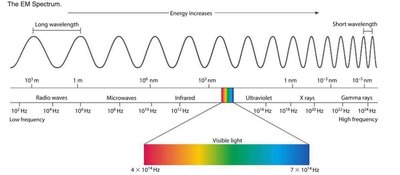
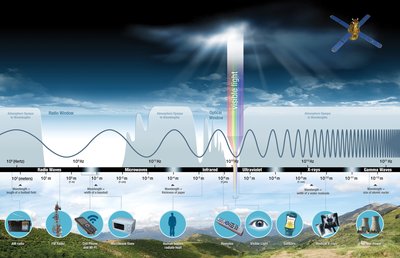
The electromagnetic spectrum encompasses all types of electromagnetic radiation, from radio waves to gamma rays. Visible light is a small portion of this spectrum.
Long wavelength: Low frequency, low energy (e.g., radio waves)
Short wavelength: High frequency, high energy (e.g., gamma rays)
Visible Light and Color
Visible light ranges from approximately 400 nm (violet) to 700 nm (red). The color observed depends on the wavelength and frequency.
Violet: Highest frequency, highest energy
Red: Lowest frequency, lowest energy
Continuous and Line Spectra
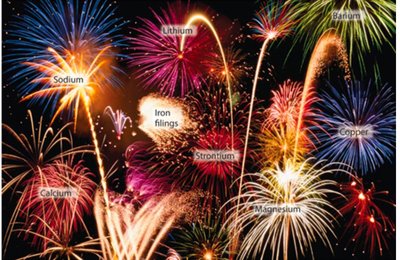
White light produces a continuous spectrum, containing all visible wavelengths. Excited atoms emit light at specific wavelengths, resulting in line spectra unique to each element.
Continuous spectrum: All wavelengths present
Line spectrum: Discrete wavelengths, characteristic of elements
Atomic fingerprint: Each element's line spectrum is unique
Bohr Model and Energy Levels
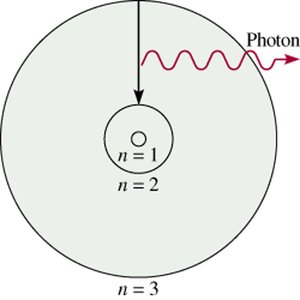
The Bohr model describes electrons as occupying quantized energy levels. Electrons absorb energy to move to higher levels and emit energy when returning to lower levels.
Energy change:
Photon emission: Occurs when electrons drop to lower energy levels
Wave-Particle Duality and Quantum Theory
Electrons, like light, exhibit both particle and wave properties. Louis de Broglie proposed that electrons are standing waves, and only certain wavelengths fit in an orbit, explaining quantization.
de Broglie wavelength:
Schrödinger equation: Describes electrons as three-dimensional stationary waves
Quantum Mechanical Model
The quantum mechanical model groups electrons into energy levels, sublevels (s, p, d, f), and orbitals. Each orbital can hold two electrons with opposite spins.
Principal quantum number (n): Indicates main energy level
Sublevels: s (1 orbital), p (3 orbitals), d (5 orbitals), f (7 orbitals)
Orbital: Region where electrons are likely to be found
Electron Configuration and Orbital Diagrams
Electron configuration describes how electrons are distributed among atomic orbitals. Rules for filling orbitals include the Aufbau principle, Pauli exclusion principle, and Hund’s rule.
Aufbau principle: Electrons fill lowest energy orbitals first
Pauli exclusion principle: Maximum two electrons per orbital, with opposite spins
Hund’s rule: Electrons occupy separate orbitals of the same energy before pairing
Valence Electrons and Periodic Properties
Valence electrons are those in the outermost energy level and determine chemical reactivity. Elements in the same group have the same number of valence electrons.
Valence shell: Last filled principal energy level
Core electrons: All other electrons
Electron Configurations for Ions
Ions form when atoms gain or lose electrons. Electron configurations must be adjusted accordingly.
Anions: Gain electrons
Cations: Lose electrons
Periodic Properties of Atoms
Electron configurations influence atomic properties such as reactivity, ionization energy, and atomic radius.
Group 1A (Alkali metals): Highly reactive, reactivity increases down the group
Group 2A (Alkaline earth metals): Less reactive than alkali metals
Group 7A (Halogens): Reactivity increases up the group
Group 8A (Noble gases): Very low reactivity
Atomic Size and Ionization Energy
Atomic size is measured as atomic radius. Cations are smaller, anions are larger than their neutral atoms. Ionization energy is the energy required to remove a valence electron.
Atomic radius: Increases down a group, decreases across a period
Ionization energy: Increases across a period, decreases down a group
Equation:
Successive ionization energies: Reveal stability of core electrons
