 Back
Electronic Structure of Atoms: Quantum Mechanics and Electron Configuration
Study Guide - Smart Notes
 Tailored notes based on your materials, expanded with key definitions, examples, and context.
Electronic Structure of Atoms
Wavelength, Frequency, and the Nature of Light
The study of the electronic structure of atoms begins with understanding the properties of light, which behaves as both a wave and a particle. Key characteristics include wavelength, frequency, and amplitude.
Wavelength (\( \lambda \)): The distance between consecutive crests or troughs of a wave, typically measured in meters (m) or nanometers (nm).
Frequency (\( \nu \)): The number of wave cycles that pass a given point per second, measured in Hertz (Hz).
Amplitude: The height of the wave from the origin to the crest or trough, related to the intensity of the wave.
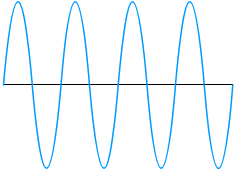
The relationship between wavelength and frequency is given by the speed of light equation:
Where c is the speed of light (\( 3.00 \times 10^8 \) m/s in a vacuum).
Wavelength and frequency are inversely proportional: as one increases, the other decreases.
The Energy of Light and Photons
Light energy is quantized in packets called photons. The energy of a photon is directly proportional to its frequency and inversely proportional to its wavelength.
Planck's Equation (Energy and Frequency):
Planck's constant (h): J·s
Energy and Wavelength:
Where E is energy (J), h is Planck's constant, c is the speed of light, and \( \lambda \) is wavelength (m).
Quantum Mechanical Model of the Atom
De Broglie Wavelength
Louis de Broglie proposed that all matter exhibits wave-like properties. The wavelength associated with a moving particle is given by the de Broglie equation:
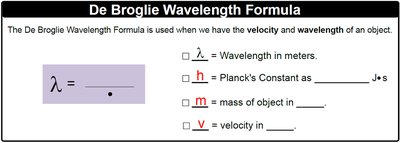
\( \lambda \): Wavelength (m)
h: Planck's constant (J·s)
m: Mass of the object (kg)
v: Velocity of the object (m/s)
This equation shows that as the mass or velocity of an object increases, its wavelength decreases.
Schrödinger Wave Equation
Erwin Schrödinger developed a mathematical equation to describe the behavior of electrons as waves in atoms. The solutions to this equation are called atomic orbitals, which describe the probability distribution of an electron's position.
The wave function (\( \psi \)) describes the probability amplitude of finding an electron in a particular region of space.
The square of the wave function (\( |\psi|^2 \)) gives the probability density.
Quantum Numbers
Quantum numbers are used to describe the unique quantum state of an electron in an atom. There are four quantum numbers:
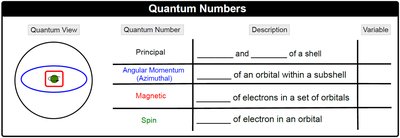
Quantum Number | Description | Symbol |
|---|---|---|
Principal | Energy level and size of the orbital | n |
Angular Momentum (Azimuthal) | Shape of the orbital | l |
Magnetic | Orientation of the orbital in space | m_l |
Spin | Spin direction of the electron | m_s |
n: Principal quantum number (1, 2, 3, ...)
l: Angular momentum quantum number (0 to n-1)
m_l: Magnetic quantum number (–l to +l)
m_s: Spin quantum number (+1/2 or –1/2)
Atomic Orbitals and Nodes
Atomic orbitals are regions in space where there is a high probability of finding an electron. Orbitals are characterized by their shapes and the presence of nodes—regions where the probability of finding an electron is zero.
Radial Nodes: Spherical regions where the probability of finding an electron is zero.
Angular Nodes: Planar or conical regions where the probability is zero.



The total number of nodes in an orbital is given by:
Number of radial nodes:
Number of angular nodes:
Summary Table: Quantum Numbers and Orbitals
Quantum Number | Symbol | Possible Values | Physical Meaning |
|---|---|---|---|
Principal | n | 1, 2, 3, ... | Energy level, size |
Angular Momentum | l | 0 to n-1 | Shape (s, p, d, f) |
Magnetic | m_l | –l to +l | Orientation |
Spin | m_s | +1/2, –1/2 | Spin direction |
Additional info: The images included above directly illustrate the concepts of wave behavior, quantum numbers, and orbital nodes, which are central to understanding the quantum mechanical model of the atom.
