 Back
BackElectronic Structure of Atoms: Quantum Theory and Electron Configurations
Study Guide - Smart Notes
 Tailored notes based on your materials, expanded with key definitions, examples, and context.
Electronic Structure of Atoms
Introduction to Electronic Structure
The electronic structure of atoms describes the arrangement and energy of electrons within an atom. Understanding this structure is essential for explaining chemical properties and behaviors. The study of electronic structure begins with the nature of electromagnetic radiation and its interaction with matter.
Waves and Electromagnetic Radiation
Nature of Electromagnetic Waves
Electromagnetic radiation travels as waves through space at the speed of light (c = 3.00 × 10⁸ m/s).
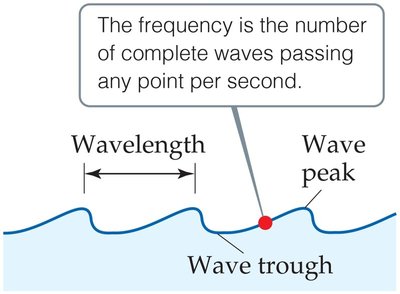
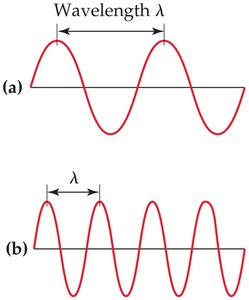
The wavelength (λ) is the distance between corresponding points on adjacent waves.
The frequency (ν) is the number of waves passing a given point per unit time.
Relationship Between Wavelength, Frequency, and Speed of Light
All electromagnetic radiation travels at the same velocity: c = λν.
As wavelength increases, frequency decreases, and vice versa.
Equation:
Electromagnetic Spectrum
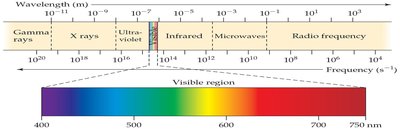
The electromagnetic spectrum includes gamma rays, X-rays, ultraviolet, visible light, infrared, microwaves, and radio waves.
Different regions correspond to different wavelengths and energies.
Units of Wavelength
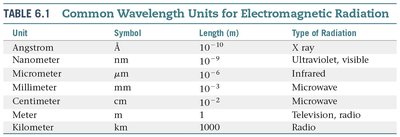
Wavelength can be measured in meters (m), nanometers (nm), angstroms (Å), and other units depending on the type of radiation.
Unit | Symbol | Length (m) | Type of Radiation |
|---|---|---|---|
Angstrom | Å | 10-10 | X ray |
Nanometer | nm | 10-9 | Ultraviolet, visible |
Micrometer | μm | 10-6 | Infrared |
Millimeter | mm | 10-3 | Microwave |
Centimeter | cm | 10-2 | Microwave |
Meter | m | 1 | Television, radio |
Kilometer | km | 1000 | Radio |
Limitations of Classical Wave Theory
Phenomena Not Explained by Wave Theory
Blackbody radiation: Emission of light from hot objects.
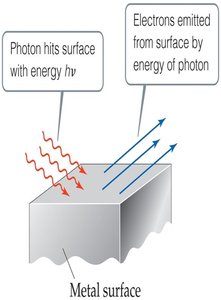
Photoelectric effect: Emission of electrons from metal surfaces when light shines on them.
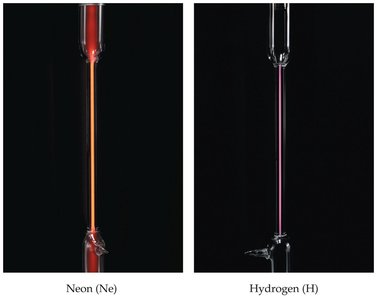
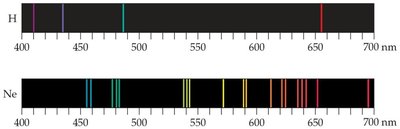
Atomic emission spectra: Emission of light from excited gas atoms, producing discrete lines.

Quantum Theory of Energy
Quantization of Energy
Max Planck proposed that energy is emitted or absorbed in discrete packets called quanta (singular: quantum).
This concept explains why energy changes are not continuous but occur in steps.

The Photoelectric Effect
Albert Einstein explained the photoelectric effect using the quantum hypothesis.
Electrons are ejected from a metal only if the incident light has a frequency above a certain threshold, regardless of intensity.
The energy of a photon is proportional to its frequency: , where is Planck's constant ( J·s).
Atomic Emission and Line Spectra
Atomic Emission Spectra
Atoms emit light at specific wavelengths, producing a line spectrum rather than a continuous spectrum.
Each element has a unique line spectrum, which can be used for identification.

The Hydrogen Spectrum and Rydberg Formula
Johann Balmer and Johannes Rydberg developed mathematical relationships for the wavelengths of hydrogen's spectral lines.
The Rydberg formula for hydrogen is:
The Bohr Model of the Atom
Key Postulates of the Bohr Model
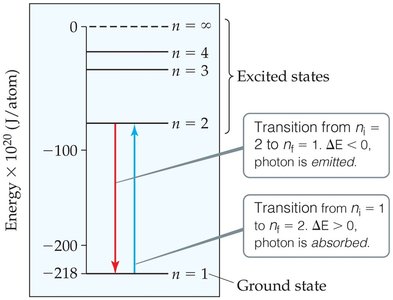
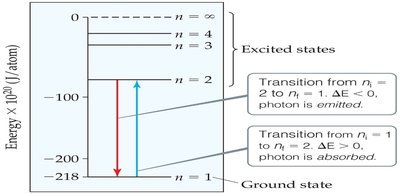
Electrons move in specific, quantized orbits around the nucleus with defined energies.
Energy is only emitted or absorbed when an electron transitions between these orbits.
The lowest energy orbit is the ground state; higher energy orbits are excited states.
Energy Transitions and Photon Emission
A positive change in energy () means energy is absorbed (electron moves to a higher level).
A negative change in energy () means energy is released (electron falls to a lower level).
The energy difference is given by:

Wave-Particle Duality and Quantum Mechanics
de Broglie Hypothesis
Louis de Broglie proposed that particles, like electrons, have wave properties.
The wavelength of a particle is given by:
Heisenberg Uncertainty Principle
It is impossible to simultaneously know both the exact position and momentum of a particle.
The uncertainty principle is expressed as:
Schrödinger Equation and Quantum Mechanics
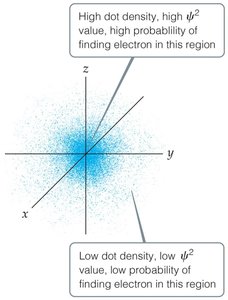
Erwin Schrödinger developed a mathematical model (wave equation) that describes the behavior of electrons as waves.
The solutions, called wave functions (ψ), describe the probability distribution of electrons.
Quantum Numbers and Atomic Orbitals
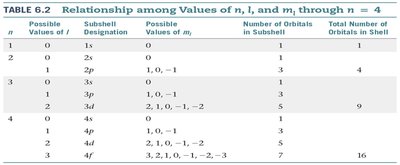
Principal Quantum Number (n)
Describes the energy level or shell of an electron.
Values: n = 1, 2, 3, ...
Angular Momentum Quantum Number (l)
Defines the shape of the orbital.
Values: l = 0 to n-1.
Letter designations: s (0), p (1), d (2), f (3).
Magnetic Quantum Number (ml)
Describes the orientation of the orbital in space.
Values: ml = -l to +l (including zero).
Spin Quantum Number (ms)
Describes the spin of the electron.
Values: +½ or –½.
Summary Table: Quantum Numbers and Orbitals
n | l | Subshell | ml | Number of Orbitals |
|---|---|---|---|---|
1 | 0 | 1s | 0 | 1 |
2 | 0,1 | 2s, 2p | 0; -1,0,1 | 1; 3 |
3 | 0,1,2 | 3s, 3p, 3d | 0; -1,0,1; -2,-1,0,1,2 | 1; 3; 5 |
4 | 0,1,2,3 | 4s, 4p, 4d, 4f | 0; -1,0,1; -2,-1,0,1,2; -3,-2,-1,0,1,2,3 | 1; 3; 5; 7 |
Electron Configurations
Rules for Electron Configurations
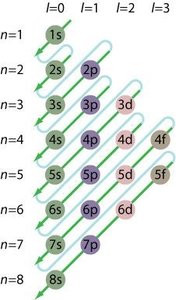
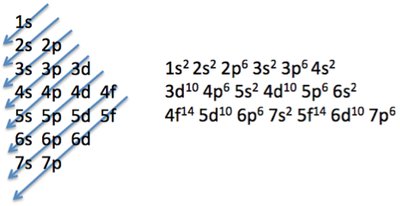
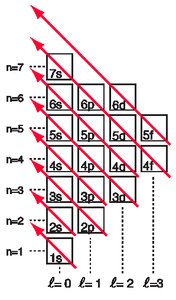
Electrons fill orbitals in order of increasing energy (Aufbau principle).
No two electrons in an atom can have the same set of four quantum numbers (Pauli exclusion principle).
Electrons occupy degenerate orbitals singly before pairing (Hund's rule).
Notation for Electron Configurations
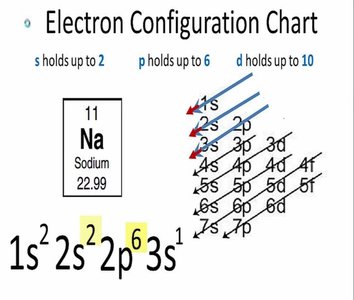
Written as: energy levelorbitalnumber of electrons
Example: 1s2 2s2 2p6 3s1 for sodium (Na).
Periodic Table and Electron Configuration
The periodic table is organized by electron configurations, with blocks corresponding to s, p, d, and f orbitals.
Transition metals and inner transition metals involve d and f orbitals, respectively.
Orbital Diagrams and Electron Spin
Orbital diagrams use boxes and arrows to represent orbitals and electron spins.
Each orbital can hold two electrons with opposite spins.
Shapes and Energies of Atomic Orbitals
s, p, d, and f Orbitals
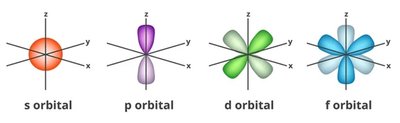
s orbitals: Spherical shape, one per energy level.
p orbitals: Dumbbell shape, three per energy level (n ≥ 2).
d orbitals: Cloverleaf shapes, five per energy level (n ≥ 3).
f orbitals: Complex shapes, seven per energy level (n ≥ 4).
Nodes in Orbitals
Nodes are regions where the probability of finding an electron is zero.
For s orbitals, the number of nodes is n – 1.
Summary Table: Maximum Electrons in Subshells
Subshell | Maximum Electrons |
|---|---|
s | 2 |
p | 6 |
d | 10 |
f | 14 |
Special Cases and Anomalies
Transition Metals and Exceptions
Some elements, such as chromium and copper, have electron configurations that differ from the expected order due to stability associated with half-filled or fully filled subshells.
Example: Chromium is [Ar] 4s1 3d5 instead of [Ar] 4s2 3d4.
Condensed Electron Configurations
Core electrons are represented by the symbol of the preceding noble gas in brackets.
Valence electrons are written explicitly.
Example: [Ne] 3s2 3p5 for chlorine.
Conclusion
The quantum mechanical model of the atom provides a comprehensive framework for understanding the arrangement and behavior of electrons. This knowledge is foundational for predicting chemical properties, bonding, and reactivity.
