 Back
Electronic Structure of Atoms: Study Guide
Study Guide - Smart Notes
 Tailored notes based on your materials, expanded with key definitions, examples, and context.
Electronic Structure of Atoms
Introduction
The electronic structure of atoms refers to the arrangement and energy of electrons within an atom. Understanding this structure is fundamental to explaining chemical properties and reactions. This chapter explores the wave nature of light, quantized energy, atomic models, and the principles governing electron configurations.
The Wave Nature of Light
Electromagnetic Radiation
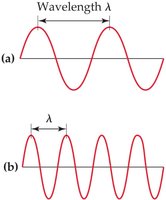
Electromagnetic radiation is energy that travels through space as waves, characterized by oscillating electric and magnetic fields. All types of electromagnetic radiation move at the speed of light, c, which is m/s.
Wavelength (\lambda): The distance between adjacent crests of a wave, measured in meters (m), centimeters (cm), or nanometers (nm).
Frequency (\nu): The number of complete waves passing a point per second, measured in Hertz (Hz), where .
Relationship:
As frequency increases, wavelength decreases, and vice versa.
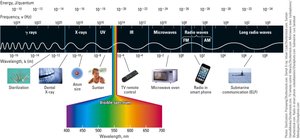
Electromagnetic Spectrum
The electromagnetic spectrum includes various types of radiation, each with distinct wavelengths and energies. Visible light is only a small portion of this spectrum.
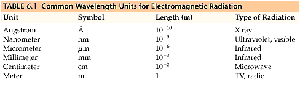
Common Wavelength Units
Different types of electromagnetic radiation are measured in different units of wavelength. The table below summarizes these units:
Unit | Symbol | Length (m) | Type of Radiation |
|---|---|---|---|
Angstrom | \AA | X-ray | |
Nanometer | nm | Ultraviolet, visible | |
Micrometer | \mu m | Infrared | |
Millimeter | mm | Infrared | |
Centimeter | cm | Microwaves | |
Meter | m | 1 | TV, radio |
Quantized Energy and Photons
Blackbody Radiation and Quanta
Classical physics could not explain why heated objects emit light (blackbody radiation). Max Planck introduced the concept of quanta, discrete packets of energy, to resolve this.
Quantum: The smallest quantity of energy that can be emitted or absorbed as electromagnetic radiation.
Planck's Equation:
Planck's constant:
The Photoelectric Effect
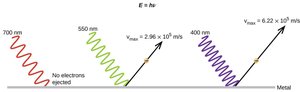
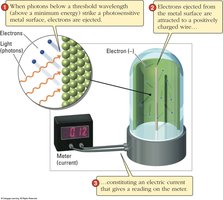
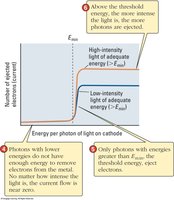
Einstein explained the photoelectric effect by proposing that light consists of photons, each carrying energy proportional to its frequency. Electrons are ejected from metal surfaces only if the photon energy exceeds a threshold.
Photon Energy:
Higher intensity light means more photons, but ejection depends on photon energy, not intensity.
For frequencies above the threshold, the kinetic energy of ejected electrons increases with photon energy.
Atomic Emission and Line Spectra
Line Spectra and the Bohr Model
Atoms emit light at specific wavelengths, producing line spectra. Niels Bohr explained this for hydrogen by proposing quantized electron orbits.
Bohr Model: Electrons orbit the nucleus in fixed energy levels, labeled by the principal quantum number n.
Energy Levels: ; ground state is , ionized state is .
Energy Transition: , where J.
Energy is absorbed (positive ) or emitted (negative $\Delta E$) as photons.
Limitations and Legacy of the Bohr Model
The Bohr model only works for hydrogen-like atoms. It introduced the concept of quantized energy levels, which is fundamental to modern atomic theory.
Electrons exist only in discrete energy levels described by quantum numbers.
Energy is involved in transitions between levels.
The Wave Behavior of Matter
de Broglie Hypothesis
Louis de Broglie proposed that matter, like light, exhibits wave properties. The wavelength of a particle is inversely proportional to its mass.
de Broglie Equation:
Heisenberg Uncertainty Principle
Werner Heisenberg showed that it is impossible to know both the position and momentum of a particle precisely. This principle is fundamental to quantum mechanics.
Uncertainty Principle:
Quantum Mechanics and Atomic Orbitals
Schrödinger Equation and Orbitals
Erwin Schrödinger developed a mathematical model (wave equation) for electrons in atoms. Solutions to this equation are called atomic orbitals, which describe the probability distribution of electrons.
The square of the wave function gives electron density.
Each orbital is defined by a set of quantum numbers.
Quantum Numbers
Quantum numbers describe the properties of atomic orbitals and electrons:
Principal Quantum Number (n): Energy level;
Angular Momentum Quantum Number (l): Orbital shape; (s), $1 (d), $3$ (f)
Magnetic Quantum Number (m_l): Orbital orientation; to
Spin Quantum Number (m_s): Electron spin; or
Orbital Shapes
s orbitals: Spherical shape,
p orbitals: Two lobes with a node,
d orbitals: Four lobes or a doughnut shape,
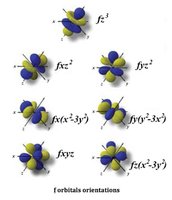
f orbitals: Complex shapes, seven orientations,
Summary Table: Quantum Numbers
Quantum Number | Symbol | Allowed Values | Property |
|---|---|---|---|
Principal | n | 1, 2, 3, ... | Energy level |
Angular Momentum | l | 0 to n-1 | Orbital shape |
Magnetic | m_l | -l to +l | Orientation |
Spin | m_s | +1/2, -1/2 | Spin direction |
Electron Configurations
Pauli Exclusion Principle
No two electrons in the same atom can have the same set of four quantum numbers. This principle ensures unique electron arrangements.
Aufbau Principle and Orbital Filling
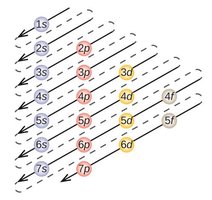
Electrons fill orbitals in order of increasing energy, following the Aufbau principle. The diagram below shows the order:
Periodic Table and Electron Configuration
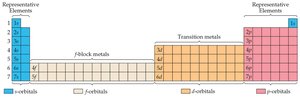
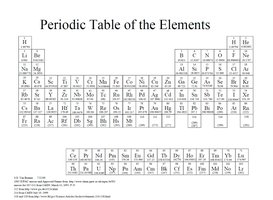
The periodic table reflects the filling of orbitals. Different blocks correspond to s, p, d, and f orbitals.
Writing Electron Configurations
Use the periodic table to determine the order of filling.
Condensed configurations use noble gas symbols for core electrons.
Valence electrons are those in the outermost shell.
Electron configurations of ions are adjusted by adding or removing electrons to achieve noble gas configurations.
Hund's Rule
When filling degenerate orbitals (same energy), electrons occupy separate orbitals with parallel spins before pairing.
Magnetism and Electron Pairing
Paramagnetism and Ferromagnetism
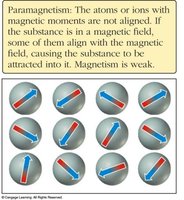
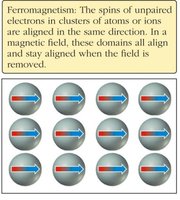
Magnetism in atoms depends on electron pairing:
Diamagnetic: All electrons paired; weakly repelled by magnetic fields.
Paramagnetic: Unpaired electrons; attracted to magnetic fields.
Ferromagnetic: Unpaired electrons in clusters align strongly; much stronger than paramagnetism.
Summary
This chapter covers the fundamental concepts of electronic structure, including the wave nature of light, quantized energy, atomic models, quantum numbers, orbital shapes, electron configurations, and magnetism. Mastery of these topics is essential for understanding chemical bonding and periodic properties.
