Back
Electronic Structure of Atoms: Study Notes for General Chemistry
Study Guide - Smart Notes
 Tailored notes based on your materials, expanded with key definitions, examples, and context.
Electronic Structure of Atoms
Introduction to Electronic Structure
The electronic structure of atoms refers to the arrangement and energy of electrons within an atom. Understanding this structure is fundamental to explaining chemical properties and reactions. The behavior of electrons is best described using concepts from both classical and quantum physics.
Waves and Electromagnetic Radiation
Nature of Waves
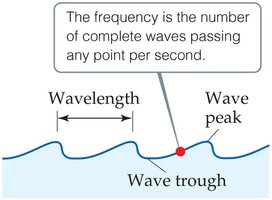
Electromagnetic radiation moves as waves through space at the speed of light. Key properties include:
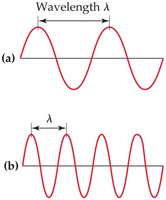
Wavelength (λ): The distance between corresponding points on adjacent waves.
Frequency (ν): The number of waves passing a given point per unit time.
For waves traveling at the same velocity, longer wavelength means lower frequency.
Electromagnetic Spectrum
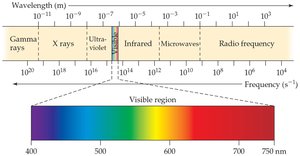
All electromagnetic radiation travels at the same velocity, the speed of light (c). The spectrum includes gamma rays, X-rays, ultraviolet, visible light, infrared, microwaves, and radio waves, each with characteristic wavelengths and frequencies.
Electronic Properties Not Explained by Waves
Phenomena Requiring Quantum Explanation
Blackbody Radiation: Emission of light from hot objects.
Photoelectric Effect: Emission of electrons from metal surfaces when illuminated.
Emission Spectra: Light emission from excited gas atoms.
The Nature of Energy and Quanta
Quantization of Energy
The wave nature of light does not explain how objects glow as temperature increases. Max Planck proposed that energy is quantized, coming in discrete packets called quanta (singular: quantum).


The Photoelectric Effect
Einstein explained the photoelectric effect using quanta. Each metal has a threshold energy for electron emission. Energy is proportional to frequency:
Equation:
h: Planck's constant
Atomic Emissions and Spectra
Emission Spectra
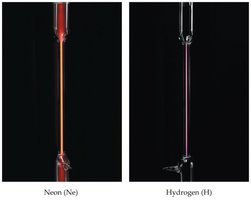
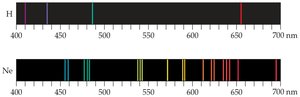
Atoms emit light at specific wavelengths, producing line spectra rather than continuous spectra. Each element has a unique line spectrum.

The Bohr Model of the Atom
Bohr Model Fundamentals
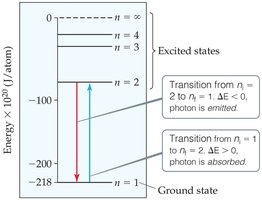
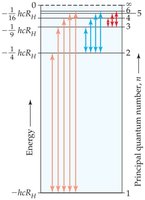
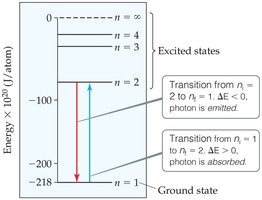
Niels Bohr proposed that electrons occupy only certain allowed orbits with specific energies. Energy is emitted or absorbed as electrons transition between these orbits, corresponding to photon emission or absorption.
Energy Levels and Transitions
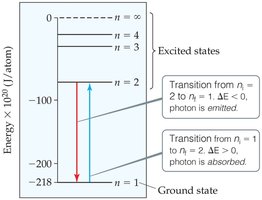
Electrons in the lowest energy state are in the ground state; higher energy states are excited states. Energy transitions can be calculated:
Positive ΔE: Energy absorbed, photon absorbed (nf > ni).
Negative ΔE: Energy released, photon emitted (nf < ni).
Limitations of the Bohr Model
The Bohr model only accurately describes hydrogen. It does not account for electron behavior in multi-electron atoms or the wave-like nature of electrons.
The Wave Nature of Matter
de Broglie Hypothesis
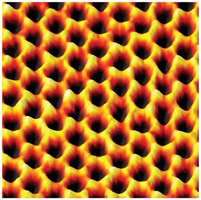
Louis de Broglie proposed that matter exhibits wave properties, with wavelength related to mass:
Equation:
The Uncertainty Principle
Heisenberg's Principle
Heisenberg showed that the more precisely the momentum of a particle is known, the less precisely its position can be known:
Equation:
Quantum Mechanics and Atomic Orbitals
Schrödinger's Wave Equation
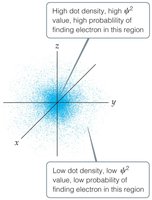
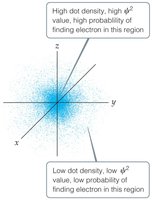
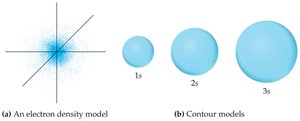
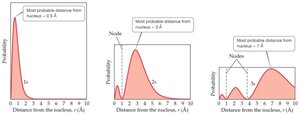
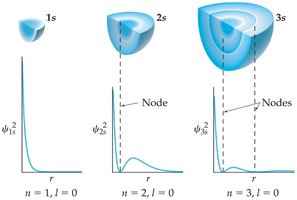
Quantum mechanics incorporates both wave and particle nature of matter. The solution to Schrödinger's equation yields wave functions, whose squares give electron density (probability of finding an electron).
Quantum Numbers
Each orbital is described by a set of three quantum numbers:
Principal Quantum Number (n): Energy level (n ≥ 1).
Angular Momentum Quantum Number (l): Shape of orbital (0 ≤ l ≤ n-1).
Magnetic Quantum Number (ml): Orientation in space (−l ≤ ml ≤ l).
Shapes and Energies of Atomic Orbitals
s Orbitals
s orbitals (l = 0) are spherical. The radius increases with n. Electron density is more spread out as n increases.
p Orbitals
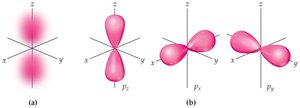
p orbitals (l = 1) have two lobes with a node between them.
d and f Orbitals
d orbitals (l = 2) have four lobes, except one which has a doughnut shape. f orbitals (l = 3) have complex shapes and seven equivalent orbitals.
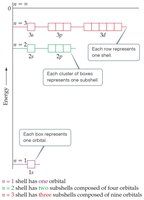
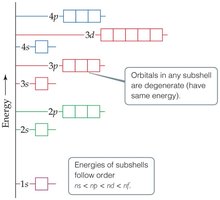
Degeneracy and Energy Levels
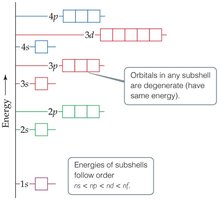
In hydrogen, orbitals on the same energy level are degenerate (same energy). In multi-electron atoms, repulsion causes energy splitting; not all orbitals on the same level are degenerate.
Spin Quantum Number and Pauli Exclusion Principle
Spin Quantum Number (ms)
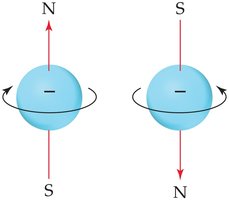
Electron spin describes its magnetic field and energy. Allowed values are +1/2 and −1/2.
Pauli Exclusion Principle
No two electrons in the same atom can have the same set of four quantum numbers (n, l, ml, ms). This ensures unique energy states for each electron.
Electron Configurations and Orbital Diagrams
Ground State Electron Configuration
Electron configuration describes the distribution of electrons in an atom. The ground state is the lowest energy arrangement. Each component includes:
Number (energy level)
Letter (type of orbital)
Superscript (number of electrons)
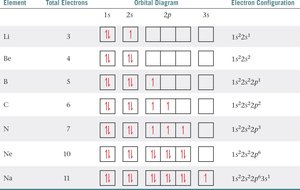
Orbital Diagrams
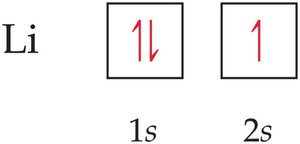
Boxes represent orbitals; arrows represent electrons and their spins.
Hund’s Rule
When filling degenerate orbitals, maximize the number of electrons with the same spin before pairing. This minimizes energy.
Element | Total Electrons | Orbital Diagram | Electron Configuration |
|---|---|---|---|
Li | 3 | 1s: ↑↓ 2s: ↑ | 1s22s1 |
Be | 4 | 1s: ↑↓ 2s: ↑↓ | 1s22s2 |
B | 5 | 1s: ↑↓ 2s: ↑↓ 2p: ↑ | 1s22s22p1 |
C | 6 | 1s: ↑↓ 2s: ↑↓ 2p: ↑ ↑ | 1s22s22p2 |
N | 7 | 1s: ↑↓ 2s: ↑↓ 2p: ↑ ↑ ↑ | 1s22s22p3 |
Ne | 10 | 1s: ↑↓ 2s: ↑↓ 2p: ↑↓ ↑↓ ↑↓ | 1s22s22p6 |
Na | 11 | 1s: ↑↓ 2s: ↑↓ 2p: ↑↓ ↑↓ ↑↓ 3s: ↑ | 1s22s22p63s1 |
Condensed Electron Configurations
Valence and Core Electrons
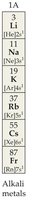
Valence electrons are in the outermost shell; core electrons are in filled inner shells. Condensed configurations use noble gas symbols in brackets for core electrons.
Transition Metals, Lanthanides, and Actinides
Transition Metals
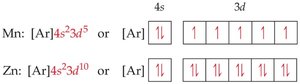
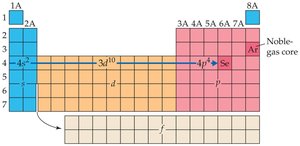
Transition metals fill 3d orbitals after 4s. Lanthanides fill 4f, actinides fill 5f orbitals.
Periodic Table and Electron Configuration
Periodic Table Blocks
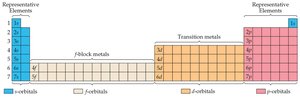
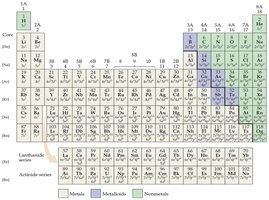
Different blocks correspond to different orbitals: s (blue), p (pink), d (orange), f (tan). The periodic table guides electron configuration for most elements.
Anomalies in Electron Configuration
Irregularities
Some elements have irregular electron configurations due to close energy levels of s and d orbitals, such as chromium. Similar anomalies occur in f-block elements.
Copyright Notice
This work is protected by copyright laws and is intended for educational use only.