 Back
Electronic Structure of Atoms: Study Notes for General Chemistry
Study Guide - Smart Notes
 Tailored notes based on your materials, expanded with key definitions, examples, and context.
Chapter 6: Electronic Structure of Atoms
6.1 The Wave Nature of Light
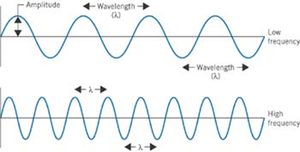
The electronic structure of atoms begins with understanding the nature of light, which exhibits both wave-like and particle-like properties. Light as an electromagnetic wave consists of oscillating electric (E) and magnetic (B) fields perpendicular to each other and to the direction of propagation. The speed of light in a vacuum is m/s. The wavelength () is the distance between two successive peaks, and the frequency () is the number of oscillations per second.
Amplitude: The height of the wave, related to the intensity of light.
Wavelength (): The distance between two consecutive peaks.
Frequency (): The number of cycles per second (Hz).
Relationship:
6.2 Photon and the Photoelectric Effect
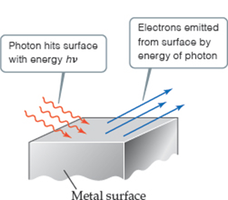
Light can also be described as a stream of photons, each carrying a quantum of energy. The energy of a photon is given by , where is Planck’s constant ( J·s). Einstein used the photon concept to explain the photoelectric effect, where electrons are ejected from a metal surface when struck by light of sufficient energy.
Photoelectric Effect: Electrons are emitted only if the photon energy exceeds a threshold specific to each metal.
Energy of Photon:
Key Point: Energy is proportional to frequency, not intensity.
6.3 Line Spectra and the Bohr Model
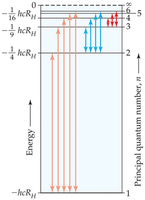
Atoms emit light as discrete wavelengths, forming a line spectrum unique to each element. The Bohr model explains these spectra for hydrogen by proposing quantized orbits for electrons.
Continuous Spectrum: Emitted by solids (e.g., incandescent lamps).
Line Spectrum: Emitted by atoms; each element has a unique pattern.
Bohr Model: Only certain orbits (energies) are allowed; electrons emit or absorb energy when transitioning between levels.
Ground State: Lowest energy level ().
Excited State: Higher energy levels ().
Energy Transition Equation:
6.4 The Wave Behavior of Matter
Louis de Broglie proposed that matter, like light, exhibits wave properties. The wavelength of a particle is inversely proportional to its mass and velocity.
de Broglie Equation:
Heisenberg Uncertainty Principle: The more precisely the momentum () of a particle is known, the less precisely its position can be known.
Uncertainty Principle Equation:
6.5 Quantum Mechanics and Atomic Orbitals
Quantum mechanics, developed by Schrödinger, describes electrons as wave functions () with quantized energy levels. The square of the wave function () gives the probability of finding an electron at a specific location.
Principal Quantum Number (): Specifies the energy level and size of the orbital.
Angular Quantum Number (): Specifies the shape of the orbital (spherical, polar, cloverleaf).
Magnetic Quantum Number (): Specifies the orientation of the orbital in space.
Quantum Number Table:
Value of l | Letter Used |
|---|---|
0 | s |
1 | p |
2 | d |
3 | f |
6.6 Representation of Orbitals
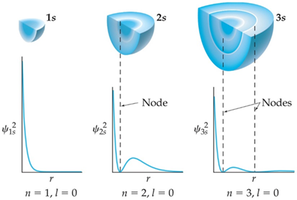
Atomic orbitals are visualized by their shapes and electron density distributions. S orbitals are spherical, and their size increases with the principal quantum number (). The number of nodes (regions of zero probability) in an s orbital is .
S Orbitals: Spherical shape, number of peaks equals , number of nodes equals .
Electron Density: As increases, electron density spreads further from the nucleus.
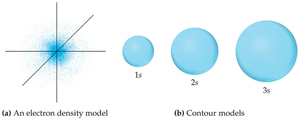
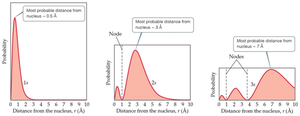
P orbitals have two lobes separated by a node at the nucleus. D orbitals have more complex shapes, typically four lobes, with one resembling a p orbital with a doughnut-shaped ring.
P Orbitals: Two lobes, node at the nucleus, .
D Orbitals: Four lobes or a doughnut shape, .
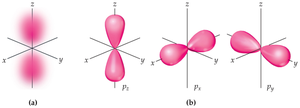
6.7 Many-Electron Atoms
In atoms with more than one electron, electron-electron repulsion causes energy levels to depend on both and . Not all orbitals with the same are degenerate (equal in energy). Orbital sets in the same sublevel (same $n$ and ) are degenerate, but energy levels can overlap (e.g., 4s is lower than 3d).
Degenerate Orbitals: Orbitals with the same energy.
Energy Overlap: Higher orbitals can be lower in energy than lower orbitals (e.g., 4s vs. 3d).
Spin Quantum Number () and Pauli Exclusion Principle
Spin Quantum Number (): Describes electron spin; allowed values are and .
Pauli Exclusion Principle: No two electrons in the same atom can have the same set of four quantum numbers (, , , ).
Maximum per Orbital: Two electrons, must have opposite spins.
6.8 Electron Configurations
Electron configuration describes the arrangement of electrons in an atom. The most stable configuration is the ground state. Orbital diagrams use lines or boxes for orbitals and arrows for electron spins. Hund’s rule states that electrons fill degenerate orbitals singly before pairing.
Notation: Number (n), letter (l), superscript (number of electrons).
Hund’s Rule: Maximize the number of unpaired electrons with the same spin in degenerate orbitals.
Condensed Configuration: Use noble gas core in brackets, list only valence electrons.
6.9 Electron Configurations and the Periodic Table
Orbitals fill in order of increasing energy, which is reflected in the structure of the periodic table. The s and p blocks are main-group elements, while d and f blocks correspond to transition metals and inner transition elements.
Periodic Table Blocks: s, p, d, f blocks correspond to types of orbitals being filled.
Lanthanides: Electrons enter 4f sublevel (atomic numbers 57–70).
Actinides: Electrons enter 5f sublevel (atomic numbers 89–103).
Irregularities: Occur when s and d orbitals are half-filled or fully filled.
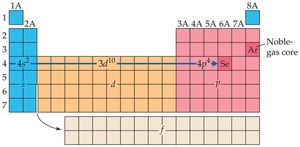
Summary Table: Quantum Numbers and Orbitals
Quantum Number | Symbol | Allowed Values | Property |
|---|---|---|---|
Principal | n | 1, 2, 3, ... | Energy level, size |
Angular | l | 0 to n-1 | Shape |
Magnetic | m_l | -l to +l | Orientation |
Spin | m_s | +1/2, -1/2 | Spin direction |
Additional info: These notes expand on brief lecture points to provide a comprehensive overview of atomic electronic structure, including quantum mechanics, orbital shapes, and periodic table relationships. All included images directly reinforce the explanations of wave nature, photoelectric effect, orbital shapes, electron density, and periodic table blocks.
