 Back
Electronic Structure of Atoms: The Wave Nature of Light and Quantum Theory
Study Guide - Smart Notes
 Tailored notes based on your materials, expanded with key definitions, examples, and context.
Electronic Structure of Atoms
Introduction to Electronic Structure
The electronic structure of atoms refers to the number and arrangement of electrons around the nucleus, as well as their energies. Understanding this structure is fundamental to explaining the chemical and physical properties of elements. Much of our knowledge about electronic structure comes from analyzing the light emitted or absorbed by substances.
The Wave Nature of Light
Electromagnetic Radiation
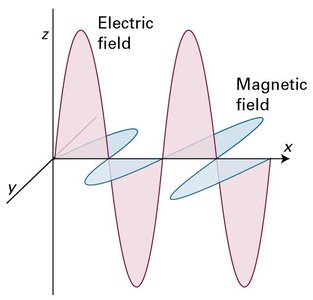
Electromagnetic radiation (light) is a form of energy that exhibits both wave-like and particle-like properties. It includes visible light, radio waves, infrared, ultraviolet, X-rays, and gamma rays. All types of electromagnetic radiation travel at the same speed in a vacuum, known as the speed of light (c), which is m/s.
Wave: A periodic disturbance that transmits energy through space.
Electromagnetic: Involves oscillating electric and magnetic fields perpendicular to each other and to the direction of propagation.
Describing Waves
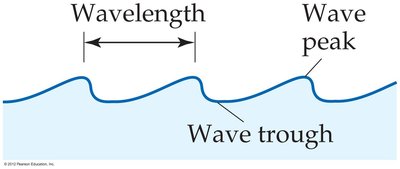
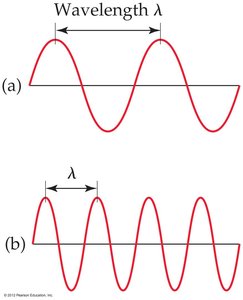
Wavelength (\(\lambda\)): The distance between corresponding points on adjacent waves (e.g., peak to peak).
Frequency (\(\nu\)): The number of waves passing a given point per unit time (measured in s-1 or Hz).
For waves traveling at the same velocity, a longer wavelength means a lower frequency.
Relationship Between Wavelength and Frequency
The speed of light relates wavelength and frequency by the equation:
Where:
\(c\) = speed of light ( m/s)
\(\lambda\) = wavelength (in meters)
\(\nu\) = frequency (in s-1)
The Electromagnetic Spectrum
The electromagnetic spectrum encompasses all types of electromagnetic radiation, from gamma rays (shortest wavelength, highest frequency) to radio waves (longest wavelength, lowest frequency). The visible region is only a small part of the spectrum.
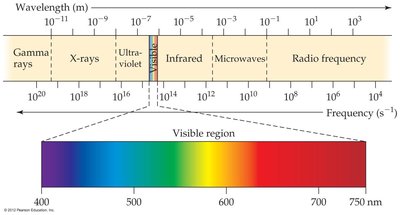
Unit | Symbol | Length (m) | Type of Radiation |
|---|---|---|---|
Angstrom | \(\text{\AA}\) | X-ray | |
Nanometer | nm | Ultraviolet, visible | |
Micrometer | \(\mu\)m | Infrared | |
Millimeter | mm | Microwave | |
Centimeter | cm | Microwave | |
Meter | m | 1 | Television, radio |
Kilometer | km | 1000 | Radio |
The Nature of Energy: Quantization and Photons
Limitations of the Wave Model
The wave model of light cannot explain certain phenomena, such as:
Why objects emit light when heated (blackbody radiation)
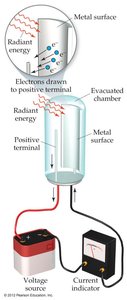
The photoelectric effect (emission of electrons from metal surfaces when light shines on them)
The emission of light from excited gas atoms (line spectra)

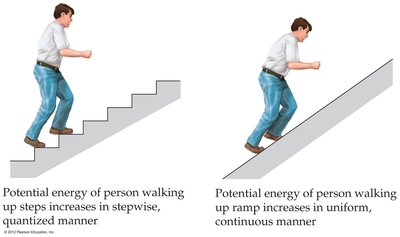
Planck's Quantum Hypothesis
Max Planck proposed that energy is quantized and can be emitted or absorbed only in discrete units called quanta. The smallest quantity of energy that can be emitted or absorbed as electromagnetic radiation is called a quantum.
Energy is proportional to frequency:
\(h\) is Planck's constant: J·s
Einstein and the Photoelectric Effect
Albert Einstein extended Planck's idea to explain the photoelectric effect. He proposed that light consists of packets of energy called photons. Each photon has energy .
Calculating Energy of a Photon
If the wavelength of light is known, the energy of a photon can be calculated using:
and
Therefore,
Atomic Spectra and the Bohr Model
Line Spectra
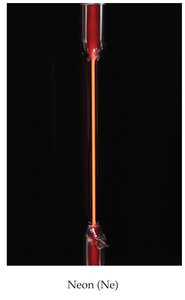
When radiation from a source is separated into its component wavelengths, a spectrum is produced. Unlike a continuous spectrum, atoms and molecules emit only certain discrete wavelengths, resulting in a line spectrum.


Bohr's Atomic Model
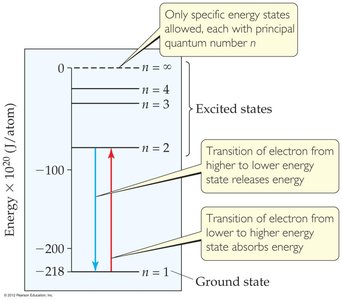
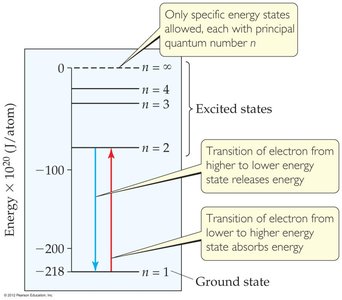
Niels Bohr explained the line spectra by proposing that:
Electrons can only occupy certain orbits with specific energies.
Electrons in permitted orbits do not radiate energy.
Energy is absorbed or emitted only when an electron moves between allowed energy states, with the energy change given by .
Energy Transitions and the Rydberg Equation
The energy absorbed or emitted during electron transitions is given by:
Where:
\(R_H\) = Rydberg constant ( m-1)
\(n_i\) = initial energy level
\(n_f\) = final energy level
The Wave Nature of Matter
de Broglie Hypothesis
Louis de Broglie proposed that matter, like light, exhibits wave properties. The wavelength of a particle is given by:
Where:
\(h\) = Planck's constant
\(m\) = mass of the particle
\(v\) = velocity of the particle

The Uncertainty Principle
Werner Heisenberg's uncertainty principle states that it is impossible to know both the exact position and momentum of a particle simultaneously:
Quantum Mechanics and Atomic Orbitals
Schrödinger Equation and Wave Functions
Erwin Schrödinger developed a mathematical model (quantum mechanics) that describes electrons as wave functions (\(\psi\)). The square of the wave function (\(\psi^2\)) gives the probability density of finding an electron at a particular location.
Quantum Numbers
Each atomic orbital is described by a set of quantum numbers:
Principal quantum number (n): Indicates the energy level (n = 1, 2, 3, ...).
Angular momentum quantum number (l): Defines the shape of the orbital (l = 0 to n-1; s, p, d, f).
Magnetic quantum number (ml): Specifies the orientation of the orbital (ml = -l to +l).
Spin quantum number (ms): Describes the spin of the electron (ms = +1/2 or -1/2).
Shapes and Energies of Orbitals
s orbitals (l = 0): Spherical shape.
p orbitals (l = 1): Dumbbell shape.
d orbitals (l = 2): Four-lobed shapes.
Pauli Exclusion Principle and Hund's Rule
Pauli Exclusion Principle: No two electrons in the same atom can have the same set of four quantum numbers. Each orbital can hold a maximum of two electrons with opposite spins.
Hund's Rule: For degenerate orbitals (same energy), the lowest energy is attained when the number of electrons with the same spin is maximized.
Electron Configurations
Writing Electron Configurations
The electron configuration of an atom describes the distribution of electrons among the various orbitals. The most stable configuration (ground state) has electrons in the lowest possible energy states.
Notation: Number (energy level), letter (type of orbital), superscript (number of electrons). Example: 1s22s22p6
Condensed notation uses the noble gas core: [Ne]3s1
Periodic Table and Electron Configuration
The periodic table is structured so that elements in the same group have similar valence electron configurations, which explains their similar chemical properties.
Exceptions and Anomalies
Some elements have electron configurations that differ from the expected order due to the stability of half-filled and fully filled subshells (e.g., chromium and copper).
Summary Table: Quantum Numbers and Orbitals
Quantum Number | Symbol | Allowed Values | Physical Meaning |
|---|---|---|---|
Principal | n | 1, 2, 3, ... | Energy level, size of orbital |
Angular Momentum | l | 0 to n-1 | Shape of orbital (s, p, d, f) |
Magnetic | ml | -l to +l | Orientation of orbital |
Spin | ms | +1/2, -1/2 | Spin direction of electron |
Additional info: This summary covers the fundamental concepts of Chapter 6: Electronic Structure of Atoms, including the wave and particle nature of light, quantization of energy, atomic spectra, quantum numbers, and electron configurations. These principles are foundational for understanding chemical bonding and periodic trends in subsequent chapters.
