 Back
BackElementary Chemical Kinetics and Reaction Rate Laws: Study Notes
Study Guide - Smart Notes
 Tailored notes based on your materials, expanded with key definitions, examples, and context.
Elementary Chemical Kinetics
Introduction to Chemical Kinetics
Chemical kinetics is the study of the rate at which chemical reactions occur and the factors that influence these rates. Understanding kinetics provides insight into reaction mechanisms and is essential for predicting how fast a reaction will proceed under various conditions.
Reaction Rate: The change in concentration of a reactant or product per unit time.
Reaction Order: The power to which the concentration of a reactant is raised in the rate law.
Rate Constant (k): A proportionality constant in the rate law, dependent on temperature and pressure.
Factors Influencing Reaction Rate
Several factors affect the rate of a chemical reaction:
Concentration of Reactants: Higher concentrations generally increase reaction rate.
Temperature: Increasing temperature usually increases reaction rate.
Pressure: For reactions involving gases, higher pressure can increase rate.
Solvent Properties: Polarity and ionic strength can affect reaction rates.
Surface Area: For solid reactants, greater surface area increases rate.
Catalysts: Catalysts lower activation energy, increasing reaction rate without being consumed.
Reaction Rate Laws
General Rate Law Expression
The rate law relates the rate of reaction to the concentrations of reactants:
General form:
Order of Reaction: The sum of exponents (a + b) gives the overall order.
Units of k: Depend on the overall order of the reaction.
Integrated Rate Laws
Integrated rate laws describe how reactant concentrations change over time for different reaction orders.
Zero Order: Rate is independent of concentration.
First Order: Rate depends linearly on concentration.
Second Order: Rate depends on the square of concentration or product of two concentrations.
Graphical Representation of Rate Laws
Zero Order: Plot of [A] vs time is linear with slope -k.
First Order: Plot of ln[A] vs time is linear with slope -k.
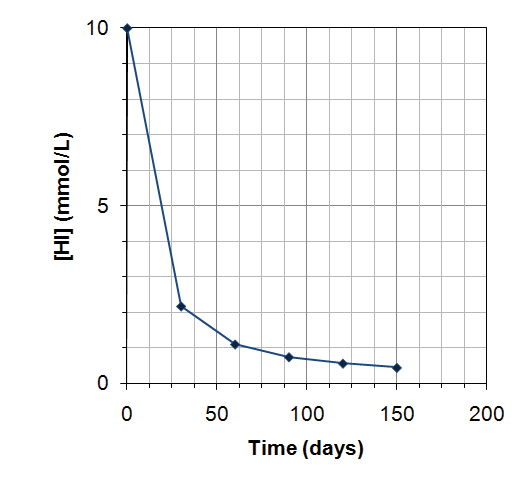
Second Order: Plot of 1/[A] vs time is linear with slope k.
![Zero order reaction: [A] vs time linear plot](https://static.studychannel.pearsonprd.tech/study_guide_files/general-chemistry/sub_images/f2b0ec17_image_16.png)
![Zero order reaction: [A] vs time linear plot with grid](https://static.studychannel.pearsonprd.tech/study_guide_files/general-chemistry/sub_images/f2b0ec17_image_17.png)
![First order reaction: [C16H21NO3] vs time non-linear plot](https://static.studychannel.pearsonprd.tech/study_guide_files/general-chemistry/sub_images/f2b0ec17_image_18.png)
![Second order reaction: [HI] vs time non-linear plot](https://static.studychannel.pearsonprd.tech/study_guide_files/general-chemistry/sub_images/f2b0ec17_image_19.png)
Half-life and Shelf-life
Definitions and Formulas
Half-life (t1/2): Time required for the concentration of a reactant to decrease by half.
Shelf-life (t0.9): Time for 10% decomposition of a pharmaceutical product.
Formulas:
Zero Order: ,
First Order: ,
Second Order: ,
Reversible Reactions
Equilibrium and Rate Constants
Reversible reactions reach equilibrium when the rate of the forward reaction equals the rate of the backward reaction.
Forward Rate:
Backward Rate:
Equilibrium Constant:
Temperature Dependence of Rate Constants
Arrhenius Equation
The Arrhenius equation describes how the rate constant (k) varies with temperature (T):
Logarithmic form:
A: Pre-exponential factor (frequency factor)
Ea: Activation energy (J/mol)
R: Gas constant (8.31 J·K-1·mol-1)
Graphical Determination of Activation Energy
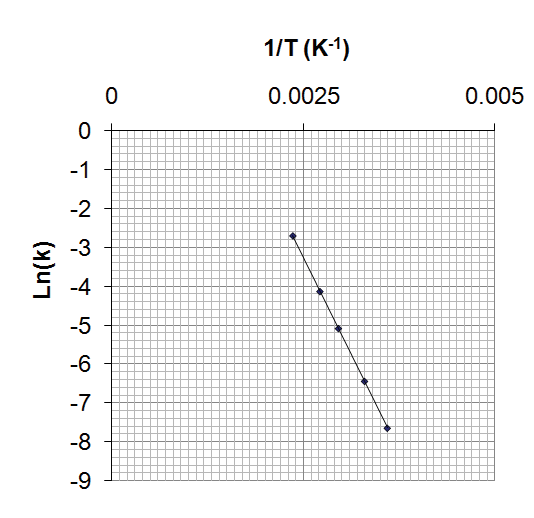
A plot of ln k vs 1/T yields a straight line with slope .
Activation energy can be calculated from the gradient of this plot.
Summary Table: Rate Laws and Integrated Rate Laws
Order | Rate Law | Integrated Rate Law | Units for k | Linear Plot | Half-life | Shelf-life |
|---|---|---|---|---|---|---|
Zero | concentration·time-1 | [A] vs time | ||||
First | time-1 | ln[A] vs time | ||||
Second | concentration-1·time-1 | 1/[A] vs time |
Applications in Pharmacy
Kinetics of Drug Release and Degradation
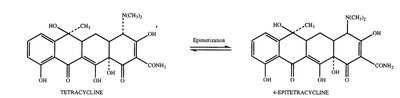
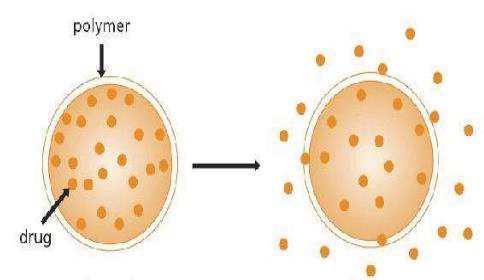
Drug release from polymers and degradation follow kinetic principles.
Understanding kinetics is crucial for determining drug shelf-life and efficacy.
Gas Constant in Kinetics
The gas constant R is used in the Arrhenius equation and other thermodynamic calculations.

Conclusion
Understanding chemical kinetics and rate laws is fundamental for predicting reaction behavior, optimizing pharmaceutical formulations, and ensuring drug stability. Mastery of these concepts enables accurate determination of reaction rates, half-lives, and shelf-lives, which are essential in both academic and practical settings.
