 Back
BackLesson 5.1: Energy Changes in Chemical and Nuclear Reactions: Thermochemistry Study Guide
Study Guide - Smart Notes
 Tailored notes based on your materials, expanded with key definitions, examples, and context.
Energy Changes in Chemical and Nuclear Reactions
The Nature of Energy
Energy is fundamental to all chemical and nuclear processes, enabling work and driving changes in matter. The study of energy changes during physical or chemical transformations is called thermochemistry. Understanding energy is crucial for addressing challenges such as sustainable fuel sources and environmental impacts.
Energy: The ability to do work; measured in joules (J).
Work: Energy transferred to an object by a force causing movement; also measured in joules (J).
Kinetic Energy: Energy of motion. Example: Spinning turbine blades.
Potential Energy: Energy due to position or composition. Example: Water behind a dam or energy stored in chemical bonds.
Chemical Bonds: Store potential energy; energy is released or absorbed during bond breaking and formation.
Example: The combustion of gasoline in an internal combustion engine releases energy, converting potential energy in chemical bonds to kinetic energy in moving gases and mechanical parts.

Additional info: This image illustrates the widespread use of fossil fuels in transportation, highlighting the need for sustainable energy solutions.
Thermal Energy, Heat, and Temperature
Thermal energy is the total quantity of kinetic and potential energy in a substance. Heat refers to the transfer of thermal energy from a warmer object to a cooler one. Temperature measures the average kinetic energy of the entities (atoms, ions, molecules) in a substance.
Thermal Energy: Increases as entities move faster; decreases as they slow down.
Heat: The process of transferring thermal energy.
Temperature: Higher temperature means higher average kinetic energy.
Example: An iceberg has more total thermal energy than a cup of hot water, despite the lower temperature, due to its much greater mass.
Law of Conservation of Energy
The law of conservation of energy states that energy cannot be created or destroyed, only converted from one form to another. This principle is essential for analyzing energy changes in chemical reactions.
Chemical System: The reactants and products being studied.
Surroundings: Everything outside the system.
Open System: Exchanges both energy and matter with surroundings.
Closed System: Exchanges energy but not matter.
Isolated System: Exchanges neither energy nor matter (idealized concept).
Example: A propane barbecue is an open system; a glow stick is a closed system.

Additional info: The barbecue image demonstrates the conversion of chemical energy in propane to thermal energy used for cooking.

Additional info: Glow sticks are examples of closed systems where energy (light) is released but matter remains contained.
Endothermic and Exothermic Reactions
Chemical reactions involve breaking and forming bonds, resulting in energy changes. These reactions are classified as exothermic or endothermic based on whether energy is released or absorbed.
Exothermic Reaction: Releases energy to surroundings; products have lower potential energy than reactants.
Endothermic Reaction: Absorbs energy from surroundings; products have higher potential energy than reactants.
Example: Combustion of methane (exothermic): Synthesis of nitric oxide (endothermic):
Nuclear Energy: Fission and Fusion
Nuclear reactions release much more energy per unit mass than chemical reactions. The two main types are fission and fusion.
Fusion: Combining nuclei of low atomic mass to form a heavier nucleus. Example: Fusion in the Sun produces helium and releases vast energy.
Fission: Splitting a nucleus of high atomic mass into smaller nuclei by collision with a neutron. Example: Fission of uranium-235 in nuclear power plants.
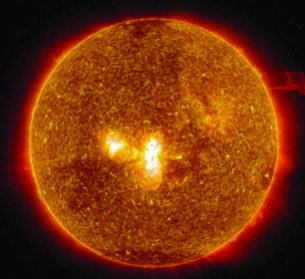
Additional info: The Sun image visually represents nuclear fusion, the process powering stars and releasing immense energy.
Comparing Energy Changes: Phase, Chemical, and Nuclear
Energy changes occur during phase changes, chemical reactions, and nuclear reactions. The magnitude of potential energy change varies greatly among these processes.
Type of Change | Example | Potential Energy Change (ΔEp) |
|---|---|---|
Phase Change | 44.0 kJ/mol | |
Chemical Change | 285.8 kJ/mol | |
Nuclear Change | 1.7 × 10⁹ kJ/mol |
Additional info: Nuclear changes release vastly more energy than chemical or phase changes.
Summary of Key Concepts
Energy is the ability to do work.
Potential energy is due to position or composition; kinetic energy is due to motion.
Thermal energy is the sum of potential and kinetic energy in a substance.
Heat is the transfer of thermal energy; temperature measures average kinetic energy.
Energy is conserved; it can be converted but not created or destroyed.
Open systems exchange energy and matter; closed systems exchange energy only.
Exothermic reactions release energy; endothermic reactions absorb energy.
Fusion combines light nuclei; fission splits heavy nuclei.
