 Back
BackEntropy and Spontaneous Processes: Visualizing Molecular Changes
Study Guide - Smart Notes
 Tailored notes based on your materials, expanded with key definitions, examples, and context.
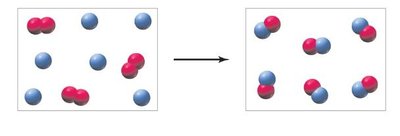
Q5a. Write a balanced equation for the reaction shown in the diagram and predict the sign of ΔS.
Background
Topic: Entropy and Molecular Changes
This question tests your ability to interpret molecular diagrams, write balanced chemical equations, and predict the sign of the entropy change (ΔS) for a reaction based on changes in molecular arrangement.
Key Terms and Formulas
Entropy (S): A measure of disorder or randomness in a system.
ΔS: The change in entropy during a process or reaction.
Balanced Equation: Represents the reactants and products with correct stoichiometry.
Step-by-Step Guidance
Examine the diagram: Count the number and types of particles before and after the reaction. Identify which are reactants and which are products.
Write the balanced chemical equation based on the molecular changes shown. For example, if red pairs (A2) react with blue singles (B) to form red-blue pairs (AB), the equation might look like: .
Consider the change in the number of molecules and their arrangement. Are you forming more complex molecules or breaking them apart?
Predict the sign of ΔS: If the reaction results in fewer molecules or more order, ΔS is likely negative. If it produces more molecules or more disorder, ΔS is likely positive.
Try solving on your own before revealing the answer!
Final Answer:
The balanced equation is . The sign of ΔS is negative because the reaction results in fewer total molecules, indicating a decrease in disorder.
We see that the number of gas particles decreases, so entropy decreases.
