 Back
BackEntropy Change During Vaporization of Methanol
Study Guide - Smart Notes
 Tailored notes based on your materials, expanded with key definitions, examples, and context.
Q4. What is the change in entropy that occurs in the system when 1.00 mol of methanol (CH3OH) vaporizes from a liquid to a gas at its boiling point (64.6°C)? For methanol, ΔHvap = 35.2 kJ/mol.
Background
Topic: Thermodynamics – Entropy Change During Phase Transitions
This question tests your understanding of how to calculate the entropy change () for a substance undergoing a phase change (liquid to gas) at its boiling point. The process is isothermal, and the heat absorbed is equal to the enthalpy of vaporization.
Key Terms and Formulas
Entropy (): A measure of disorder or randomness in a system.
Enthalpy of vaporization (): The energy required to convert 1 mole of a liquid to a gas at constant temperature and pressure.
Boiling point: The temperature at which the liquid turns into gas (here, 64.6°C).
Formula for entropy change during a phase transition:
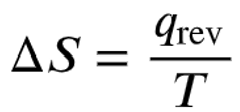
Where is the heat absorbed in a reversible process (here, ), and is the absolute temperature in Kelvin.
Step-by-Step Guidance
Convert the boiling point from Celsius to Kelvin:
Express the enthalpy of vaporization in joules (since entropy is typically in J/K):
Plug the values into the entropy change formula:
Set up the calculation with your converted values, but do not solve yet:
Try solving on your own before revealing the answer!
Final Answer: 98.2 J/mol·K
The entropy change is positive, reflecting increased disorder as methanol vaporizes.
