 Back
BackEntropy of the Surroundings & Gibbs Free Energy: Spontaneity and Temperature Dependence
Study Guide - Smart Notes
 Tailored notes based on your materials, expanded with key definitions, examples, and context.
Entropy of the Surroundings
Heat Transfer and Entropy Change
The entropy change of the surroundings (ΔSsurr) is a key factor in determining the spontaneity of chemical reactions. It is directly related to the heat exchanged with the surroundings and the temperature at which the process occurs.
Formula: , where T is in Kelvins.
Exothermic reactions (ΔHsys < 0): Surroundings gain heat, so ΔSsurr > 0.
Endothermic reactions (ΔHsys > 0): Surroundings lose heat, so ΔSsurr < 0.
Temperature dependence: At low T, ΔSsurr is large; at high T, ΔSsurr is small for the same ΔH.
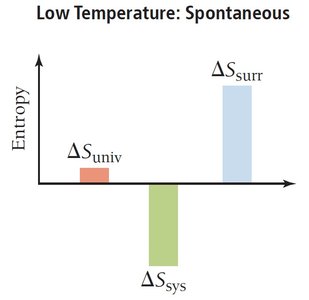
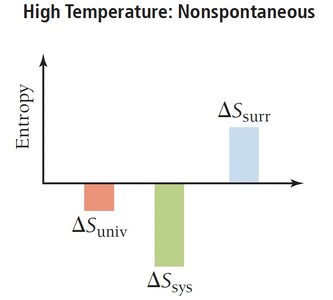
Example: When water freezes (liquid → solid), ΔSsys < 0 (system becomes more ordered), but the process is exothermic, so ΔSsurr > 0. At low temperatures, the positive ΔSsurr dominates, making the process spontaneous.
Temperature Dependence of Spontaneity
Why Phase Transitions Occur at Specific Temperatures
The spontaneity of a process depends on the balance between the entropy changes of the system and the surroundings. The sum, ΔSuniv = ΔSsys + ΔSsurr, determines whether a process is spontaneous (ΔSuniv > 0) or not.
At low temperature: ΔSsurr is large and can outweigh a negative ΔSsys, making ΔSuniv positive (spontaneous).
At high temperature: ΔSsurr is small, so a negative ΔSsys dominates, making ΔSuniv negative (nonspontaneous).
This explains why, for example, water freezes spontaneously below 0°C but not above.
Gibbs Free Energy: The Criterion for Spontaneity
Definition and Equation
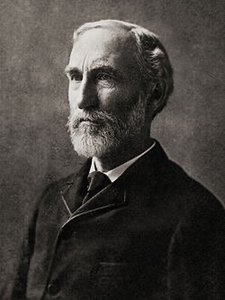
Gibbs free energy (G) is a thermodynamic function that combines enthalpy and entropy to predict the spontaneity of a process at constant temperature and pressure.
Equation:
Change in Gibbs free energy:
Relationship to the universe:
Spontaneity criterion:
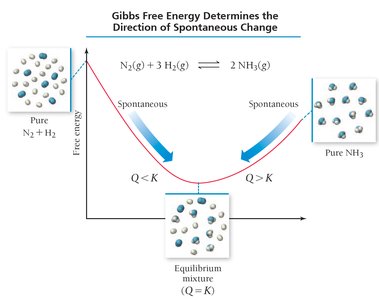
ΔG < 0: Process is spontaneous
ΔG = 0: System is at equilibrium
ΔG > 0: Process is nonspontaneous (reverse is spontaneous)
Physical meaning: |ΔG| is the maximum useful work obtainable from a process (if ΔG < 0), or the minimum work required to drive a nonspontaneous process (if ΔG > 0).
The Four Cases: How ΔH, ΔS, and T Determine Spontaneity
Classification of Reaction Spontaneity
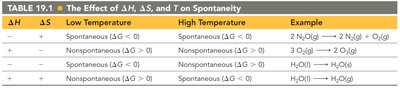
The sign of ΔH (enthalpy change) and ΔS (entropy change), along with temperature, determines whether a reaction is spontaneous.
Case 1: ΔH < 0, ΔS > 0 — Always spontaneous (ΔG < 0 at all T)
Case 2: ΔH > 0, ΔS < 0 — Never spontaneous (ΔG > 0 at all T)
Case 3: ΔH < 0, ΔS < 0 — Spontaneous at low T only
Case 4: ΔH > 0, ΔS > 0 — Spontaneous at high T only
Crossover temperature: The temperature at which ΔG changes sign is .
Practice Problems and Applications
Sample Calculations
Example 1: For the reaction 2 N2(g) + O2(g) → 2 N2O(g), ΔH°rxn = +163.2 kJ, ΔSsys = −109 J/K at 25°C.
Calculate ΔSsurr at 25°C (T = 298.15 K):
Calculate ΔSuniv:
Since ΔSuniv < 0, the reaction is NOT spontaneous at 25°C.
Example 2: For C2H4(g) + H2(g) → C2H6(g), ΔH = −137.5 kJ, ΔS = −120.5 J/K:
Case 3: Spontaneous at low T only (ΔH−, ΔS−)
Crossover T:
Example 3: Electrolysis of water (2H2O(l) → 2H2(g) + O2(g)): ΔH > 0, ΔS > 0 — Spontaneous only at high T, but requires electrical input at room temperature.
Summary Table: Effect of ΔH, ΔS, and T on Spontaneity
ΔH | ΔS | Low Temperature | High Temperature | Example |
|---|---|---|---|---|
− | + | Spontaneous (ΔG < 0) | Spontaneous (ΔG < 0) | 2 N2(g) + O2(g) → 2 N2O(g) |
+ | − | Nonspontaneous (ΔG > 0) | Nonspontaneous (ΔG > 0) | 3 O2(g) → 2 O3(g) |
− | − | Spontaneous (ΔG < 0) | Nonspontaneous (ΔG > 0) | H2O(g) → H2O(l) |
+ | + | Nonspontaneous (ΔG > 0) | Spontaneous (ΔG < 0) | H2O(l) → H2O(g) |
Key Takeaways
ΔSsurr = −ΔHsys/T: Exothermic reactions increase surroundings entropy; endothermic reactions decrease it.
ΔSsurr is larger at low T.
Gibbs free energy: ΔG = ΔH − TΔS = −TΔSuniverse; ΔG < 0 → spontaneous.
Four cases: (1) ΔH−, ΔS+: always spontaneous; (2) ΔH+, ΔS−: never spontaneous; (3) ΔH−, ΔS−: spontaneous at low T only; (4) ΔH+, ΔS+: spontaneous at high T only.
Crossover temperature: Tcrossover = ΔH/ΔS (where ΔG changes sign).
