 Back
BackEquilibria of Sparingly Soluble Salts and Lewis Acid-Base Chemistry
Study Guide - Smart Notes
 Tailored notes based on your materials, expanded with key definitions, examples, and context.
Equilibria of Sparingly Soluble Salts
Solubility and Precipitation Equilibria
The dissolution of sparingly soluble ionic compounds in water establishes a dynamic equilibrium between the solid phase and its dissociated ions in solution. This equilibrium can be represented by a chemical equation and is governed by the solubility product constant, Ksp.
Sparingly soluble compounds dissolve only to a small extent, but an equilibrium is established between the solid and its ions.
Soluble compounds dissociate completely in water.
Even 'insoluble' compounds dissolve slightly, establishing a saturated solution at equilibrium.
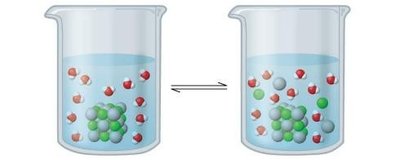
Example: The equilibrium for silver chloride is: The equilibrium constant for this process is the solubility product, .
Solubility Product Constant (Ksp)
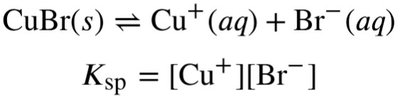
The solubility product constant (Ksp) quantifies the equilibrium between a solid and its ions in a saturated solution. It is temperature dependent and specific for each compound.
For a generic salt:
Calculating Molar Solubility from Ksp
Molar solubility is the number of moles of solute that dissolve per liter of solution to reach saturation. It can be calculated from the Ksp value using an ICE (Initial, Change, Equilibrium) table.
For : If , then
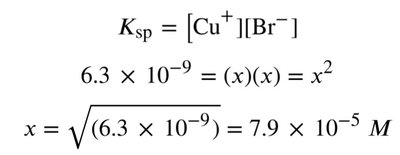
Note: Always ensure solubility is expressed in moles per liter (M) when using the Ksp expression.
Comparing Ksp and Solubility
While Ksp values are related to solubility, direct comparison is only valid for compounds that dissociate into the same number of ions. Otherwise, the relationship between Ksp and solubility is not straightforward.
Common Ion Effect
The common ion effect describes the decrease in solubility of a sparingly soluble salt when a solution already contains one of the ions present in the salt. This is an application of Le Châtelier’s Principle.
Adding a soluble salt with a common ion shifts the equilibrium to the left, decreasing solubility.
Predicting Precipitation: The Reaction Quotient (Q)
The reaction quotient (Q) is calculated using the same expression as Ksp, but with current (not necessarily equilibrium) concentrations. Comparing Q to Ksp predicts whether a precipitate will form:
If Q > Ksp: Precipitation occurs.
If Q < Ksp: No precipitate forms; solution is unsaturated.
If Q = Ksp: Solution is saturated; equilibrium exists.
Lewis Acids and Bases
Lewis Acid-Base Theory
The Lewis acid-base model expands the definition of acids and bases beyond proton transfer. A Lewis acid is an electron pair acceptor, while a Lewis base is an electron pair donor.
Lewis acid: Electron pair acceptor (often electron-deficient species or cations).
Lewis base: Electron pair donor (must have a lone pair of electrons).
A coordinate covalent bond (dative bond) forms when both electrons in the bond originate from the Lewis base.
Examples of Lewis Acid-Base Reactions
Lewis acid-base reactions result in the formation of an adduct, a compound containing a coordinate covalent bond.
Example 1: (Lewis base) donates a pair of electrons to (Lewis acid) to form .
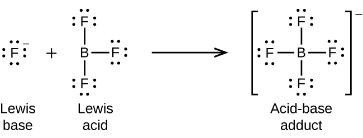
Example 2: (Lewis base) donate electron pairs to (Lewis acid) to form .
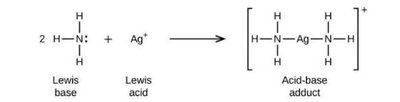
Example 3: (Lewis base) donates electron pairs to (Lewis acid) to form adduct.
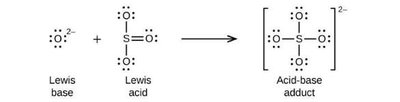
Key Features of Lewis Acid-Base Chemistry
Many Brønsted-Lowry bases are also Lewis bases, but not all Lewis acids are Brønsted-Lowry acids.
Lewis acid-base theory is especially useful for describing reactions involving metal ions and ligands, and for understanding catalysis and complex ion formation.
Summary Table: Comparison of Acid-Base Theories
Theory | Acid | Base |
|---|---|---|
Arrhenius | Produces H+ in water | Produces OH- in water |
Brønsted-Lowry | Proton donor | Proton acceptor |
Lewis | Electron pair acceptor | Electron pair donor |
Additional info: The Lewis model is the most general and encompasses the other two models as special cases.
