 Back
BackEssential Chemistry Tools and Ideas: Foundations of General Chemistry
Study Guide - Smart Notes
 Tailored notes based on your materials, expanded with key definitions, examples, and context.
Introduction to Chemistry
What is Chemistry?
Chemistry is the scientific study of the properties, composition, and behavior of matter. It is often called the "central science" because it connects and overlaps with other sciences such as biology, physics, and environmental science. Chemistry is an experimental science, relying on observation, hypothesis formation, experimentation, and the development of laws and theories.
Key Focus: Chemistry investigates the connection between the properties of matter and the behavior of atoms and molecules.
Scientific Method: Observation → Hypothesis → Experiment → Law or Theory.
Matter and Its Properties
What are Matter and Mass?
Matter is anything that takes up space and has mass. Mass is a measure of the amount of matter in a sample.
All physical objects are made of matter.
Mass is measured in units such as grams (g) or kilograms (kg).
Law of Conservation of Mass
The law of conservation of mass states that the total mass of a closed system remains constant during any process, including chemical reactions.
In a closed system, mass is neither created nor destroyed.
Example: If 1.85 g of wood burns in 9.45 g of air and produces 0.28 g of ash, the mass of gases produced is:
Basic States of Matter
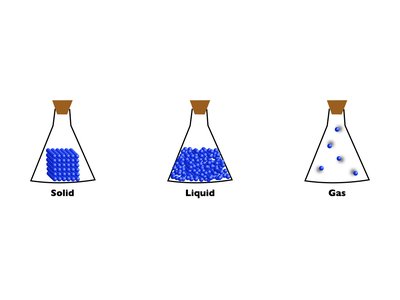
Matter exists in three primary states: solid, liquid, and gas. The state can be changed by increasing or decreasing temperature or pressure.
Solids: Definite shape and volume; particles are closely packed.
Liquids: Definite volume but no definite shape; particles are less tightly packed than in solids.
Gases: No definite shape or volume; particles are far apart and move freely.
Classification of Matter
How Can Matter Be Classified by Composition?
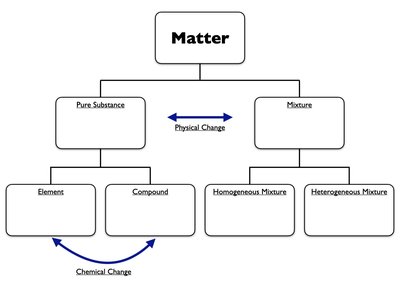
Matter can be classified as a pure substance or a mixture:
Pure Substance: Has a fixed composition and distinct properties. Can be an element (cannot be broken down further) or a compound (can be broken down into elements by chemical means).
Mixture: Consists of two or more substances physically combined. Can be homogeneous (uniform composition, also called a solution) or heterogeneous (non-uniform composition).
Physical vs. Chemical Changes
Physical Change: Alters the form or appearance of matter but does not change its composition (e.g., melting, boiling, dissolving).
Chemical Change: Alters the composition of matter, resulting in the formation of new substances (e.g., burning, rusting).
Physical vs. Chemical Properties
Physical Properties: Can be observed or measured without changing the substance's composition (e.g., color, melting point, density).
Chemical Properties: Describe a substance's ability to undergo chemical changes (e.g., flammability, reactivity with acid).
Measurement in Chemistry
Units of Measurement: SI and CGS Systems
In science, measurements are made using standardized units. The two main systems are:
SI (mks) Units: Used extensively in science (meter, kilogram, second).
CGS Units: Used more often in some fields (centimeter, gram, second).
SI Base and Derived Units
Base Units: Fundamental quantities such as mass (kilogram, kg), length (meter, m), time (second, s), temperature (kelvin, K), amount of substance (mole, mol), and electric current (ampere, A).
Derived Units: Combinations of base units (e.g., volume in cubic meters, m3; density in kg/m3).
Scientific Notation and SI Prefixes
Expressing Numbers Using Scientific Notation
Scientific notation is used to express very large or very small numbers in the form , where and is an integer.
Move the decimal point until the number is between 1 and 10.
Multiply by 10 raised to the appropriate power.
Example: 93,000,000 mi = mi; 0.000000486 m = m.
SI Prefixes
SI prefixes are used to represent powers of 10 for units in scientific notation.
Prefix | Symbol | Definition |
|---|---|---|
Mega- | M | |
Kilo- | k | |
Centi- | c | |
Milli- | m | |
Micro- | μ | |
Nano- | n | |
Pico- | p |
Example: 139 cm = 1.39 m; 55.8 kJ = 55,800 J; m = 656 nm.
Significant Figures and Measurement Precision
Measured vs. Exact Numbers
Measured Numbers: Obtained by measurement; have limited precision.
Exact Numbers: Defined values or counted quantities (e.g., 1 dozen = 12, 100 cm = 1 m).
Significant Figures (Sig Figs)
Significant figures reflect the precision of a measurement. Zeros may be significant or just placeholders, depending on their position.
All nonzero digits are significant.
Zeros between nonzero digits are significant.
Leading zeros are not significant; trailing zeros may be significant depending on the presence of a decimal point.
Rounding and Calculations with Significant Figures
Multiplication/Division: Round the final answer to the same number of significant figures as the least precise measurement.
Addition/Subtraction: Round the final answer to the same number of decimal places as the least precise measurement.
For multi-step calculations, only round after the last operation.
Unit Conversion and Dimensional Analysis
Unit Conversion Techniques
Dimensional analysis (factor-label method) is used to convert between units and solve problems involving measured numbers. Always ensure the final answer has the correct units.
Example: Convert 2235 ft/s to km/hr.
Example: The average US farm occupies 435 acres. How many square kilometers is this?
Example: The space shuttle used 227,641 lb of liquid hydrogen during takeoff. If the density of liquid hydrogen is 0.07085 g/cm3, determine the volume in gallons.
Additional info: For complex conversions, break the process into steps, converting one unit at a time and using appropriate conversion factors.
