Back
BackEssential Polyatomic Ions for General Chemistry
Study Guide - Smart Notes
 Tailored notes based on your materials, expanded with key definitions, examples, and context.
Polyatomic Ions
Introduction to Polyatomic Ions
Polyatomic ions are charged species composed of two or more atoms covalently bonded, acting as a single unit in chemical reactions. Understanding their names, formulas, and charges is fundamental for predicting compound formation, writing chemical equations, and performing stoichiometric calculations in general chemistry.
Definition: A polyatomic ion is a group of atoms with an overall charge, held together by covalent bonds.
Importance: Polyatomic ions frequently appear in ionic compounds, acid-base reactions, and solution chemistry.
Notation: The charge is shown as a superscript (e.g., SO42−).
Common Polyatomic Ions
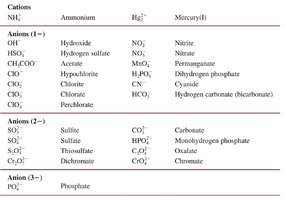
The following table summarizes the most important polyatomic ions, grouped by charge and type. Memorizing these ions is essential for success in general chemistry.
Cations | Anions (1−) | Anions (2−) | Anion (3−) |
|---|---|---|---|
NH4+ (Ammonium) Hg22+ (Mercury(I)) | OH− (Hydroxide) HSO4− (Hydrogen sulfate) CH3COO− (Acetate) ClO− (Hypochlorite) ClO2− (Chlorite) ClO3− (Chlorate) ClO4− (Perchlorate) NO2− (Nitrite) NO3− (Nitrate) MnO4− (Permanganate) H2PO4− (Dihydrogen phosphate) CN− (Cyanide) HCO3− (Hydrogen carbonate/bicarbonate) | SO32− (Sulfite) SO42− (Sulfate) S2O32− (Thiosulfate) CrO42− (Chromate) CO32− (Carbonate) HPO42− (Monohydrogen phosphate) C2O42− (Oxalate) Cr2O72− (Dichromate) | PO43− (Phosphate) |
Key Properties and Examples
Charge: Polyatomic ions can be positive (cations) or negative (anions), with charges ranging from 1− to 3−.
Compound Formation: Polyatomic ions combine with other ions to form ionic compounds, e.g., sodium sulfate (Na2SO4).
Acid-Base Chemistry: Many polyatomic ions are conjugate bases of acids, e.g., carbonate (CO32−) from carbonic acid.
Example: Naming Ionic Compounds with Polyatomic Ions
Potassium nitrate: KNO3 (contains K+ and NO3−)
Calcium phosphate: Ca3(PO4)2 (contains Ca2+ and PO43−)
Formulas and Charges
To write formulas, balance the total positive and negative charges.
Example equation for charge balance: