 Back
BackExam 2 Study Guide: Chemical Bonding, Molecular Structure, and Quantitative Chemistry
Study Guide - Smart Notes
 Tailored notes based on your materials, expanded with key definitions, examples, and context.
Chemical Bonding and Molecular Structure
Polarity of Covalent Bonds
Covalent bonds can vary in polarity depending on the difference in electronegativity between the two atoms involved. The greater the difference, the more polar the bond.
Most polar covalent bond: Typically, bonds between hydrogen and highly electronegative elements (like oxygen or fluorine) are highly polar.
Electronegativity: The tendency of an atom to attract electrons in a bond. Fluorine is the most electronegative element.
Example: The O–H bond in water is highly polar due to the large electronegativity difference between O and H.
Atomic Radius and Periodic Trends
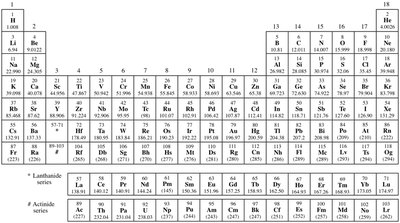
The atomic radius is the distance from the nucleus to the outermost electron shell. It generally increases down a group and decreases across a period.
Largest atomic radius: Found in elements lower in a group and further left in a period.
Example: Among halide ions, I- has the largest radius; among H, C, F, O, hydrogen has the largest radius.
Formal Charge and Hybridization
Formal charge helps determine the most stable Lewis structure for a molecule. Hybridization describes the mixing of atomic orbitals to form new hybrid orbitals suitable for bonding.
Formal charge: Calculated as:
Hybridization: Common types include sp, sp2, sp3, depending on the number of electron domains.
Example: Carbon in methane (CH4) is sp3 hybridized.
Ionization Energy and Electron Affinity
Ionization energy is the energy required to remove an electron from an atom. Electron affinity is the energy change when an atom gains an electron.
First ionization energy: Highest for noble gases and elements at the top right of the periodic table.
Most negative electron affinity: Typically found in halogens.
Electron Geometry and Molecular Geometry
Electron geometry considers all electron domains (bonding and lone pairs), while molecular geometry considers only the arrangement of atoms.
Common geometries: Linear, trigonal planar, tetrahedral, trigonal bipyramidal, octahedral.
Bond angles: Determined by geometry; e.g., tetrahedral has 109.5°.
Quantitative Chemistry and Molecular Formulas
Empirical and Molecular Formulas
The empirical formula is the simplest ratio of elements in a compound. The molecular formula is the actual number of atoms in a molecule.
Calculation: , where
Example: Ascorbic acid (Vitamin C) with empirical formula C3H4O3 and molecular weight 176.13 g/mol.
Resonance Structures
Resonance structures are alternate Lewis structures for a molecule, showing delocalized electrons. The major contributor is the most stable structure.
Formal charges: Used to identify the most stable resonance structure.
Example: Ozone (O3) has two resonance structures.
Lewis Dot Structures
Lewis structures show the arrangement of valence electrons around atoms in a molecule.
Steps: Count valence electrons, arrange atoms, assign electrons to bonds and lone pairs, check formal charges.
Example: N3- and H2COH+ structures.
Molecular Orbitals and Bonding
Molecular Orbital Diagrams
Molecular orbital theory explains bonding by combining atomic orbitals to form molecular orbitals, which can be bonding or antibonding.
Bond order:
Types of bonds: Sigma (σ) bonds are head-on overlaps; pi (π) bonds are side-on overlaps.
Stoichiometry and Chemical Quantities
Mole Calculations and Avogadro's Number
Stoichiometry involves calculating quantities of reactants and products using balanced equations and the concept of the mole.
Avogadro's number: molecules/mol
Example: Calculating molecules of caffeine consumed from Red Bull.
Combustion Analysis and Molecular Formula Determination
Combustion analysis is used to determine the empirical and molecular formula of organic compounds by measuring the amounts of CO2 and H2O produced.
Steps: Convert masses to moles, determine mole ratios, calculate empirical formula, compare to molecular weight for molecular formula.
Example: Styrene analysis for molecular formula determination.
Visual Representation of Covalent Bonding
Covalent Bonding and Stability
Covalent bonds involve the sharing of electrons between atoms, leading to stable molecules. The cartoon below humorously illustrates the concept of covalent bonding as 'codependence' and emphasizes molecular stability.
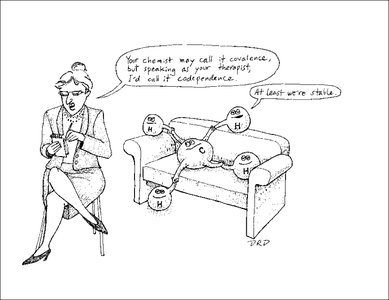 Additional info: The cartoon is a lighthearted representation of covalent bonding, reinforcing the idea that atoms share electrons to achieve stability, which is a central concept in chemical bonding.
