 Back
Exceptions to the Octet Rule, Bond Energies, and Bond Lengths
Study Guide - Smart Notes
 Tailored notes based on your materials, expanded with key definitions, examples, and context.
Exceptions to the Octet Rule
Odd-Electron Species
Certain molecules and ions possess an odd number of electrons in their Lewis structures, resulting in species known as free radicals or simply radicals. These species do not satisfy the octet rule and are typically highly reactive and unstable. For example, nitrogen monoxide (NO) is a stable molecule despite nitrogen not having a complete octet. The Lewis octet theory cannot adequately describe such cases, though they are relatively rare in chemistry.
Incomplete Octets
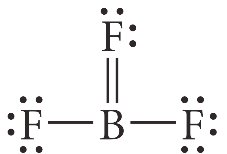
Some elements, most notably boron, frequently form compounds where the central atom has fewer than eight electrons. Examples include boron trifluoride (BF3) and borane (BH3). In these molecules, boron does not achieve an octet:
In BH3, there are no additional electrons to complete boron's octet.
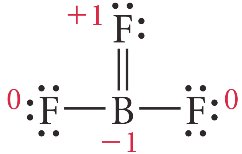
In BF3, attempting to move a lone pair from fluorine to boron would result in an unfavorable positive formal charge on fluorine, the most electronegative element.
Experimental data suggest that the B–F bond in BF3 is slightly shorter than a typical single bond, indicating some degree of delocalization or partial double bond character.
BH3 is highly reactive and tends to complete its octet through chemical reactions.
Expanded Octets
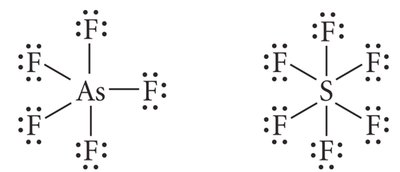
Elements in the third period (row) and beyond of the periodic table can accommodate more than eight electrons, resulting in expanded octets. This is possible because these elements have energetically accessible d orbitals that can participate in bonding. Examples include arsenic pentafluoride (AsF5) and sulfur hexafluoride (SF6):
These molecules can have up to 12 or even 14 electrons around the central atom.
For example, phosphorus in PF6− can expand its octet, but nitrogen in NF6− cannot, as nitrogen lacks accessible d orbitals (it is in the second period).
Example Question: Why does PF6− exist but not NF6−? Answer: Phosphorus (period 3) has accessible 3d orbitals for expansion, while nitrogen (period 2) does not have 2d orbitals, so it cannot expand its octet.
Bond Energies and Bond Lengths
Bond Energies
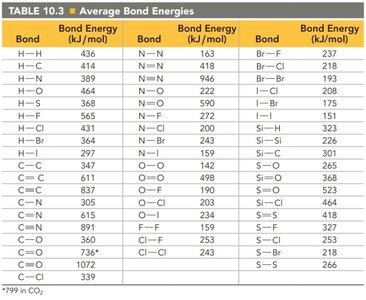
Bond energy is the energy required to break one mole of a particular type of bond in a gaseous substance. It is a measure of bond strength. The enthalpy change for a reaction can be estimated using bond energies:
Formula:
Bond energies vary depending on the atoms involved and the bond order (single, double, triple). Average bond energies for common bonds are summarized below:
Bond | Bond Energy (kJ/mol) | Bond | Bond Energy (kJ/mol) | Bond | Bond Energy (kJ/mol) |
|---|---|---|---|---|---|
H–H | 436 | N–N | 163 | Br–F | 237 |
H–N | 389 | N≡N | 946 | Br–Cl | 218 |
H–O | 464 | N–O | 201 | Br–Br | 193 |
H–F | 568 | N=O | 607 | I–Cl | 208 |
H–Cl | 431 | N–F | 272 | I–Br | 175 |
H–Br | 364 | N–Cl | 200 | I–I | 151 |
H–I | 299 | N–Br | 243 | Cl–F | 253 |
C–H | 413 | N–I | 159 | Cl–Cl | 243 |
C–C | 348 | O–O | 146 | Cl–Br | 218 |
C=C | 614 | O=O | 498 | Cl–I | 208 |
C≡C | 839 | O–F | 190 | F–F | 155 |
C–N | 305 | O–Cl | 203 | F–Cl | 253 |
C=N | 615 | O–Br | 201 | F–Br | 237 |
C≡N | 891 | O–I | 201 | S–H | 347 |
C–O | 358 | O–S | 363 | S–S | 266 |
C=O | 799* | O–Se | 276 | ||
C–F | 485 | O–Te | 200 | ||
C–Cl | 327 | ||||
C–Br | 285 | ||||
C–I | 213 |
Bond Lengths
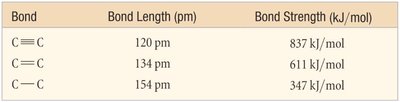
Bond length is the average distance between the nuclei of two bonded atoms. It depends on the types of atoms involved and the bond order:
For a given pair of atoms: triple bond length < double bond length < single bond length.
As bond length increases, bond strength (energy) decreases for the same pair of atoms.
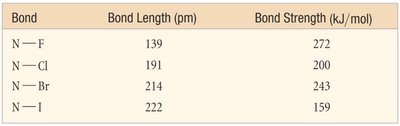
This trend does not necessarily apply when comparing bonds between different pairs of atoms.
Bond | Bond Length (pm) | Bond Strength (kJ/mol) |
|---|---|---|
C≡C | 120 | 837 |
C=C | 134 | 611 |
C–C | 154 | 347 |
Bond | Bond Length (pm) | Bond Strength (kJ/mol) |
|---|---|---|
N–F | 139 | 272 |
N–Cl | 191 | 200 |
N–Br | 214 | 243 |
N–I | 222 | 159 |
Summary Table: For a given pair of atoms, as the number of shared electron pairs increases (single → double → triple), the bond becomes shorter and stronger.
Example: The C≡C bond is shorter and stronger than the C=C bond, which is in turn shorter and stronger than the C–C bond.
Additional info: Bond energies and lengths are crucial for understanding molecular stability, reactivity, and the energetics of chemical reactions.
