 Back
Formulas and Names of Ionic, Molecular Compounds, and Acids
Study Guide - Smart Notes
 Tailored notes based on your materials, expanded with key definitions, examples, and context.
3.5 Ionic Compounds: Formulas and Names
Forming Ionic Compounds
Ionic compounds are formed from the combination of metals and nonmetals. Metals lose electrons to become cations, while nonmetals gain electrons to become anions. The resulting compound is electrically neutral, with the total positive charge balancing the total negative charge.
Key Point 1: The formula of an ionic compound reflects the smallest whole-number ratio of ions that results in a neutral compound.
Key Point 2: The metal (cation) is written first, followed by the nonmetal (anion) with its ending changed to -ide.
Example: The formula for the compound formed between lithium (Li) and fluorine (F) is LiF. Lithium forms Li+ and fluorine forms F−, so the charges balance in a 1:1 ratio.
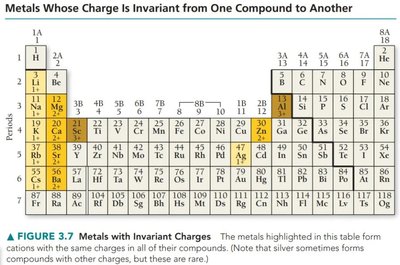
Additional info: The periodic table highlights metals whose charges are invariant (do not change) from one compound to another, simplifying the prediction of ionic formulas.
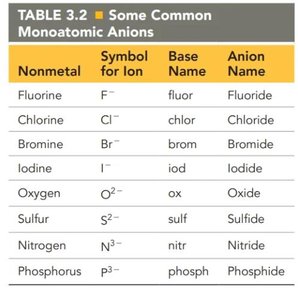
Common Monoatomic Anions
Nonmetals form anions by gaining electrons. Their names are derived from the element name with the ending changed to -ide.
Nonmetal | Symbol for Ion | Base Name | Anion Name |
|---|---|---|---|
Fluorine | F− | fluor | Fluoride |
Chlorine | Cl− | chlor | Chloride |
Bromine | Br− | brom | Bromide |
Iodine | I− | iod | Iodide |
Oxygen | O2− | ox | Oxide |
Sulfur | S2− | sulf | Sulfide |
Nitrogen | N3− | nitr | Nitride |
Phosphorus | P3− | phosph | Phosphide |
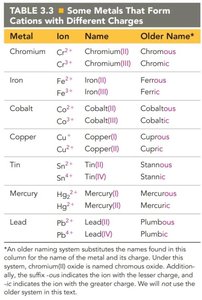
Metals That Form More Than One Kind of Cation
Some metals, especially transition metals, can form cations with different charges. Their names include a Roman numeral to indicate the charge.
Metal | Ion | Name | Older Name |
|---|---|---|---|
Chromium | Cr2+ | Chromium(II) | Chromous |
Chromium | Cr3+ | Chromium(III) | Chromic |
Iron | Fe2+ | Iron(II) | Ferrous |
Iron | Fe3+ | Iron(III) | Ferric |
Cobalt | Co2+ | Cobalt(II) | Cobaltous |
Cobalt | Co3+ | Cobalt(III) | Cobaltic |
Copper | Cu+ | Copper(I) | Cuprous |
Copper | Cu2+ | Copper(II) | Cupric |
Tin | Sn2+ | Tin(II) | Stannous |
Tin | Sn4+ | Tin(IV) | Stannic |
Mercury | Hg22+ | Mercury(I) | Mercurous |
Mercury | Hg2+ | Mercury(II) | Mercuric |
Lead | Pb2+ | Lead(II) | Plumbous |
Lead | Pb4+ | Lead(IV) | Plumbic |
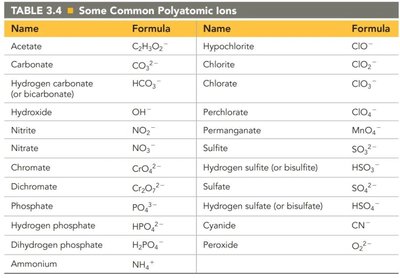
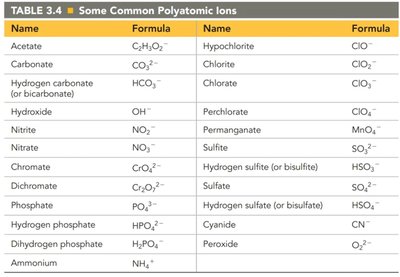
Common Polyatomic Ions
Polyatomic ions are ions composed of more than one atom. They often appear in ionic compounds and have characteristic names and formulas.
Name | Formula | Name | Formula |
|---|---|---|---|
Acetate | C2H3O2− | Hypochlorite | ClO− |
Carbonate | CO32− | Chlorite | ClO2− |
Hydrogen carbonate | HCO3− | Chlorate | ClO3− |
Hydroxide | OH− | Perchlorate | ClO4− |
Nitrite | NO2− | Permanganate | MnO4− |
Nitrate | NO3− | Sulfite | SO32− |
Chromate | CrO42− | Hydrogen sulfate | HSO4− |
Dichromate | Cr2O72− | Sulfate | SO42− |
Phosphate | PO43− | Hydrogen phosphate | HPO42− |
Dihydrogen phosphate | H2PO4− | Cyanide | CN− |
Ammonium | NH4+ | Peroxide | O22− |
3.6 Molecular Compounds: Formulas and Names
Forming Molecular Compounds
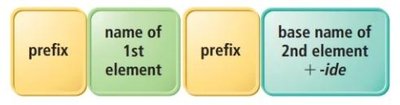
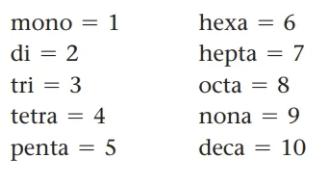
Molecular compounds are composed of two or more nonmetals. They are held together by covalent bonds, where atoms share electrons. The names of molecular compounds use prefixes to indicate the number of each type of atom present.
Key Point 1: The first element is the one with the lowest atomic number and is written first. Prefixes are used to indicate the number of atoms.
Key Point 2: The second element's name ends with -ide. If there is only one atom of the first element, the prefix "mono-" is omitted.
Example: CO2 is named carbon dioxide, and N2O is dinitrogen monoxide.
Examples of Molecular Compound Names
NO2: Nitrogen dioxide
N2O: Dinitrogen monoxide
H2O: Water (common name)
PCl5: Phosphorus pentachloride
SO3: Sulfur trioxide
CO: Carbon monoxide
CO2: Carbon dioxide
Naming Acids
Types of Acids
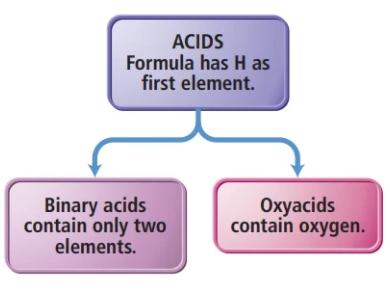
Acids are compounds that release H+ ions when dissolved in water. They are classified as binary acids (containing hydrogen and one other element) or oxyacids (containing hydrogen, oxygen, and another element).
Naming Binary Acids
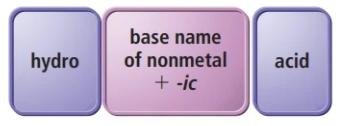
Binary acids have the general formula HX, where X is a nonmetal. Their names begin with "hydro-", followed by the base name of the nonmetal with the ending -ic, and the word "acid".
Example: HCl (aq) is named hydrochloric acid.
Naming Oxyacids
Oxyacids contain hydrogen, oxygen, and another element (usually a nonmetal). Their names are based on the name of the polyatomic ion present:
If the polyatomic ion ends in -ate, the acid name ends in -ic (e.g., HNO3 is nitric acid).
If the polyatomic ion ends in -ite, the acid name ends in -ous (e.g., HNO2 is nitrous acid).

Summary Table: Common Polyatomic Ions in Oxyacids
Additional info: Understanding the naming conventions for acids is essential for predicting the formulas and names of many important compounds in chemistry.
