 Back
BackFormulas, Nomenclature, and Stoichiometry in Inorganic Chemistry
Study Guide - Smart Notes
 Tailored notes based on your materials, expanded with key definitions, examples, and context.
Formulas and Nomenclature of Inorganic Compounds
Introduction to Inorganic Nomenclature
Inorganic chemistry involves the study and classification of compounds that do not primarily contain carbon-hydrogen bonds. A fundamental skill in general chemistry is the ability to write chemical formulas from compound names and vice versa. This process follows systematic rules established by IUPAC (International Union of Pure and Applied Chemistry).
Oxides: Compounds formed by the combination of oxygen with another element.
Hydroxides: Compounds containing the hydroxide ion (OH-).
Acids: Compounds that release hydrogen ions (H+) in solution; classified as binary (e.g., HCl) or oxoacids (e.g., H2SO4).
Salts: Ionic compounds formed from the neutralization of an acid and a base.
Example: The formula Sb2O5 corresponds to antimony(V) oxide, and H2SO4 is sulfuric acid.
Key Rules for Writing and Naming Compounds
Stock System: Indicates the oxidation state of the metal in Roman numerals (e.g., iron(III) chloride for FeCl3).
Prefixes: Used for nonmetals to indicate the number of atoms (e.g., dinitrogen pentoxide for N2O5).
Acids: The suffix changes depending on the anion (e.g., -ic for -ate, -ous for -ite).
Example: HNO3 is nitric acid (from nitrate), while HNO2 is nitrous acid (from nitrite).
Chemical Quantities and Stoichiometry
Fundamental Concepts
Stoichiometry is the branch of chemistry that deals with the quantitative relationships between reactants and products in a chemical reaction. It allows chemists to determine the proportions of elements in compounds and the amounts of substances involved in reactions.
Atomic Mass Unit (u or amu): Defined as one-twelfth the mass of a carbon-12 atom.
Relative Atomic Mass (Ar): The average mass of atoms of an element, compared to 1 u, considering isotopic abundance.
Relative Molecular Mass (Mr): The sum of the relative atomic masses of all atoms in a molecule.
Example: The relative molecular mass of water (H2O) is u.
The Mole and Avogadro's Number
The mole (mol) is the SI unit for the amount of substance. One mole contains Avogadro's number () of elementary entities (atoms, molecules, ions, etc.).
1 mol of atoms: atoms
1 mol of molecules: molecules
1 mol of ions: ions
Example: 1 mol of Na+ contains sodium ions.
Molar Mass and Calculations
Molar mass (M) is the mass of one mole of a substance, expressed in grams per mole (g/mol). It is numerically equal to the relative molecular or atomic mass but expressed in grams.
Example: The molar mass of H2O is 18 g/mol.
For elements: The molar mass of O (as atoms) is 16 g/mol, but for O2 (as molecules) it is 32 g/mol.
Molar Volume of Gases
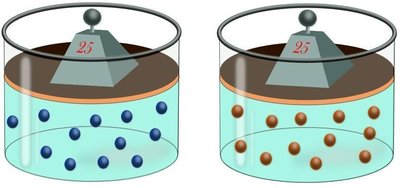
At standard temperature and pressure (STP: 0°C and 1 atm), one mole of any ideal gas occupies a volume of 22.4 liters (dm3), regardless of the gas type. This is known as the molar volume.
Avogadro's Hypothesis: Equal volumes of gases, at the same temperature and pressure, contain equal numbers of molecules.
Molar Volume at STP:
Example: 2 mol of O2 gas at STP occupy L.
Stoichiometric Calculations
Sample Calculations
Calculating Molar Mass: Add the atomic masses of all atoms in the formula.
Converting Moles to Mass:
Converting Mass to Moles:
Calculating Number of Particles:
Gas Volume at STP:
Example: To find the mass of 7.5 mol of H2O2 (molar mass = 34 g/mol):
Practice Problems and Results
Practice problems involve calculating molar masses, converting between grams, moles, and number of particles, and applying stoichiometric relationships in chemical reactions. The provided answers serve as a reference for self-assessment.
Example: 150 g of H2SO4 is approximately 1.53 mol.
Example: 90 L of Cl2O5 at STP is about 606.7 g.
Summary Table: Key Stoichiometric Quantities
Quantity | Symbol | Definition | Unit |
|---|---|---|---|
Atomic Mass Unit | u | 1/12 mass of a 12C atom | 1.661 × 10⁻²⁴ g |
Relative Atomic Mass | Ar | Average mass of element atoms relative to u | Dimensionless |
Relative Molecular Mass | Mr | Sum of atomic masses in a molecule | Dimensionless |
Mole | mol | 6.02 × 10²³ entities | mol |
Molar Mass | M | Mass of 1 mol of substance | g/mol |
Molar Volume (gas, STP) | Vm | Volume of 1 mol of gas at STP | 22.4 L |
