 Back
BackFoundations of General Chemistry: Matter, Measurement, Atoms, and Electrons
Study Guide - Smart Notes
 Tailored notes based on your materials, expanded with key definitions, examples, and context.
Chapter 1: Matter – Its Properties and Measurement
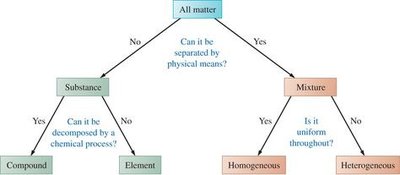
Matter and Its Classification
Matter is anything that has mass and occupies space. It can be classified based on its physical and chemical properties, as well as its composition.
Substance: A form of matter with a definite composition and distinct properties. Substances can be elements or compounds.
Mixture: A combination of two or more substances in which each retains its own identity and properties. Mixtures can be homogeneous (uniform throughout) or heterogeneous (not uniform).
Separation of Mixtures
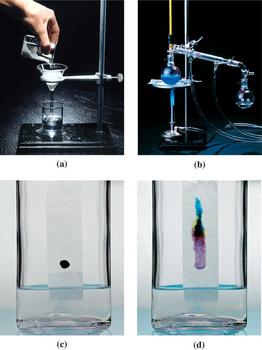
Mixtures can be separated into their components by physical means, utilizing differences in physical properties such as boiling point, solubility, or particle size.
Filtration: Separates solids from liquids.
Distillation: Separates substances based on differences in boiling points.
Chromatography: Separates components based on their movement through a medium.
SI Units and Measurement
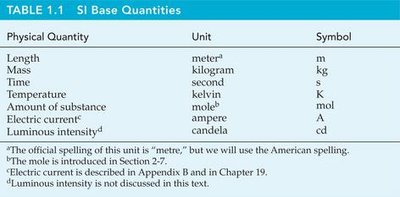
The International System of Units (SI) is the standard for scientific measurements. Each physical quantity has a base unit and symbol.
Physical Quantity | Unit | Symbol |
|---|---|---|
Length | meter | m |
Mass | kilogram | kg |
Time | second | s |
Temperature | kelvin | K |
Amount of substance | mole | mol |
Electric current | ampere | A |
Luminous intensity | candela | cd |
SI Prefixes
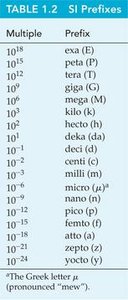
SI prefixes are used to express multiples or fractions of units, making it easier to handle very large or small numbers.
Multiple | Prefix | Symbol |
|---|---|---|
103 | kilo | k |
10-3 | milli | m |
10-6 | micro | µ |
10-9 | nano | n |
Temperature Scales
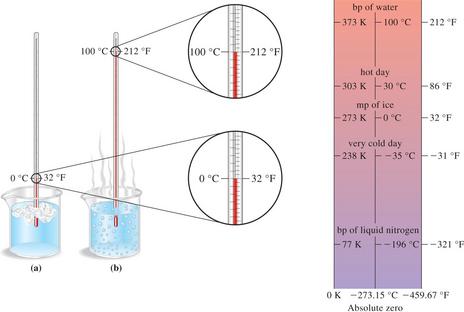
Temperature can be measured in Celsius (°C), Kelvin (K), or Fahrenheit (°F). The Kelvin scale is the SI unit for temperature and is based on absolute zero.
Conversion formulas:
Volume and Its Units
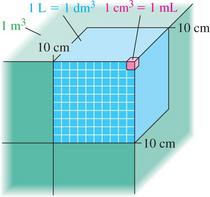
Volume is the amount of space occupied by a substance. Common units include liters (L), milliliters (mL), and cubic centimeters (cm3).
1 L = 1 dm3
1 mL = 1 cm3
Density and Percent Composition
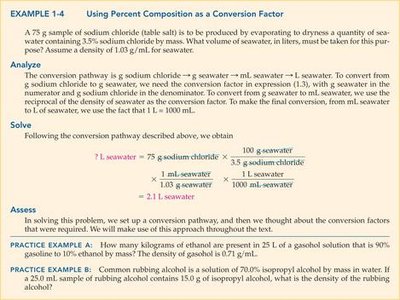
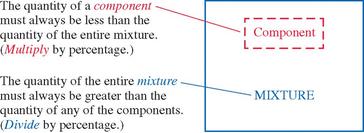
Density is an intensive property defined as mass per unit volume. Percent composition expresses the mass percentage of a component in a mixture or compound.
Density formula:
Percent composition:
Chapter 2: Atoms and the Atomic Theory
Early Discoveries and Laws
Several fundamental laws laid the groundwork for atomic theory:
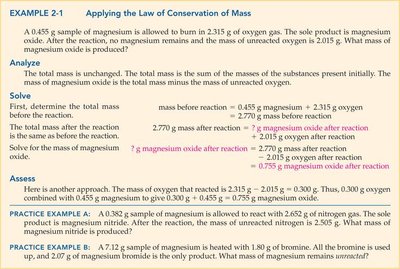
Law of Conservation of Mass (Lavoisier): Mass is neither created nor destroyed in a chemical reaction.
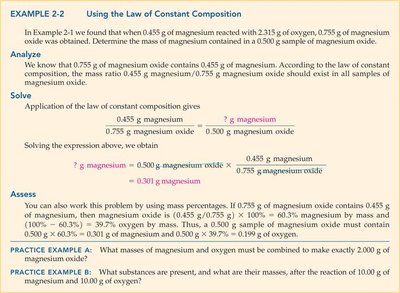
Law of Constant Composition (Proust): All samples of a compound have the same proportions by mass of the constituent elements.
Law of Multiple Proportions (Dalton): When two elements form more than one compound, the masses of one element that combine with a fixed mass of the other are in ratios of small whole numbers.
Dalton’s Atomic Theory
John Dalton proposed that matter is composed of indivisible atoms, each element consists of identical atoms, and compounds are combinations of atoms in fixed ratios.
Atoms cannot be created or destroyed in chemical reactions.
Atoms of different elements have different properties.
Discovery of Subatomic Particles
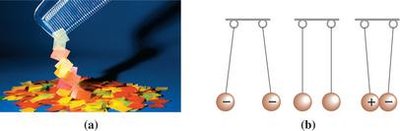
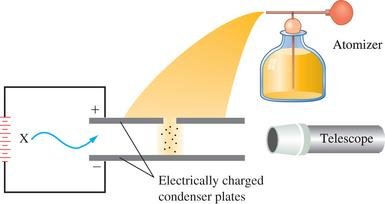
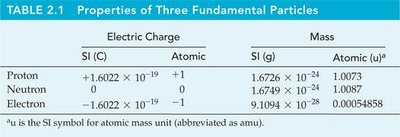
Atoms are composed of smaller particles: electrons, protons, and neutrons.
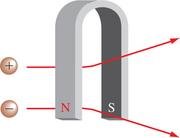
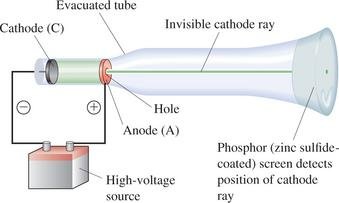
Electrons: Discovered by J.J. Thomson using cathode ray tubes.
Protons and Neutrons: Identified through experiments with atomic nuclei.
The Nuclear Atom and Radioactivity
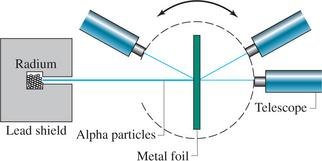
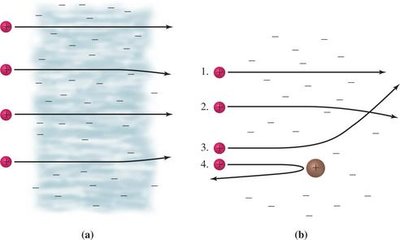
Rutherford’s gold foil experiment demonstrated that atoms have a small, dense, positively charged nucleus. Radioactivity is the spontaneous emission of particles or energy from unstable nuclei.
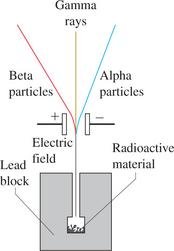
Alpha, beta, and gamma radiation: Types of radioactive emissions with different properties.
Structure of the Atom
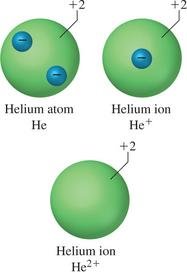
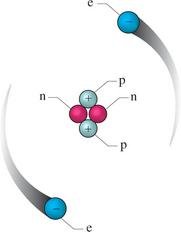
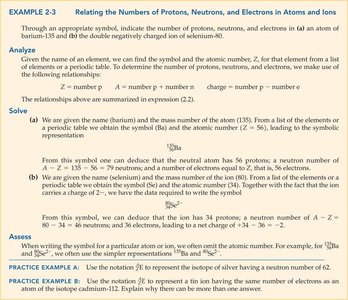
Atoms consist of a nucleus (protons and neutrons) surrounded by electrons. The number of protons defines the element (atomic number), and the sum of protons and neutrons gives the mass number.
Isotopes
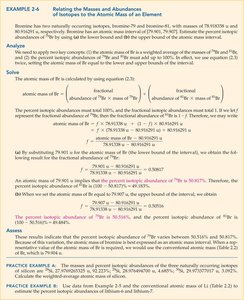
Isotopes are atoms of the same element with different numbers of neutrons, and thus different mass numbers. The percent natural abundance of an isotope is the fraction of that isotope among all atoms of the element.
Percent natural abundance formula:
Atomic Mass and Weighted Averages
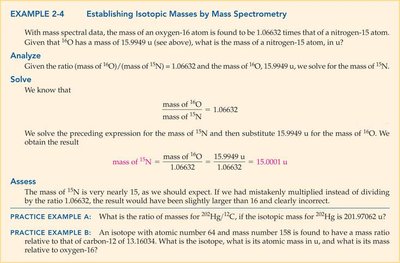
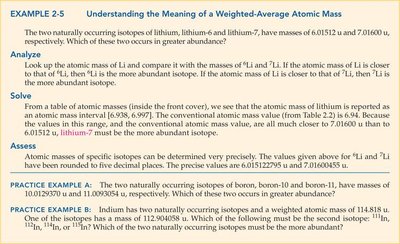
The atomic mass of an element is the weighted average of the masses of its naturally occurring isotopes.
Atomic mass unit (u or amu): Defined as 1/12 the mass of a carbon-12 atom.
Weighted average formula:
The Periodic Table
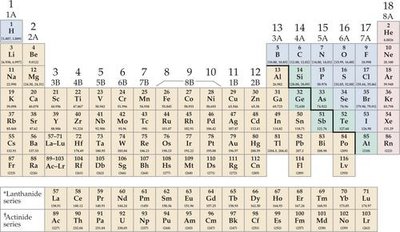
The periodic table organizes elements by increasing atomic number and similar chemical properties. Groups (columns) contain elements with similar valence electron configurations.
The Mole Concept and Avogadro’s Constant
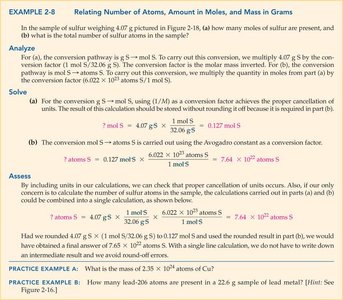
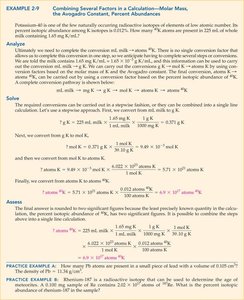
The mole is the SI unit for the amount of substance. One mole contains Avogadro’s number () of entities (atoms, molecules, ions): mol-1.
Chapter 8: Electrons in Atoms
Electromagnetic Radiation
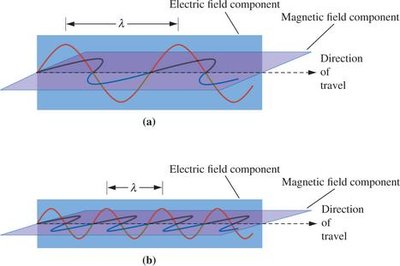
Electromagnetic radiation consists of oscillating electric and magnetic fields that propagate through space as waves. Light is a form of electromagnetic radiation.
Wavelength (): Distance between successive crests (meters).
Frequency (): Number of cycles per second (Hz or s-1).
Speed of light (): m/s.
Relationship:
Blackbody Radiation and the Quantum Hypothesis
Blackbody radiation experiments led to the quantum hypothesis: energy is emitted or absorbed in discrete packets called quanta. The energy of a quantum is given by:
Where is Planck’s constant ( J·s).
The Photoelectric Effect
When light of sufficient frequency strikes a metal surface, electrons are ejected. The number of electrons depends on light intensity, but their kinetic energy depends on light frequency.
The Bohr Model of the Atom
Bohr proposed that electrons move in fixed orbits around the nucleus with quantized energies. Energy is emitted or absorbed when an electron transitions between orbits.
(for hydrogen-like atoms)
J
Energy Levels and Atomic Spectra
Electrons in atoms occupy discrete energy levels. Transitions between these levels produce atomic spectra, with each line corresponding to a specific energy change.
Wave-Particle Duality and the Uncertainty Principle
Particles such as electrons exhibit both wave-like and particle-like properties (de Broglie hypothesis). The uncertainty principle states that the position and momentum of a particle cannot both be precisely known:
Quantum Numbers and Atomic Orbitals
Quantum numbers describe the properties of atomic orbitals and the electrons within them:
Principal quantum number (): Energy level (1, 2, 3, ...)
Angular momentum quantum number (): Shape of orbital (0 = s, 1 = p, 2 = d, 3 = f)
Magnetic quantum number (): Orientation of orbital (– to +)
Spin quantum number (): Electron spin (+1/2 or –1/2)
Electron Spin and the Pauli Exclusion Principle
Electrons have an intrinsic property called spin. The Pauli exclusion principle states that no two electrons in an atom can have the same set of four quantum numbers.
Penetration and Shielding
Electrons in inner orbitals shield outer electrons from the full nuclear charge, reducing the effective nuclear attraction. s orbitals penetrate closer to the nucleus than p or d orbitals, experiencing less shielding.
Electron Configurations and the Aufbau Principle
Electron configurations describe the arrangement of electrons in an atom. The Aufbau principle states that electrons fill orbitals in order of increasing energy. The Pauli exclusion principle and Hund’s rule also govern electron arrangements:
Aufbau principle: Fill lowest energy orbitals first.
Pauli exclusion principle: Maximum two electrons per orbital, with opposite spins.
Hund’s rule: Electrons occupy degenerate orbitals singly before pairing.
Additional info: This guide covers foundational topics in general chemistry, including matter classification, measurement, atomic structure, and the quantum mechanical model of the atom. Worked examples and tables are included to reinforce key concepts and calculations.
