 Back
Free Energy and Thermodynamics: Entropy, Spontaneity, and Gibbs Free Energy
Study Guide - Smart Notes
 Tailored notes based on your materials, expanded with key definitions, examples, and context.
Free Energy and Thermodynamics
Introduction to Thermodynamics
Thermodynamics is the study of energy changes and transfers in chemical and physical processes. It helps us understand why reactions occur, their spontaneity, and the maximum work they can perform. The driving force behind these changes is entropy, which is related to the dispersion of energy.
The Laws of Thermodynamics
First Law: Energy is conserved in chemical processes; it cannot be created or destroyed, only transferred or transformed.
Second Law: Every spontaneous energy transaction requires the dispersal of energy. Energy spontaneously spreads out unless constrained.
Third Law: The entropy of a perfect crystal at absolute zero (0 K) is zero.
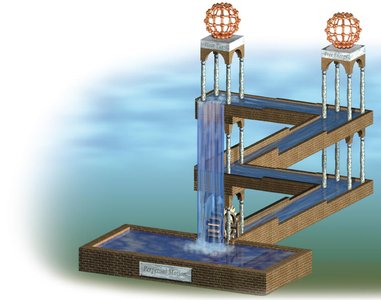
Example: A perpetual motion machine is impossible because some energy must always be dispersed to the surroundings.
Spontaneous and Nonspontaneous Processes
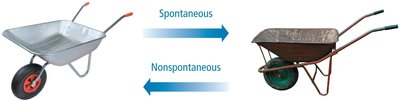
A spontaneous process occurs without ongoing outside intervention. Spontaneity does not imply speed; a process can be spontaneous but slow.
Spontaneous: Iron rusts when exposed to oxygen.
Nonspontaneous: Extraction of iron from ore requires external energy.
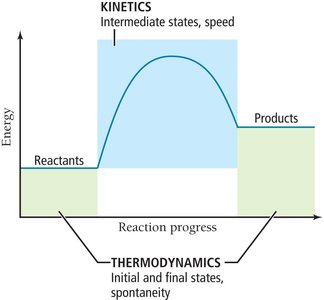
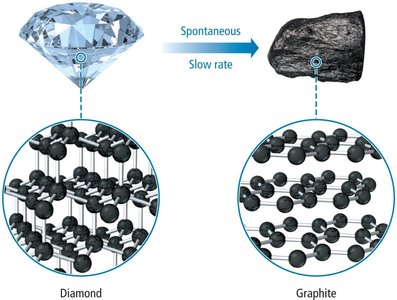
Example: Diamond spontaneously converts to graphite, but the process is extremely slow.
Additional info: Nonspontaneous processes can be made spontaneous by coupling them to spontaneous processes or supplying external energy.
Enthalpy and Entropy in Spontaneous Processes
Most spontaneous processes are exothermic (ΔH < 0), but some are endothermic (ΔH > 0). Entropy is the true criterion for spontaneity.
Evaporation of water: Spontaneous and endothermic.
Dissolution of NaCl: Spontaneous and endothermic.
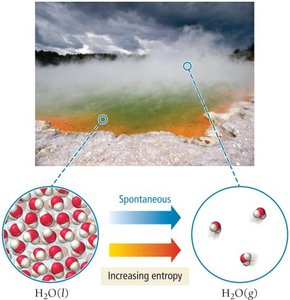
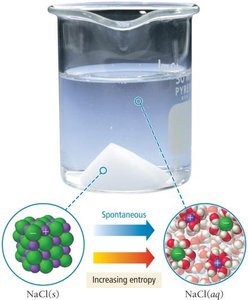
Energy disperses as processes occur, increasing entropy.
Entropy and the Second Law of Thermodynamics
Definition and Mathematical Expression
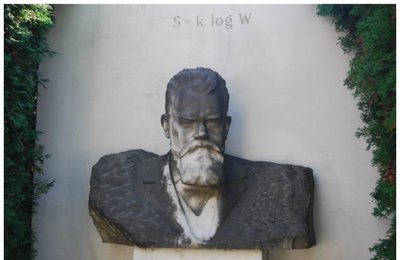
Entropy (S) is a thermodynamic function that increases with the number of energetically equivalent ways to arrange the components of a system. Ludwig Boltzmann expressed entropy mathematically:
k: Boltzmann constant ( J/K)
W: Number of microstates (energetically equivalent arrangements)
Microstates and Macrostates
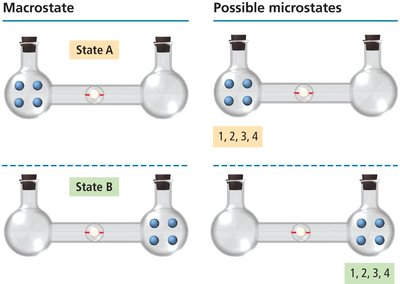
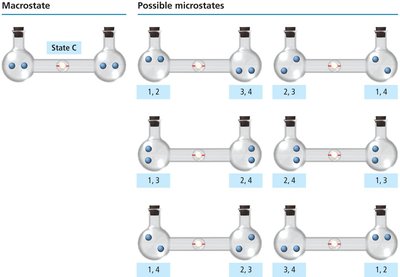
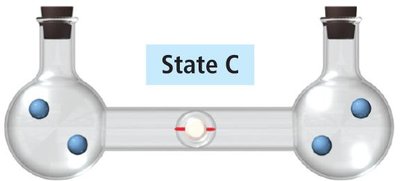
A microstate is a specific arrangement of energy among particles at a given instant. A macrostate is defined by observable properties (P, V, T) and can be achieved by many microstates.
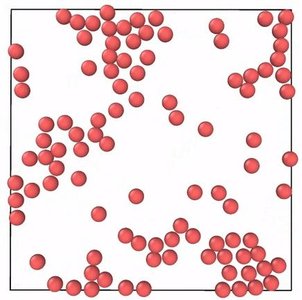
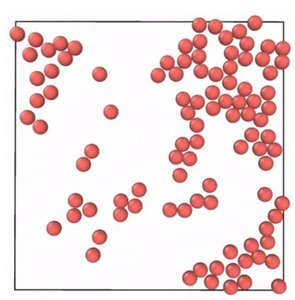
W is the number of microstates for a given macrostate.
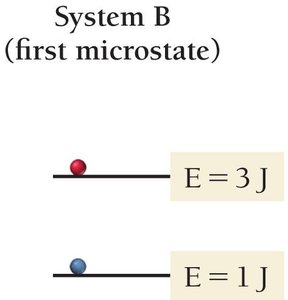
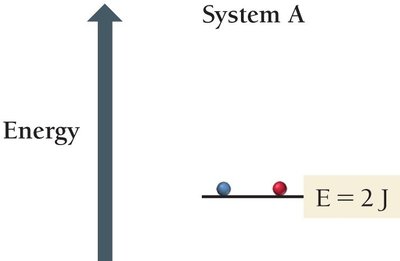
Entropy Comparison Example
Systems with more microstates have higher entropy.
Second Law of Thermodynamics
For any spontaneous process, the entropy of the universe increases:
Processes that increase energy dispersal occur spontaneously.
Entropy is a state function:
Entropy Change in Gas Expansion
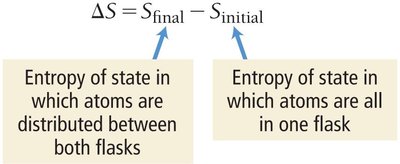
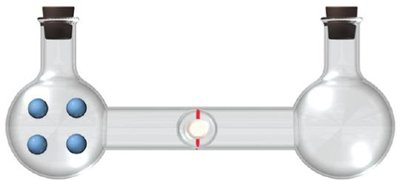
When an ideal gas expands into a vacuum, the number of microstates increases, leading to a positive entropy change.
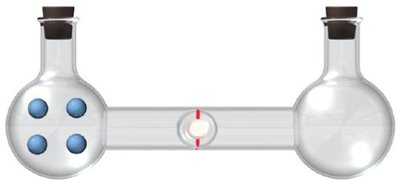
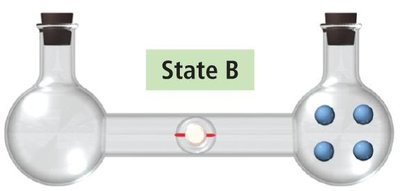
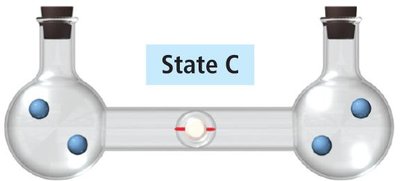
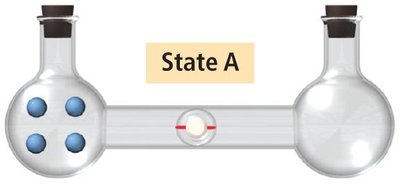
The final state has greater entropy than the initial state.
Heat Transfer and Entropy
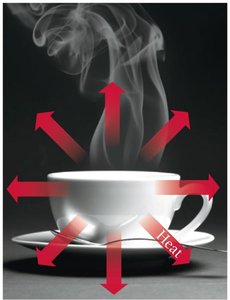
Heat transfer from a hot substance to a cold one increases the randomization of energy, dispersing it into the surroundings.
Entropy Changes Associated with State Changes
Phase Transitions and Entropy
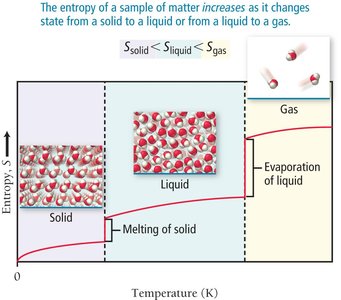
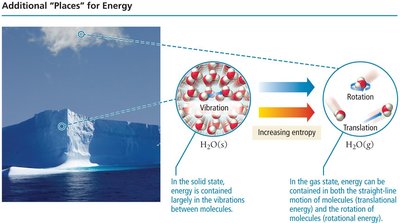
The entropy of a sample increases as it changes state from solid to liquid or liquid to gas. Gases have more ways to distribute energy than solids or liquids.
Entropy increases () for:
Solid to liquid
Solid to gas
Liquid to gas
Increase in number of moles of gas in a reaction
Predicting Entropy Change
Condensation of water (gas to liquid) results in a decrease in entropy.
Calculating Entropy Change for State Changes
The change in entropy when a system exchanges heat at constant temperature is:
: Heat exchanged in a reversible process
: Temperature in Kelvin
Example: Melting 1 mol of ice at 0°C ( kJ/mol, K):
J/K
Entropy Changes in the Surroundings
Heat Transfer and Surroundings
For any spontaneous process, the entropy of the universe increases:
When water freezes below 0°C, is negative, but is positive and larger, making positive.
Exothermic processes increase the energy of the surroundings; endothermic processes decrease it.
Quantifying Entropy Change in Surroundings
The entropy change in the surroundings is:
Exothermic: ,
Endothermic: ,
Gibbs Free Energy
Definition and Equation
Gibbs Free Energy (ΔG) is the energy available to do work in a chemical system at constant temperature and pressure. It determines the direction of spontaneous change.
: Spontaneous process
: Nonspontaneous process
Effect of ΔH, ΔS, and T on Spontaneity
ΔH | ΔS | Spontaneous? | Comments |
|---|---|---|---|
- | + | Yes (all T) | Always spontaneous |
- | - | Yes (low T) | Spontaneous at low T |
+ | + | Yes (high T) | Spontaneous at high T |
+ | - | No | Never spontaneous |
Calculating Gibbs Free Energy
Example: For the decomposition of CCl4 ( kJ, J/K, K):
J (Nonspontaneous)
To find the temperature at which the reaction becomes spontaneous:
, K
Entropy Changes in Chemical Reactions
Standard States and Entropy Change
Gas: Pure gas at 1 atm
Liquid/Solid: Pure substance in most stable form at 1 atm
Solution: 1 M concentration
The standard entropy change for a reaction:
Factors Affecting Standard Entropy
State of matter: Entropy of gas > liquid > solid
Molar mass: Higher molar mass increases entropy (within same state)
Allotropes: More flexible structures (e.g., graphite vs diamond) have higher entropy
Molecular complexity: More complex molecules have higher entropy
Dissolution: Dissolving solids increases entropy
Example Calculation
For the reaction: 4 NH3(g) + 5 O2(g) → 4 NO(g) + 6 H2O(g)
J/K
Free Energy Changes in Chemical Reactions
Methods to Calculate ΔG°rxn
Calculate and , then use
Use tabulated values of free energies of formation:
Determine free energy change for stepwise reactions from the free energy changes of each step
Free Energy and Equilibrium
Relationship Between ΔG°rxn and K
At equilibrium:
K < 1: is positive, reaction is spontaneous in reverse
K > 1: is negative, reaction is spontaneous in forward
K = 1: is zero, reaction is at equilibrium
Free Energy Under Nonstandard Conditions
The free energy change under nonstandard conditions:
Q: Reaction quotient
R: Gas constant (8.314 J/(mol·K))
T: Temperature in K
Summary Table: Spontaneity Criteria
Criterion | Spontaneous Process |
|---|---|
ΔSuniverse > 0 | Yes |
ΔG < 0 | Yes |
K > 1 | Yes (forward reaction) |
