 Back
BackFree Energy and Thermodynamics: Spontaneity, Entropy, and Gibbs Free Energy
Study Guide - Smart Notes
 Tailored notes based on your materials, expanded with key definitions, examples, and context.
Free Energy and Thermodynamics
Overview of Thermodynamic Laws
Thermodynamics is the study of energy transformations in chemical and physical processes. The laws of thermodynamics govern the direction and extent of these processes, determining whether a reaction is spontaneous and how energy is distributed.
0th Law of Thermodynamics: If system A is in thermal equilibrium with system B, and B with C, then A is in equilibrium with C.
1st Law of Thermodynamics: The energy of the universe is constant (conservation of energy). where is heat absorbed by the system and is work done on the system.
2nd Law of Thermodynamics: In a spontaneous process, the entropy of the universe increases. (if spontaneous)
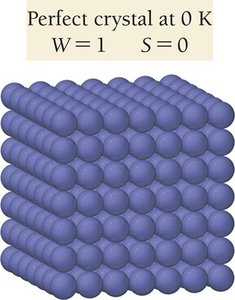
3rd Law of Thermodynamics: The entropy of a pure crystalline substance at absolute zero is zero: .
Thermodynamics and Spontaneity
Spontaneous vs. Nonspontaneous Processes
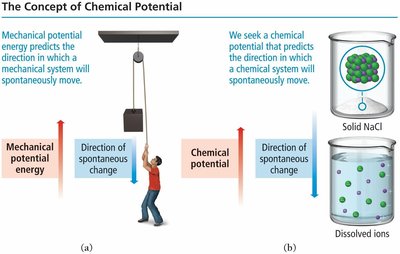
Thermodynamics predicts whether a process will occur under given conditions. Spontaneous processes occur without ongoing outside intervention, while nonspontaneous processes require energy input. Spontaneity is determined by comparing the chemical potential energy before and after a reaction.
If the system after reaction has less potential energy than before, the reaction is thermodynamically favorable.
The direction of spontaneity can be determined by comparing the potential energy of the system at the start and end.
Kinetics Versus Thermodynamics
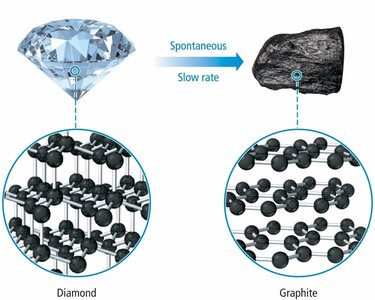
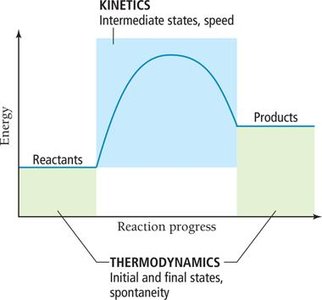
Spontaneity does not indicate the speed of a reaction. Thermodynamics determines if a reaction can occur, while kinetics determines how fast it occurs. For example, the conversion of diamond to graphite is spontaneous but occurs at a very slow rate.

Entropy and Spontaneous Processes
Definition and Role of Entropy
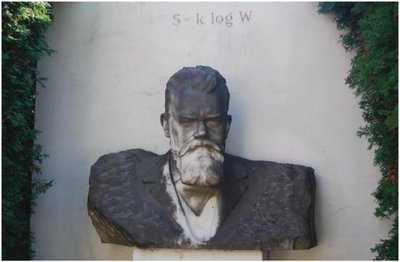
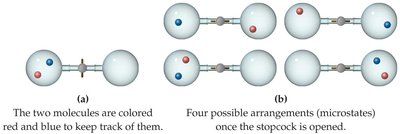
Entropy (S) is a thermodynamic function that increases with the number of energetically equivalent ways to arrange the components of a system (microstates). The second law states that for any spontaneous process, the entropy of the universe increases.
Entropy is a state function, measured in J/(mol·K).
Boltzmann equation: where is the Boltzmann constant ( J/K) and is the number of microstates.
Entropy increases with the number of microstates.
Change in entropy:
Entropy and State Changes
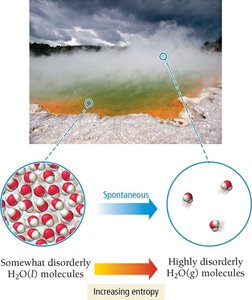
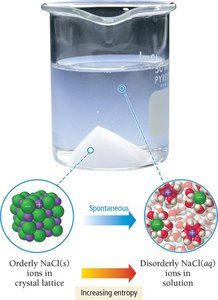
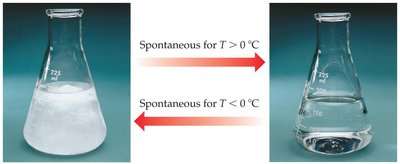
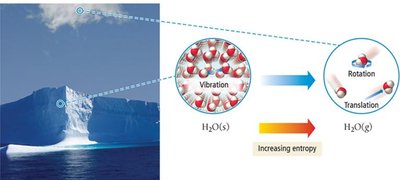
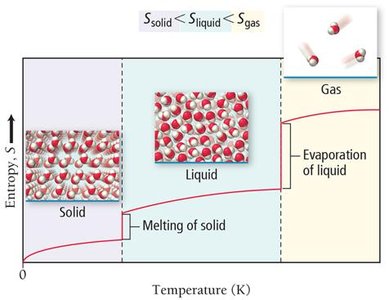
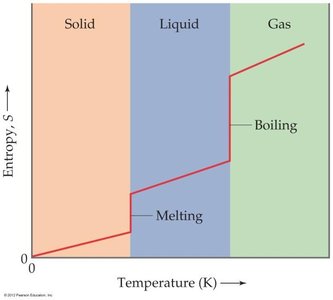
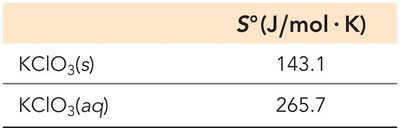
When materials change state, the number of possible configurations (macrostates) changes. Gases have greater entropy than liquids, which have greater entropy than solids.
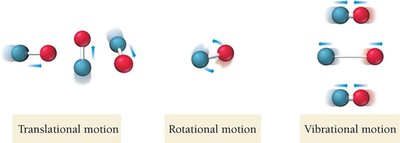
Translational, vibrational, and rotational motions contribute to entropy.
Entropy increases with freedom of motion:
Microstates and Probability
Microstates are specific arrangements of energy among particles. The more microstates, the higher the entropy. Probability favors states with more microstates.
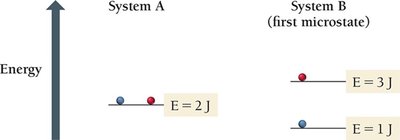
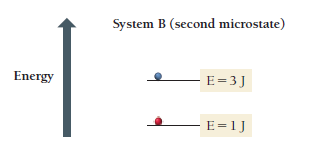
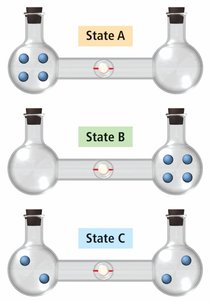
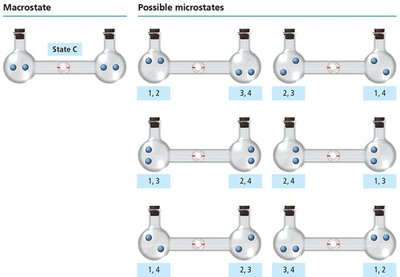
Entropy Change in State Change
Entropy increases when a substance changes from solid to liquid to gas. The more energetically equivalent configurations, the greater the entropy.
Calculating Entropy Changes
The change in entropy for a process at constant temperature is:
where is the heat exchanged in a reversible process and is the temperature in Kelvin.
Entropy of System, Surroundings, and Universe
Relationship Between System and Surroundings
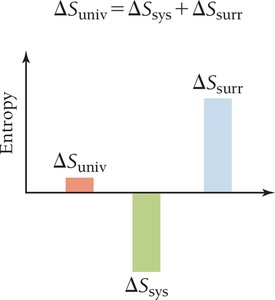
For a process to be spontaneous, the total entropy change of the universe must be positive. If the system's entropy decreases, the surroundings' entropy must increase by a greater amount.
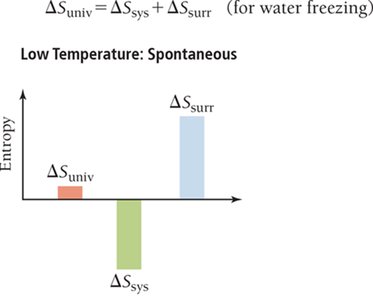
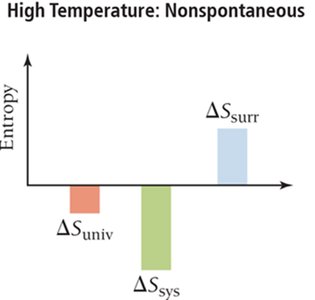
Heat Exchange and Entropy of Surroundings
Exothermic process: increases entropy of surroundings ()
Endothermic process: decreases entropy of surroundings ()
Magnitude of depends on temperature:
Gibbs Free Energy and Spontaneity
Definition and Criteria for Spontaneity
Gibbs free energy (G) is the maximum amount of work energy that can be released to the surroundings by a system at constant temperature and pressure. The change in free energy is given by:
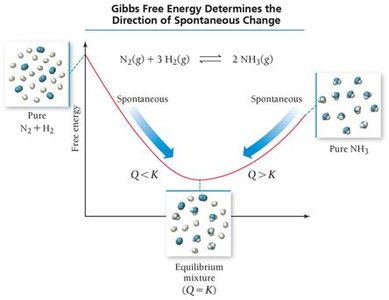
If , the process is spontaneous.
If , the system is at equilibrium.
If , the process is nonspontaneous in the forward direction.
Effect of Enthalpy, Entropy, and Temperature
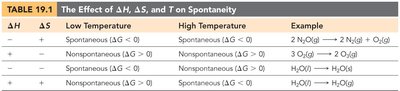
The spontaneity of a process depends on the signs and magnitudes of , , and temperature ():
Low Temperature | High Temperature | Example | ||
|---|---|---|---|---|
- | + | Spontaneous () | Spontaneous () | 2 N2O(g) → 2 N2(g) + O2(g) |
+ | - | Nonspontaneous () | Nonspontaneous () | 2 O3(g) → 3 O2(g) |
- | - | Spontaneous () | Nonspontaneous () | H2O(l) → H2O(s) |
+ | + | Nonspontaneous () | Spontaneous () | H2O(l) → H2O(g) |
Standard State and Absolute Entropy
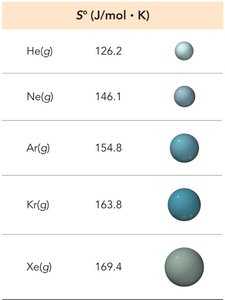
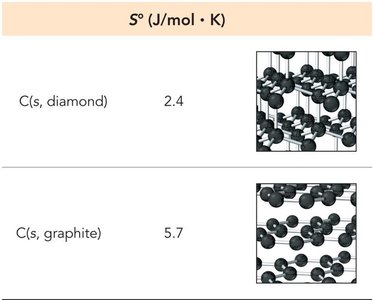
The standard state is the state of a material at a defined set of conditions (1 atm for gases, 1 M for solutions, pure substance for solids/liquids at 1 atm and 25°C). The absolute entropy of a substance is always positive and is zero only for a perfect crystal at 0 K.
Standard Molar Entropies
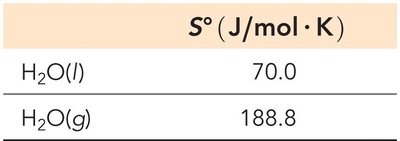
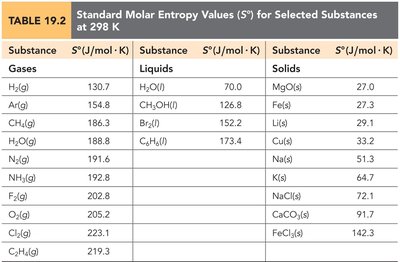
Standard molar entropy () values are tabulated for substances at 298 K. Gases have higher entropy than liquids, which have higher entropy than solids. Entropy increases with molar mass and molecular complexity.


Calculating Standard Entropy Change ()
The standard entropy change for a reaction is:
where and are the stoichiometric coefficients.
Gibbs Free Energy Calculations
Standard Free Energy Change ()
The standard free energy change for a reaction is:
Alternatively, (at 25°C).
Temperature Dependence of Spontaneity
The sign of can change with temperature, especially when and have the same sign. The temperature at which a reaction changes from spontaneous to nonspontaneous can be found by setting :
Free Energy, Equilibrium, and the Reaction Quotient
Free Energy Under Nonstandard Conditions
For reactions not at standard state, the free energy change is:
where is the reaction quotient, is the gas constant, and is temperature in Kelvin.
Relationship Between Free Energy and Equilibrium Constant
At equilibrium (), :
When , is negative (spontaneous forward). When , $\Delta G^\circ$ is positive (spontaneous reverse).
Temperature Dependence of the Equilibrium Constant
The relationship between and temperature is given by:
This equation shows that a plot of versus yields a straight line, with slope and intercept .
Summary Table: Effect of , , and on Spontaneity
Low Temperature | High Temperature | Example | ||
|---|---|---|---|---|
- | + | Spontaneous () | Spontaneous () | 2 N2O(g) → 2 N2(g) + O2(g) |
+ | - | Nonspontaneous () | Nonspontaneous () | 2 O3(g) → 3 O2(g) |
- | - | Spontaneous () | Nonspontaneous () | H2O(l) → H2O(s) |
+ | + | Nonspontaneous () | Spontaneous () | H2O(l) → H2O(g) |
Additional info: This guide covers the core concepts of thermodynamics, entropy, and free energy as they relate to spontaneity and equilibrium in chemical systems, with examples and tables to reinforce key points.
