 Back
BackFree Energy, Nonstandard States, and Equilibrium in Chemical Reactions
Study Guide - Smart Notes
 Tailored notes based on your materials, expanded with key definitions, examples, and context.
Free Energy Changes for Nonstandard States
From Standard Free Energy (ΔG°) to Actual Free Energy (ΔG)
In real chemical systems, conditions often differ from the standard state (1 M concentration, 1 atm pressure). The Gibbs free energy change under these nonstandard conditions is given by:
Key Equation:
R: Universal gas constant, 8.314 J/(mol·K)
T: Temperature in Kelvin
Q: Reaction quotient, reflecting current concentrations/pressures
Physical Interpretation:
When Q = 1 (standard conditions):
When Q < K: (forward reaction is spontaneous)
When Q > K: (reverse reaction is spontaneous)
When Q = K: (system at equilibrium)
The term corrects the standard free energy for the actual conditions of the system.
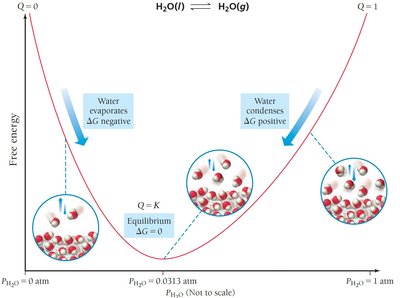
Free Energy and Equilibrium: Relating ΔG° to K
Derivation and Interpretation of ΔG° = −RT ln K
At equilibrium, the reaction quotient Q equals the equilibrium constant K, and the free energy change ΔG is zero. Substituting these values into the key equation yields:
Therefore,
Or, rearranged:
Implications:
Small changes in ΔG° cause large changes in K due to the logarithmic relationship.
ΔG° < 0: K > 1 (products favored at equilibrium)
ΔG° > 0: K < 1 (reactants favored at equilibrium)
ΔG° = 0: K = 1 (reactants and products equally favored)
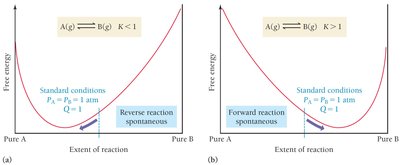
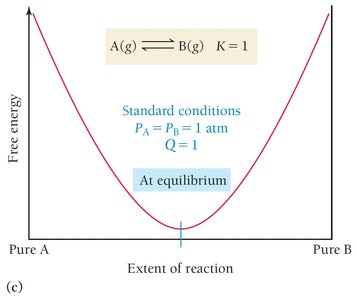
Summary Table: Relationship Between ΔG° and K
The following table summarizes how the sign and magnitude of ΔG° relate to the equilibrium constant K and the position of equilibrium:
ΔG°rxn | K value | Equilibrium Position | Reaction at Standard Conditions |
|---|---|---|---|
ΔG° << 0 (large negative) | K >> 1 | Products strongly favored | Spontaneous forward |
ΔG° < 0 (moderately negative) | K > 1 | Products favored | Spontaneous forward |
ΔG° = 0 | K = 1 | Reactants = products | At equilibrium |
ΔG° > 0 (moderately positive) | K < 1 | Reactants favored | Spontaneous reverse |
ΔG° >> 0 (large positive) | K << 1 | Reactants strongly favored | Spontaneous reverse |
Additional info: Small changes in ΔG° produce large changes in K due to the exponential relationship.
Example: Calculating K from ΔG°rxn
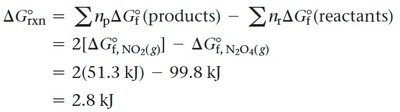
Consider the reaction: N2O4(g) ⇌ 2 NO2(g). Given the following standard free energies of formation:
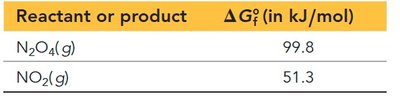
Calculate ΔG°rxn:
Calculate K at 298 K:
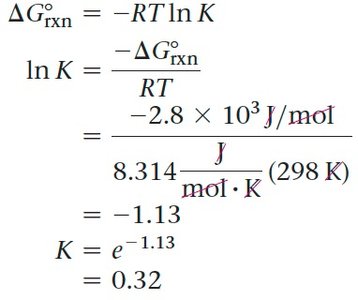
Result: K = 0.32, indicating that products are slightly disfavored at standard conditions.
Coupling Reactions: Driving Nonspontaneous Processes
Thermodynamic Coupling in Chemistry and Biology
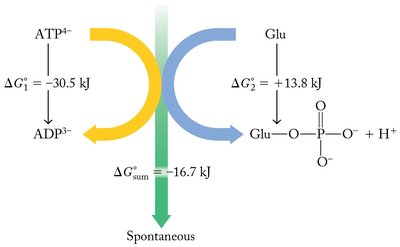
Some reactions with ΔG > 0 (nonspontaneous) can be made to occur by coupling them with a spontaneous reaction (ΔG < 0) so that the overall ΔG is negative. This principle is fundamental in both industrial and biological processes.
Industrial Example: Extraction of iron from iron ore (Fe2O3) is nonspontaneous, but becomes spontaneous when coupled with the combustion of carbon.
Biological Example: ATP hydrolysis (ΔG ≈ −30.5 kJ/mol) is coupled to many cellular reactions to make them spontaneous overall.
Key Equations in Thermodynamics and Equilibrium
Boltzmann Equation (Entropy):
Entropy Change (Reversible Process):
Entropy of Surroundings:
Gibbs Free Energy:
Standard Entropy Change:
Standard Free Energy Change:
Free Energy at Nonstandard Conditions:
Relationship to Equilibrium Constant:
Comprehensive Review: Final Takeaways
ΔG = ΔG° + RT ln Q: Corrects standard free energy for actual conditions.
ΔG° = −RT ln K: Master equation linking thermodynamics and equilibrium.
Large negative ΔG° → K ≫ 1 (products favored); large positive ΔG° → K ≪ 1 (reactants favored).
Coupling reactions: Nonspontaneous processes can be driven by coupling with spontaneous ones.
All spontaneous processes are driven by ΔS_universe > 0; ΔG = −TΔS_universe is the practical criterion.
Key equations: S = k ln W; ΔS = q/T; ΔS_surr = −ΔH/T; ΔG = ΔH−TΔS; ΔS°_rxn and ΔG°_rxn formulas; ΔG = ΔG° + RT ln Q; ΔG° = −RT ln K.
