 Back
BackFree Energy, Spontaneity, and Entropy: Foundations of Thermodynamics
Study Guide - Smart Notes
 Tailored notes based on your materials, expanded with key definitions, examples, and context.
Spontaneous Processes and Chemical Potential
Understanding Spontaneity in Chemistry
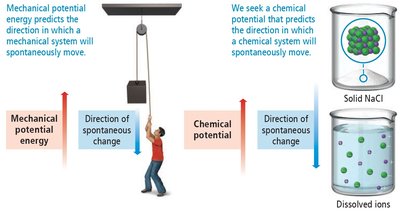
Spontaneous processes are those that occur without ongoing external intervention. In chemistry, predicting whether a reaction or process will occur spontaneously is fundamental to understanding chemical change. The concept of chemical potential is analogous to mechanical potential energy, which determines the direction of spontaneous change in physical systems.
Spontaneous process: Occurs naturally without continuous external energy input (e.g., a book falling off a table).
Nonspontaneous process: Requires continuous energy input to proceed (e.g., lifting a book onto a table).
For chemical systems, we seek a chemical potential that predicts the direction of spontaneous change.
Spontaneity vs. Speed: Thermodynamics and Kinetics
Distinguishing Thermodynamics from Kinetics
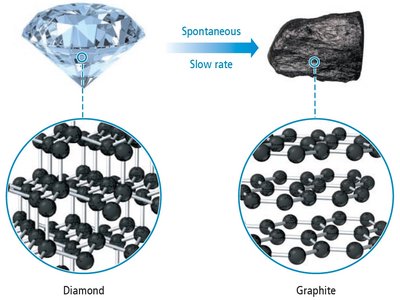
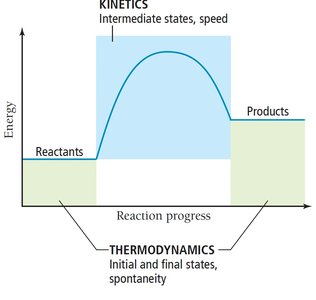
It is crucial to distinguish between whether a reaction can occur (thermodynamics) and how fast it occurs (kinetics). Spontaneity does not imply rapid change; some spontaneous processes are extremely slow.
Thermodynamics: Determines if a reaction is possible and to what extent it will proceed (spontaneity and equilibrium).
Kinetics: Studies the rate and mechanism of a reaction (how fast and by what pathway).
A catalyst can speed up a spontaneous reaction but cannot make a nonspontaneous reaction spontaneous.
Example: The conversion of diamond to graphite is spontaneous but occurs at an imperceptibly slow rate at room temperature.
Entropy and the Second Law of Thermodynamics
Key Definitions
Entropy (S): A thermodynamic state function that measures the number of energetically equivalent ways to arrange a system. Units: J/(mol·K).
Microstate (W): A specific microscopic arrangement of the components of a system at one instant.
Macrostate: The macroscopic description of a system (e.g., defined by pressure, volume, temperature); one macrostate corresponds to many possible microstates.
Boltzmann Equation: , where J/K (Boltzmann constant) and is the number of microstates.
Entropy as Energy Dispersal
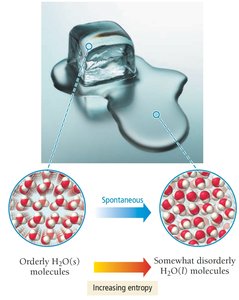
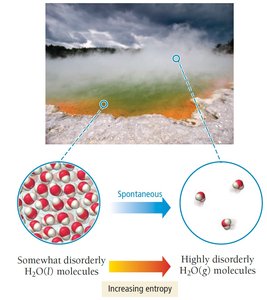
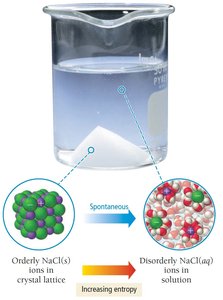
Entropy quantifies the dispersal of energy and matter. Processes that increase disorder or randomness (i.e., increase the number of microstates) are generally spontaneous.
Ice melting: (ordered to disordered; )
Evaporation: (more disordered; )
NaCl dissolution: (ordered crystal to random ions; )
Boltzmann's Equation and Microstates
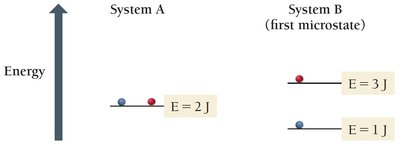
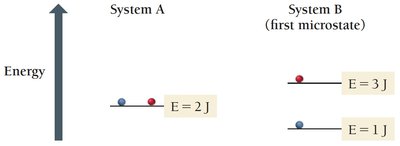
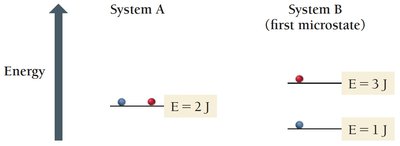
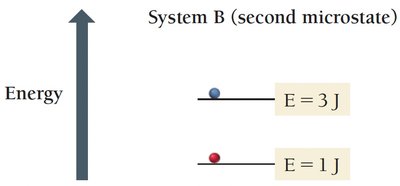
The number of microstates () available to a system determines its entropy. More microstates mean higher entropy.
System A (one energy level):
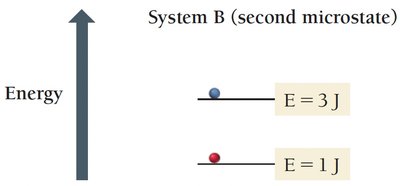
System B (two energy levels):
;
Statistical Argument for Gas Expansion
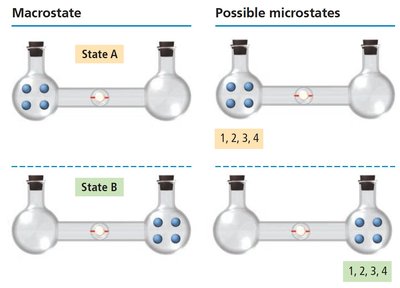
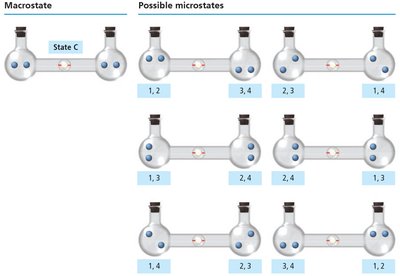
When a gas expands into a vacuum, the number of possible microstates increases dramatically, making the expansion spontaneous. The most probable macrostate is the one with the greatest number of microstates.
For atoms, the equally distributed state has 6 microstates versus 1 for all-in-one-flask.
For atoms, the equally distributed state has 184,756 microstates versus 1 for all-in-one-flask.
The Second Law of Thermodynamics
The second law states that for any spontaneous process, the total entropy of the universe increases:
(spontaneous process)
(equilibrium, reversible process)
(nonspontaneous process; reverse is spontaneous)
This law explains the unidirectional flow of time and the tendency for energy to disperse, leading to the concept of 'heat death' of the universe.

Entropy Changes with State Changes
Entropy and Phase Transitions
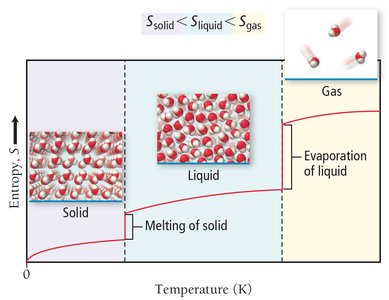
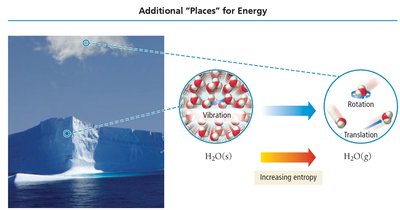
Entropy increases as a substance changes from solid to liquid to gas, reflecting greater energy dispersal and more available microstates.
Vaporization adds translational and rotational energy modes, dramatically increasing microstates.
Practice: Predicting Entropy Changes
For each process, predict whether is positive, negative, or approximately zero:
H2O(l) → H2O(g) at 100°C: (liquid to gas, more disorder)
AgCl(s) → Ag+(aq) + Cl-(aq): (solid to ions in solution, more disorder)
2 H2(g) + O2(g) → 2 H2O(l): (gases to liquid, less disorder)
CO2(g) → CO2(s): (gas to solid, less disorder)
Calculating Entropy Change for Phase Transitions
For a reversible phase change at constant temperature:
= heat exchanged at the phase transition (J)
= temperature in Kelvin
For melting: (positive, heat absorbed)
For condensation: (negative, heat released)
Temperature must be in Kelvin:
Practice: Calculating for Phase Changes
1.00 mol of liquid water freezes at 0°C ( kJ/mol): K, J/mol J/(mol·K)
1.00 mol of ethanol vaporizes at 78.4°C ( kJ/mol): K, J/mol J/(mol·K)
Reversible Processes
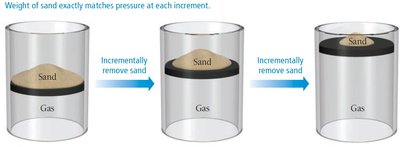
A reversible process is one that can be reversed without leaving any net change in the system or its surroundings. An example is the isothermal expansion or compression of a gas under infinitesimal changes in external force.
Key Takeaways
Spontaneous processes occur without ongoing external energy input; spontaneity does not imply speed.
Entropy () measures the number of energetically equivalent microstates; more microstates mean higher entropy.
Second Law: for all spontaneous processes.
Entropy increases: solid → liquid → gas; dissolution of solids; expansion of gases.
For reversible phase transitions: (T in Kelvin).
The most probable macrostate is the one with the greatest number of microstates—this drives spontaneous change.
