 Back
BackGas Stoichiometry and Ideal Gas Law Problem-Solving Guidance
Study Guide - Smart Notes
 Tailored notes based on your materials, expanded with key definitions, examples, and context.
Q1. 8.00 g of hydrogen gas (H2) are combined with excess oxygen gas (O2) to produce water vapor at 1 atm and 273 K. How many liters of water vapor are produced?
Background
Topic: Gas Stoichiometry at STP
This question tests your ability to use stoichiometry and the concept of molar volume at standard temperature and pressure (STP) to determine the volume of a gas produced in a chemical reaction.
Key Terms and Formulas
STP (Standard Temperature and Pressure): 273 K and 1.00 atm
Molar volume at STP: 1 mol of any gas occupies 22.4 L
Balanced equation:
Molar mass of H2: 2.02 g/mol

Step-by-Step Guidance
Calculate the number of moles of H2 used:
Use the stoichiometry of the reaction to find the moles of H2O produced. According to the balanced equation, 2 mol H2 produces 2 mol H2O, so the mole ratio is 1:1.
Since the reaction occurs at STP, use the molar volume to convert moles of H2O to liters:
Try solving on your own before revealing the answer!
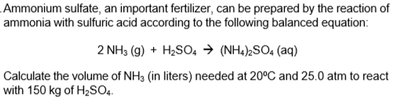
Q2. Calculate the volume of NH3 (in liters) needed at 20°C and 25.0 atm to react with 150 kg of H2SO4 according to: 2 NH3 (g) + H2SO4 → (NH4)2SO4 (aq)
Background
Topic: Gas Stoichiometry Using the Ideal Gas Law
This question tests your ability to use stoichiometry and the ideal gas law to determine the volume of a gas required for a reaction under non-STP conditions.
Key Terms and Formulas
Ideal Gas Law:
Balanced equation:
Molar mass of H2SO4: 98.09 g/mol
R (gas constant): 0.0821 L·atm/(mol·K)
Step-by-Step Guidance
Convert 150 kg of H2SO4 to grams:
Calculate the number of moles of H2SO4:
Use the stoichiometry of the reaction to find the moles of NH3 needed. According to the balanced equation, 1 mol H2SO4 reacts with 2 mol NH3.
Use the ideal gas law to solve for the volume of NH3: , where is the moles of NH3, is 293 K (20°C), and is 25.0 atm.
Try solving on your own before revealing the answer!
