 Back
BackGases and the Kinetic-Molecular Theory: Study Notes
Study Guide - Smart Notes
 Tailored notes based on your materials, expanded with key definitions, examples, and context.
Gases and Their Properties
General Characteristics of Gases
Gases are distinguished from solids and liquids by their ability to change volume significantly with pressure and temperature. They flow freely, have low densities, and can form solutions in any proportion. Air itself is a mixture of approximately 18 different gases.
Compressibility: Gases can be compressed much more than solids or liquids.
Expansion: Gases expand when heated and contract when cooled.
Density: Gases have much lower densities compared to solids and liquids.
Mixing: Gases mix evenly and completely when combined.
Gas Pressure and Atmospheric Pressure
Gas particles are always in motion, colliding with the walls of their container and exerting pressure. Atmospheric pressure is the result of the mass of atmospheric gases pressing down on Earth's surface, and it decreases with altitude.
Pressure: The force exerted by gas particles per unit area on the container walls.
Atmospheric Pressure: Standard atmospheric pressure at sea level is about 14.7 psi (pounds per square inch).
Altitude Effect: Atmospheric pressure decreases as altitude increases.
Pressure Differences and Container Volume
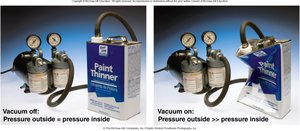
When the pressure inside a container differs from the pressure outside, nature tends to equalize the pressures by changing the container's volume.
Equal Pressure: When inside and outside pressures are equal, the container maintains its shape.
Unequal Pressure: If the inside pressure is reduced, the outside pressure can crush the container.
Gas Laws
Variables in Gas Laws
The physical behavior of gases is described by four variables: pressure (P), temperature (T), volume (V), and amount (n, in moles). An ideal gas is one that follows linear relationships among these variables, though no real gas is perfectly ideal.
Pressure (P): Measured in units such as atm, torr, or Pa.
Temperature (T): Must be in Kelvin for calculations.
Volume (V): Typically measured in liters (L).
Amount (n): Number of moles of gas.
Boyle's Law: Volume and Pressure
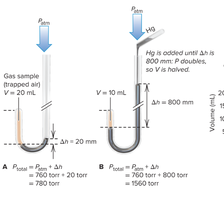
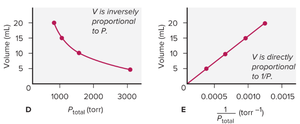
Boyle's Law states that at constant temperature and amount, the volume of a gas is inversely proportional to its pressure.
Mathematical Expression:
Relationship: As pressure increases, volume decreases, and vice versa.
Example: Doubling the pressure halves the volume.
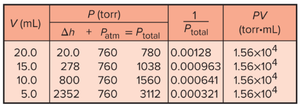
V (mL) | P (torr) | 1/P (torr-1) | PV (torr·mL) |
|---|---|---|---|
20.0 | 780 | 0.00128 | 1.56×10⁴ |
15.0 | 1038 | 0.000963 | 1.56×10⁴ |
10.0 | 1560 | 0.000641 | 1.56×10⁴ |
5.0 | 3112 | 0.000321 | 1.56×10⁴ |
Charles's Law: Volume and Temperature
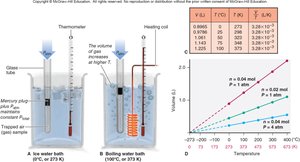
Charles's Law states that at constant pressure and amount, the volume of a gas is directly proportional to its absolute temperature (Kelvin).
Mathematical Expression:
Relationship: As temperature increases, volume increases.
Example: Heating a gas causes it to expand.
Gay-Lussac's Law: Pressure and Temperature
Gay-Lussac's Law states that at constant volume and amount, the pressure of a gas is directly proportional to its absolute temperature.
Mathematical Expression:
Relationship: As temperature increases, pressure increases.
Avogadro's Law: Volume and Amount
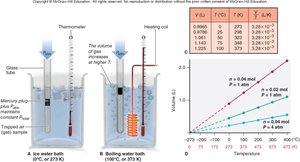
Avogadro's Law states that at constant temperature and pressure, the volume of a gas is directly proportional to the number of moles.
Mathematical Expression:
Relationship: More moles of gas occupy more volume.
Example: Doubling the amount of gas doubles the volume.
Standard Temperature and Pressure (STP) and Molar Volume
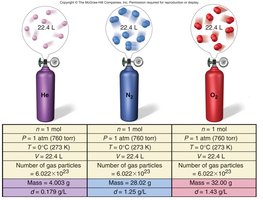
At STP (0°C, 1 atm), one mole of any ideal gas occupies 22.414 L. This is known as the standard molar volume.
STP: Standard Temperature = 0°C (273.15 K), Standard Pressure = 1 atm (760 torr).
Standard Molar Volume: 22.414 L for 1 mol of gas at STP.
Ideal Gas Law
The ideal gas law combines Boyle's, Charles's, and Avogadro's laws into a single equation:
Equation:
R: Gas constant, typically atm·L/(mol·K).
Application: Used to solve for any variable when the others are known.
Density and Molar Mass of Gases
The ideal gas law can be rearranged to calculate the density and molar mass of gases.
Density Equation:
Molar Mass Equation:
Mixtures of Gases and Partial Pressures
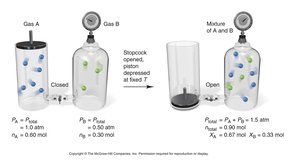
In a mixture of gases, each gas exerts a partial pressure proportional to its mole fraction. Dalton's Law states that the total pressure is the sum of the partial pressures.
Dalton's Law:
Mole Fraction:
Partial Pressure:
Collecting Gas Over Water
When gases are collected over water, the total pressure includes both the gas and water vapor. The partial pressure of the gas is found by subtracting the vapor pressure of water from the total pressure.
Equation:
Application: Used to determine the amount of gas collected in reactions.

Kinetic-Molecular Theory
Postulates of the Kinetic-Molecular Theory
The kinetic-molecular theory explains the behavior of gases based on the motion and collisions of particles.
Particle Volume: Gas particles are tiny with large spaces between them; their volume is negligible compared to the total gas volume.
Particle Motion: Gas particles move in constant, random, straight-line motion.
Particle Collisions: Collisions are elastic; no energy is lost.
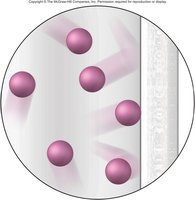
Origin of Pressure
Pressure results from countless collisions of gas particles with the container walls. The greater the number of particles, the more frequent the collisions, and the higher the pressure.
Boyle's Law Explained by Kinetic Theory
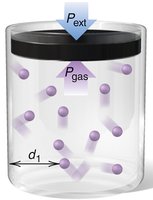
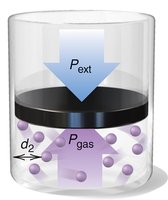
Increasing external pressure at constant temperature decreases the average distance between gas particles and the container walls, reducing volume and increasing collision frequency.
Charles's Law Explained by Kinetic Theory
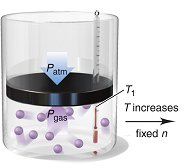
Increasing temperature increases the speed and kinetic energy of gas particles, causing more frequent and energetic collisions, which increases pressure and volume until equilibrium is restored.
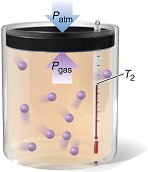
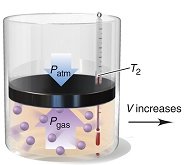
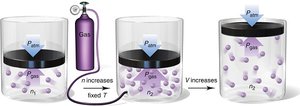
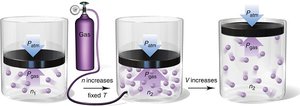
Avogadro's Law Explained by Kinetic Theory
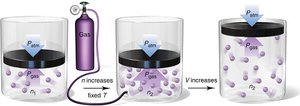
Adding more gas increases the number of particles and collisions, temporarily increasing pressure. The piston moves up, increasing volume until pressure is equalized.
Real Gases and Deviations from Ideal Behavior
Real Gases
Real gases deviate from ideal behavior at low temperatures and high pressures. They have actual volume and experience intermolecular forces.
Volume: Gas particles have real, nonzero volume.
Intermolecular Forces: Attractive and repulsive forces exist between particles.
Deviation: Most pronounced at low temperature and high pressure.
van der Waals Equation
The van der Waals equation modifies the ideal gas law to account for real gas behavior, but is more complex and not required for introductory courses.
