 Back
BackGases II: Properties, Laws, and Real Gas Behavior
Study Guide - Smart Notes
 Tailored notes based on your materials, expanded with key definitions, examples, and context.
Gases: Properties and Laws
Overview of Gases
Gases are composed of particles (atoms or molecules) that move rapidly and randomly, occupying the entire volume of their container. The behavior of gases can be described by several fundamental laws and equations, which relate pressure, volume, temperature, and amount of gas.
Gas Pressure: Results from collisions of gas particles with the walls of the container.
Ideal Gas Law: Relates the four basic properties of gases: pressure (P), volume (V), temperature (T), and amount (n).
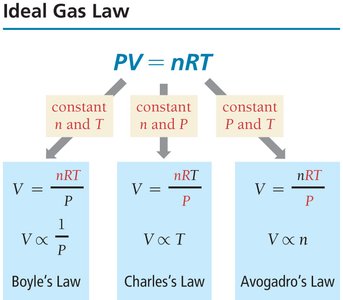
Equation:
P: Pressure (atm or Pa)
V: Volume (L or m3)
n: Amount (mol)
T: Temperature (K)
R: Gas constant (0.08206 L·atm/(mol·K) or 8.314 J/(mol·K))
The ideal gas law can be rearranged to derive Boyle's Law, Charles's Law, and Avogadro's Law, each describing the relationship between two variables when the others are held constant.
Molar Volume and Density of Gases
Molar Volume at STP
The molar volume is the volume occupied by one mole of an ideal gas at standard temperature and pressure (STP: 273.15 K, 1 atm). This value is independent of the chemical identity of the gas.
Equation:
At STP, L for any ideal gas.
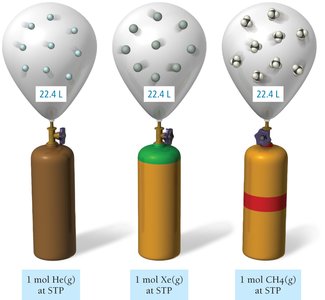
Example: 1 mol of He, Xe, or CH4 each occupies 22.4 L at STP.
Density of Gases
The density of a gas can be calculated using its molar mass and molar volume:
d: Density (g/L)
M: Molar mass (g/mol)
Vmol: Molar volume (L/mol)
Application: Gases with molar mass less than air (M < 28 g/mol) rise in air; those with greater molar mass sink.
Deducing Molar Mass from Gas Properties
The molar mass of a gas can be determined experimentally using the ideal gas law:
m: Mass of gas sample (g)
R: Gas constant
T: Temperature (K)
P: Pressure (atm)
V: Volume (L)
Partial Pressure and Gas Mixtures
Dalton’s Law of Partial Pressures
In a mixture of gases, each gas exerts a pressure independently of the others. The total pressure is the sum of the partial pressures of each component:
Partial pressure: , where is the mole fraction.
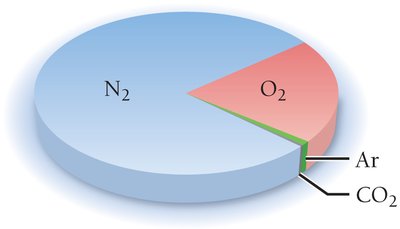
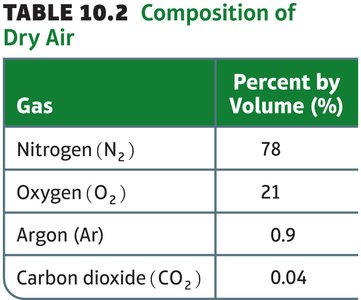
Example: In dry air, N2 is 78%, O2 is 21%, Ar is 0.9%, and CO2 is 0.04% by volume.
Partial Pressure in Deep-Sea Diving
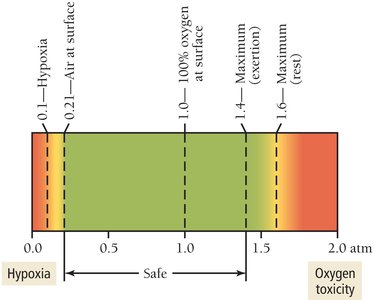
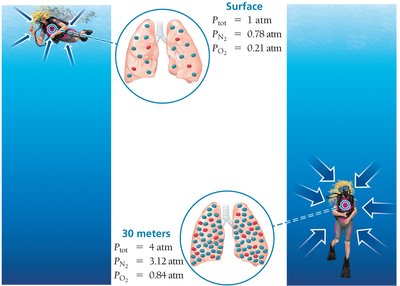
When diving, the total pressure increases with depth, raising the partial pressures of gases in the air mixture. This can lead to physiological effects such as oxygen toxicity or hypoxia.
Kinetic Molecular Theory and Molecular Motion
Root Mean Square (RMS) Velocity
The average kinetic energy of gas particles is related to temperature. The root mean square (RMS) velocity is a measure of the average speed of gas molecules:
Higher temperature and lower molar mass lead to higher RMS velocity.
Distribution of Molecular Velocities
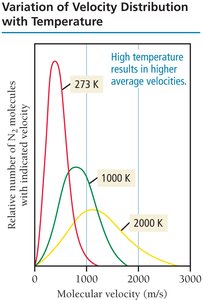
Not all molecules move at the same speed. The Maxwell-Boltzmann distribution describes the range of molecular velocities in a gas sample.
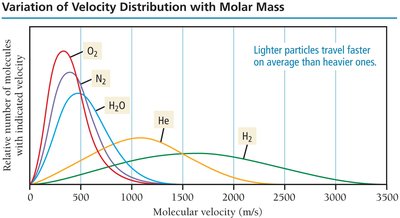
Lighter particles travel faster on average than heavier ones.
Higher temperature increases the average velocity.
Diffusion and Effusion of Gases
Definitions and Factors Affecting Rates
Diffusion: The process by which gas molecules spread out due to a concentration gradient.
Effusion: The process by which gas molecules escape through a small hole into a vacuum.
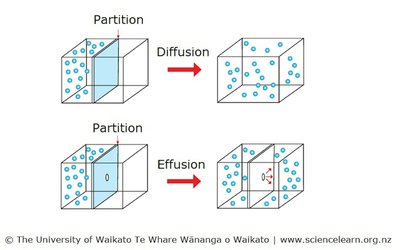
The rate of diffusion or effusion is proportional to (Graham's law):
Higher temperature and lighter molecules result in faster diffusion/effusion.
Breakdown of the Ideal Gas Law: Real Gases
Non-Ideal Behavior at High Pressure and Low Temperature
The ideal gas law assumes that gas molecules have negligible volume and do not interact. These assumptions break down at high pressures and low temperatures.
High Pressure: The volume of gas molecules becomes significant, causing the real volume to be greater than predicted.
Low Temperature: Intermolecular attractions become significant, reducing the pressure exerted by the gas.
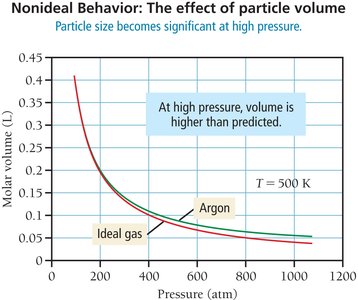
Van der Waals Equation
The Van der Waals equation modifies the ideal gas law to account for the volume of gas molecules and intermolecular forces:
a: Corrects for intermolecular attractions (pressure correction).
b: Corrects for the finite volume of molecules (volume correction).
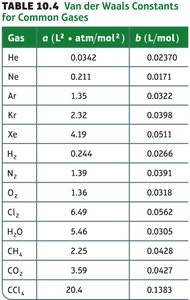
Table: Van der Waals constants for selected gases.
Summary Table: Key Equations and Concepts
Concept | Equation |
|---|---|
Ideal Gas Law | |
Molar Volume | |
Density | |
Molar Mass (from gas data) | |
Dalton's Law | |
Partial Pressure | |
RMS Velocity | |
Diffusion/Effusion Rate | |
Van der Waals Equation |
