 Back
BackGases in the Atmosphere and Their Chemical Properties
Study Guide - Smart Notes
 Tailored notes based on your materials, expanded with key definitions, examples, and context.
Gases in the Atmosphere
Composition of Air
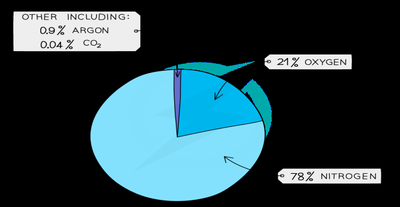
The Earth's atmosphere is a mixture of several gases, with nitrogen and oxygen being the most abundant. The composition has remained relatively stable for millions of years, providing a suitable environment for life.
Nitrogen (N2): 78.1% by volume
Oxygen (O2): 21.0% by volume
Argon (Ar): 0.9% by volume
Carbon Dioxide (CO2): 0.04% by volume
Other Gases: Small amounts of water vapor and trace noble gases
Experimental Determination of Oxygen in Air
Using Copper to Measure Oxygen Percentage
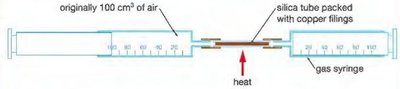
Oxygen in air can be measured by reacting it with a substance such as copper. The decrease in gas volume after the reaction indicates the amount of oxygen present.
100 cm3 of air is passed over heated copper, which reacts with oxygen to form copper(II) oxide.
The reaction:
After the reaction, the volume decreases to about 79 cm3, showing that 21 cm3 of oxygen was used.
Percentage of oxygen:
Other Methods: Iron and Phosphorus
Iron Filings: Iron rusts in damp air, using up oxygen. The decrease in air volume over time gives the oxygen percentage.
Phosphorus: Phosphorus burns in air, forming phosphorus oxide. The rise in water level in a closed container after burning indicates the oxygen used.
Combustion of Elements in Oxygen
Definition and General Properties
Combustion is a chemical reaction where a substance reacts with oxygen, producing heat and light (exothermic reaction). The products are usually oxides.
Magnesium: Burns with a bright white flame, forming magnesium oxide (). Magnesium oxide is slightly soluble in water, forming a weakly alkaline solution.
Hydrogen: Explodes with oxygen to form water ().
Sulfur: Burns with a blue flame, forming sulfur dioxide (), which dissolves in water to form sulfurous acid.
Properties of Oxides
Metal Oxides: Usually ionic and basic; react with acids to form salts. Some are soluble in water, forming alkaline solutions.
Non-metal Oxides: Usually covalent and acidic; react with bases to form salts. Often soluble in water, forming acidic solutions.
Thermal Decomposition and Carbon Dioxide
Thermal Decomposition of Metal Carbonates
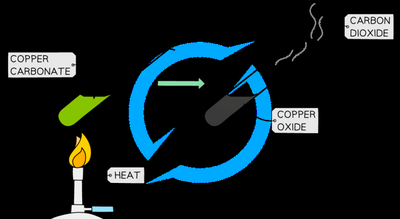
Thermal decomposition is the breakdown of a compound by heat. Many metal carbonates decompose to form metal oxides and carbon dioxide gas.
Copper(II) carbonate:
The green copper(II) carbonate turns black as copper(II) oxide forms. Carbon dioxide can be tested by bubbling it through limewater, which turns milky.
Other Sources of Carbon Dioxide
Reaction of calcium carbonate with acids:
Combustion of fossil fuels:
Burning hydrocarbons:
Carbon Dioxide and the Greenhouse Effect
The Greenhouse Effect
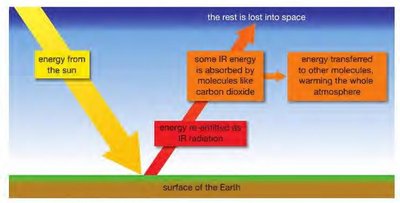
Carbon dioxide is a greenhouse gas that traps heat in the Earth's atmosphere. This process is essential for maintaining Earth's temperature but excessive greenhouse gases can lead to global warming and climate change.
Sunlight passes through the atmosphere and warms the Earth's surface.
The Earth emits infrared (IR) radiation.
Greenhouse gases like CO2 absorb IR radiation and re-emit it, warming the atmosphere.
Increased CO2 levels, mainly from burning fossil fuels and deforestation, enhance this effect, causing climate change.
Why Some Gases Are Greenhouse Gases
Not all atmospheric gases are greenhouse gases. A molecule must be able to absorb IR radiation, which requires a change in polarity during vibration.
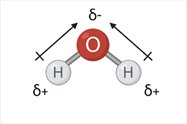
Water (H2O): Polar molecule; its polarity changes as it vibrates, making it an effective greenhouse gas.
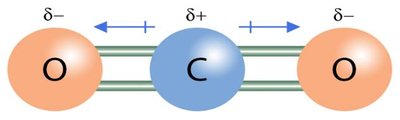
Carbon Dioxide (CO2): Although linear and non-polar overall, its vibrations can create temporary polarity, allowing it to absorb IR radiation.
Nitrogen (N2) and Oxygen (O2): Non-polar molecules; their vibrations do not change polarity, so they do not absorb IR radiation and are not greenhouse gases.
Greenhouse gases are necessary to keep Earth warm, but excessive amounts can make the planet too hot for life.
