 Back
BackGeneral Chemistry 1 – Chapter 1 Quiz Study Guidance
Study Guide - Smart Notes
 Tailored notes based on your materials, expanded with key definitions, examples, and context.
Q1. Which of the following is a physical property of a substance?
Background
Topic: Physical vs. Chemical Properties
This question tests your understanding of the difference between physical and chemical properties of matter.
Key Terms:
Physical property: A characteristic that can be observed or measured without changing the substance's identity (e.g., color, melting point, density).
Chemical property: A characteristic that describes a substance's ability to undergo a specific chemical change (e.g., flammability, reactivity).
Step-by-Step Guidance
Read each answer choice and ask yourself: "Can this property be observed without changing the substance into something new?"
Identify which options describe a change in composition (chemical property) and which do not (physical property).
Recall examples of physical properties (e.g., melting point, boiling point, density, color, state of matter).
Try solving on your own before revealing the answer!
Q2. A homogeneous mixture is also known as a:
Background
Topic: Classification of Matter
This question tests your knowledge of the types of mixtures and their definitions.
Key Terms:
Homogeneous mixture: A mixture with a uniform composition throughout (e.g., saltwater, air).
Heterogeneous mixture: A mixture where the components are not uniformly distributed (e.g., salad, sand and iron filings).
Step-by-Step Guidance
Recall the definition of a homogeneous mixture and think of common examples.
Match the definition to the correct term among the answer choices (e.g., solution, compound, element, heterogeneous mixture).
Try solving on your own before revealing the answer!
Q3. Which of the following describes a chemical change?
Background
Topic: Physical vs. Chemical Changes
This question tests your ability to distinguish between physical and chemical changes.
Key Terms:
Chemical change: A process in which one or more substances are converted into new substances with different properties (e.g., burning, rusting).
Physical change: A change that does not alter the chemical composition of a substance (e.g., melting, freezing, dissolving).
Step-by-Step Guidance
Review each answer choice and ask: "Is a new substance formed?"
Identify which option involves a chemical reaction (e.g., burning, rusting, reacting with acid).
Eliminate options that only involve changes in state or appearance without new substances forming.
Try solving on your own before revealing the answer!
Q4. A compound is a substance composed of two or more elements in a fixed, definite proportion. Which of the following is a compound?
Background
Topic: Elements, Compounds, and Mixtures
This question tests your understanding of the definition of a compound and how to identify one.
Key Terms:
Compound: A substance made of two or more elements chemically combined in a fixed ratio (e.g., H2O, CO2).
Element: A pure substance consisting of only one type of atom (e.g., O2, Fe).
Mixture: A combination of two or more substances that are not chemically combined.
Step-by-Step Guidance
Review each answer choice and determine if it is made of more than one element.
Check if the elements are chemically bonded in a fixed ratio (not just mixed together).
Eliminate options that are elements or mixtures.
Try solving on your own before revealing the answer!
Q5. The SI base unit for mass is the:
Background
Topic: SI Units
This question tests your knowledge of the International System of Units (SI) and the base unit for mass.
Key Terms:
SI base unit for mass: The kilogram (kg).
Other SI base units include meter (length), second (time), mole (amount of substance), etc.
Step-by-Step Guidance
Recall the seven SI base units and their corresponding quantities.
Identify which unit among the choices is the SI base unit for mass.
Try solving on your own before revealing the answer!
Q6. The prefix 'centi-' corresponds to which power of 10?
Background
Topic: Metric Prefixes
This question tests your understanding of metric prefixes and their corresponding powers of ten.
Key Terms:
centi-: A metric prefix meaning one hundredth (1/100 or 10-2).
Step-by-Step Guidance
Recall the meaning of the prefix 'centi-' and its power of ten.
Match the correct power of ten to the prefix from the answer choices.
Try solving on your own before revealing the answer!
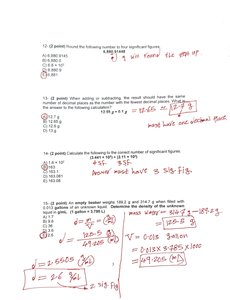
Q12. Round the following number to four significant figures: 4.1869
Background
Topic: Significant Figures
This question tests your ability to round numbers to a specified number of significant figures.
Key Terms:
Significant figures: The digits in a number that carry meaning contributing to its precision.
Step-by-Step Guidance
Identify the first four significant digits in the number 4.1869.
Look at the digit immediately after the fourth significant figure to determine if you should round up or down.
Apply the rounding rule: If the next digit is 5 or greater, round up; if less than 5, round down.
Try solving on your own before revealing the answer!
Q13. When adding or subtracting, the result should have the same number of decimal places as the measurement with the fewest decimal places. Calculate: 12.58 + 1.2
Background
Topic: Significant Figures in Addition/Subtraction
This question tests your understanding of how to apply significant figures when adding or subtracting numbers.
Key Terms:
Significant figures (addition/subtraction): The result should have the same number of decimal places as the measurement with the fewest decimal places.
Step-by-Step Guidance
Add the two numbers: 12.58 + 1.2.
Determine the number of decimal places in each number (12.58 has 2, 1.2 has 1).
Round the result to the same number of decimal places as the measurement with the fewest decimal places (1 decimal place).
Try solving on your own before revealing the answer!
Q14. Calculate the following to the correct number of significant figures: 8.5 × 2.01
Background
Topic: Significant Figures in Multiplication/Division
This question tests your ability to apply significant figures rules when multiplying or dividing numbers.
Key Terms:
Significant figures (multiplication/division): The result should have the same number of significant figures as the measurement with the fewest significant figures.
Step-by-Step Guidance
Multiply the two numbers: 8.5 × 2.01.
Count the number of significant figures in each number (8.5 has 2, 2.01 has 3).
Round the result to the same number of significant figures as the measurement with the fewest significant figures (2 significant figures).
Try solving on your own before revealing the answer!
Q15. An empty beaker weighs 32.54 g and 34.67 g when filled with an unknown liquid. Determine the mass of the liquid, using the correct number of significant figures.
Background
Topic: Mass Measurement and Significant Figures
This question tests your ability to calculate the mass of a substance by subtraction and apply significant figures rules.
Key Terms:
Mass: The amount of matter in an object, measured in grams (g).
Significant figures (addition/subtraction): The result should have the same number of decimal places as the measurement with the fewest decimal places.
Step-by-Step Guidance
Subtract the mass of the empty beaker from the mass of the filled beaker: 34.67 g - 32.54 g.
Determine the number of decimal places in each measurement (both have 2 decimal places).
Round the result to the same number of decimal places as the measurements (2 decimal places).
Try solving on your own before revealing the answer!
Q16. An alligator is 15.2 ft long. How long is he in cm?
Background
Topic: Unit Conversion (Length)
This question tests your ability to convert between units using conversion factors.
Key Terms and Formulas:
Conversion factor: 1 ft = 12 in; 1 in = 2.54 cm
Step-by-Step Guidance
Set up the conversion: Start with 15.2 ft and multiply by the appropriate conversion factors to get to cm.
First, convert feet to inches:
Next, convert inches to centimeters:
Multiply through, keeping track of significant figures (15.2 has 3 significant figures).
Try solving on your own before revealing the answer!
Q17. A liquid has a density of 0.526 g/mL. What is the mass of 41.0 mL of this liquid?
Background
Topic: Density Calculations
This question tests your ability to use the density formula to find mass.
Key Formula:
Rearranged:
Step-by-Step Guidance
Write down the given values: Density = 0.526 g/mL, Volume = 41.0 mL.
Plug the values into the rearranged formula:
Multiply and round the result to the correct number of significant figures (the answer should have 3 significant figures, based on the given values).
Try solving on your own before revealing the answer!
Q18. Classify the change represented in the molecular diagram shown below.
Background
Topic: Physical vs. Chemical Changes (Molecular Level)
This question tests your ability to interpret molecular diagrams and classify changes as physical or chemical.
Key Terms:
Physical change: Molecules remain the same, but their arrangement or state may change.
Chemical change: Molecules are broken apart or new molecules are formed.
Step-by-Step Guidance
Examine the diagram and note whether the types of molecules present before and after the change are the same or different.
If new types of molecules appear, it's a chemical change; if not, it's a physical change.
Try solving on your own before revealing the answer!
Q19. Complete the following temperature conversion: 12.3 °C to K
Background
Topic: Temperature Conversions
This question tests your ability to convert Celsius temperatures to Kelvin.
Key Formula:
Step-by-Step Guidance
Write down the given temperature in Celsius: 12.3 °C.
Add 273.15 to the Celsius temperature to convert to Kelvin.
Round the result to the correct number of significant figures (match the decimal places of the original Celsius value).
Try solving on your own before revealing the answer!
Q20. Perform the following unit conversion: 12.0 in to cm
Background
Topic: Unit Conversion (Length)
This question tests your ability to convert inches to centimeters using the appropriate conversion factor.
Key Formula:
Step-by-Step Guidance
Set up the conversion:
Multiply and round the result to the correct number of significant figures (12.0 has 3 significant figures).
Try solving on your own before revealing the answer!
