 Back
BackGeneral Chemistry Exam 1 Review: Matter, Atoms, Molecules, and Stoichiometry
Study Guide - Smart Notes
 Tailored notes based on your materials, expanded with key definitions, examples, and context.
Introduction: Matter, Energy, and Measurement
Definitions and Properties
Understanding the basic concepts of matter and measurement is foundational in chemistry. Matter is anything that occupies space and has mass, and it can exist in different states. Measurement involves quantifying properties such as mass, length, and volume, often using significant figures to express precision.
Matter: Anything that occupies space and has mass.
Atom: The smallest unit into which an element can be divided without losing its identity.
Element: A substance that cannot be broken down into simpler components.
Compound: A substance composed of two or more elements.
Significant Figures: Digits in a measurement that are known with certainty plus one estimated digit.
Example: The number 1.050 × 10⁹ has 4 significant figures.
Conversion Example: 6.00 inches = 15.2 cm.
Example: 0.00253 has 3 significant figures.
Example: 2.0 years = 6.3 × 10⁷ seconds.
Accuracy vs. Precision
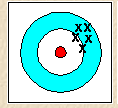
Accuracy refers to how close a measurement is to the true value, while precision refers to how close repeated measurements are to each other.
Accurate: Measurements close to the true value.
Precise: Measurements close to each other, regardless of accuracy.
Atoms, Molecules, and Ions
Atomic Structure and Mass
Atoms consist of protons, neutrons, and electrons. The atomic mass is calculated as the sum of protons and neutrons.
Atomic Mass Equation:
Example: An oxide ion (O2–) has 8 protons and 10 electrons.
Neutrons: Have no charge.
Example: One atom of 79Br has 44 neutrons.
Diatomic Elements
Certain elements naturally exist as molecules composed of two atoms.
Diatomic Elements: Br2, I2, N2, Cl2, H2, O2, F2
Ion and Molecular Formulas
Understanding chemical formulas is essential for identifying compounds and ions.
Calcium Nitrate: Ca(NO3)2
Dinitrogen Tetroxide: N2O4
Acetic Acid: CH3COOH
Empirical Formula of Glucose (C6H12O6): CH2O
Iron(III) Chlorate: Fe(ClO3)3
Oxoanions and Structural Formulas
Oxoanions are ions containing oxygen and another element. Structural formulas show the bonding arrangement of atoms in a molecule.
Sulfite Ion: SO32–
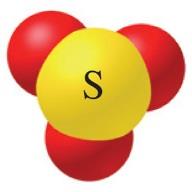
Structural Formula: Shows the bonding of all atoms in a molecule.
Chemical Reactions and Reaction Stoichiometry
Types of Chemical Changes
Chemical changes alter the composition of matter, while physical changes affect only the state or appearance.
Physical Change: Alters state/appearance without changing composition.
Chemical Change: Alters composition; atoms rearrange.
Example: Flammability is a chemical change.
Balancing Chemical Equations
Balancing equations ensures the conservation of mass and atoms in a chemical reaction.
Example: 6 Li(s) + 1 N2(g) → 2 Li3N(s)
Example: 2 N2H4 + N2O4 → 3 N2 + 4 H2O
Example: 2 C3H10(g) + 11 O2(g) → 6 CO2(g) + 10 H2O(g)
Stoichiometry: Mole Calculations
Stoichiometry involves calculating the quantities of reactants and products in a chemical reaction using balanced equations.
Subscripts: Indicate the number of atoms of each element.
Superscripts: Indicate the charge of ions.
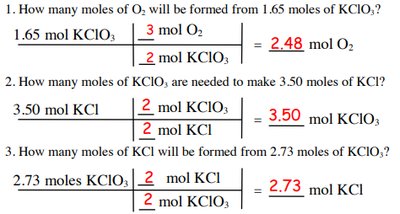
Example: KClO3 Decomposition
Calculating moles of products and reactants based on the balanced equation:
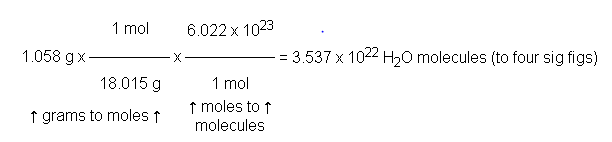
Example: Molecules in Water
Converting grams to moles and then to molecules using Avogadro's number:
Formula:
Example: Molecules in O2 and I2
Comparing the number of molecules in different masses of substances:
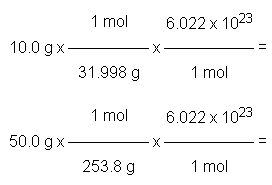
Result: 10.0 g of O2 contains more molecules than 50.0 g of I2.
Molar Mass Calculations
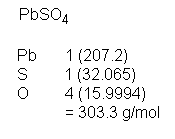
Molar mass is the mass of one mole of a substance, calculated by summing the atomic masses of its constituent atoms.
Example: Molar mass of PbSO4 is 303.3 g/mol.
Stoichiometry: Mass Calculations
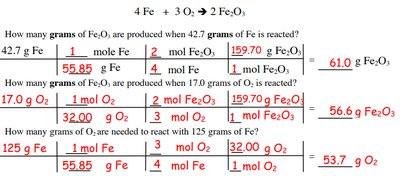
Using balanced equations to calculate the mass of products or reactants.
Example: 4 Fe + 3 O2 → 2 Fe2O3
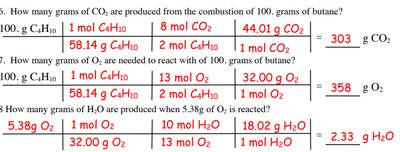
Example: Combustion of Butane
Calculating the mass of products from the combustion of butane:
Equation: 2 C4H10 + 13 O2 → 8 CO2 + 10 H2O
Limiting Reactant
The limiting reactant is the substance that is completely consumed first, thus limiting the amount of product formed.
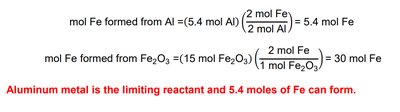
Example: For a mixture of 5.4 moles of Al and 15 moles of Fe2O3, Al is the limiting reactant and 5.4 moles of Fe can be formed.
Additional Concepts
Classification of Elements and Compounds
Noble Gases: Inert group of elements.
Chalcogens: Found in Group 6 (or 16).
States of Nonmetals: Can be solid, liquid, or gas.
Molecular Compounds: Almost always comprised of non-metals.
Types of Reactions
Combination Reaction: Two or more substances combine to form one product.
Decomposition Reaction: A single compound breaks down into two or more products.
Combustion Reaction: A substance reacts with oxygen, releasing energy and producing CO2 and H2O.
Summary Table: Molar Mass Calculation
Compound | Atoms | Atomic Mass (g/mol) | Total Mass (g/mol) |
|---|---|---|---|
PbSO4 | Pb: 1 S: 1 O: 4 | Pb: 207.2 S: 32.065 O: 15.9994 | 303.3 |
Summary Table: Stoichiometry Example (KClO3 Decomposition)
Given | Conversion Factor | Result |
|---|---|---|
1.65 mol KClO3 | 3 mol O2 / 2 mol KClO3 | 2.48 mol O2 |
3.50 mol KCl | 2 mol KClO3 / 2 mol KCl | 3.50 mol KClO3 |
2.73 mol KClO3 | 2 mol KCl / 2 mol KClO3 | 2.73 mol KCl |
Summary Table: Limiting Reactant Example
Reactant | Moles | Fe Produced |
|---|---|---|
Al | 5.4 | 5.4 |
Fe2O3 | 15 | 30 |
Limiting Reactant | Al | 5.4 |
Additional info: These notes cover foundational concepts from Chapters 1–3 of a general chemistry course, including matter, atomic structure, chemical reactions, and stoichiometry. All images included directly reinforce the adjacent explanations and calculations.
