 Back
BackGeneral Chemistry Exam 1 Study Guidance: Gases, Kinetic Theory, and Foundational Concepts
Study Guide - Smart Notes
 Tailored notes based on your materials, expanded with key definitions, examples, and context.
Q6. In an experiment performed with an open-ended mercury manometer, the atmospheric pressure is 1.00 atm. If ∆h in the figure is 20.0 mm, what is the pressure of the gas in the flask?
Background
Topic: Gas Pressure Measurement with Manometers
This question tests your understanding of how to determine the pressure of a gas using a manometer, which is a device that measures the pressure difference between a gas sample and the atmosphere.
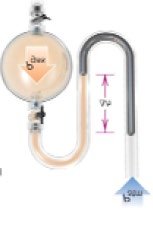
Key Terms and Formulas
Manometer: A U-shaped tube containing mercury (or another liquid) used to measure gas pressure.
Atmospheric Pressure (Patm): The pressure exerted by the atmosphere, given as 1.00 atm in this problem.
Height Difference (Δh): The vertical distance between the mercury levels in the two arms of the manometer, given as 20.0 mm.
Conversion:
Step-by-Step Guidance
First, identify whether the gas pressure is greater than or less than atmospheric pressure. In an open-ended manometer, if the mercury is higher on the side open to the atmosphere, the gas pressure is greater than atmospheric pressure. If it is higher on the gas side, the gas pressure is less than atmospheric pressure.
Determine the relationship between the gas pressure (), atmospheric pressure (), and the height difference ():
If the gas pressure is greater:
If the gas pressure is less:
Convert the height difference from mm Hg to atm:
Set up the equation for using the correct relationship and your converted value for .
Try solving on your own before revealing the answer!
Final Answer: 1.03 atm
Since the mercury is higher on the open end, .
The gas pressure is slightly higher than atmospheric pressure by the amount corresponding to the height difference.
